
From Design to Production: The Ultimate Clothing Guide for Brands in 2026
Why do nearly 70% of independent fashion brands fail within their first two years? Most of these entrepreneurs don't lack creativity; they simply lose their capital in the gap between a sketch and a store shelf. It's common to feel overwhelmed by jargon like CMT or tech packs while searching for a from design to production clothing guide that actually works. The fear of wasting thousands on poor-quality samples is a valid concern for any founder. We know that finding a reliable, ethical factory that accepts low minimum orders can feel impossible when you're starting out.
This roadmap provides the clear, predictable path you need to scale with confidence in 2026. You'll learn how to master the complete apparel lifecycle, from initial concept to premium manufacturing, while lowering your financial risk through smart sampling strategies. We'll walk you through every critical step, including how to find a trusted partner in Portugal to turn your vision into a legacy.
Key Takeaways
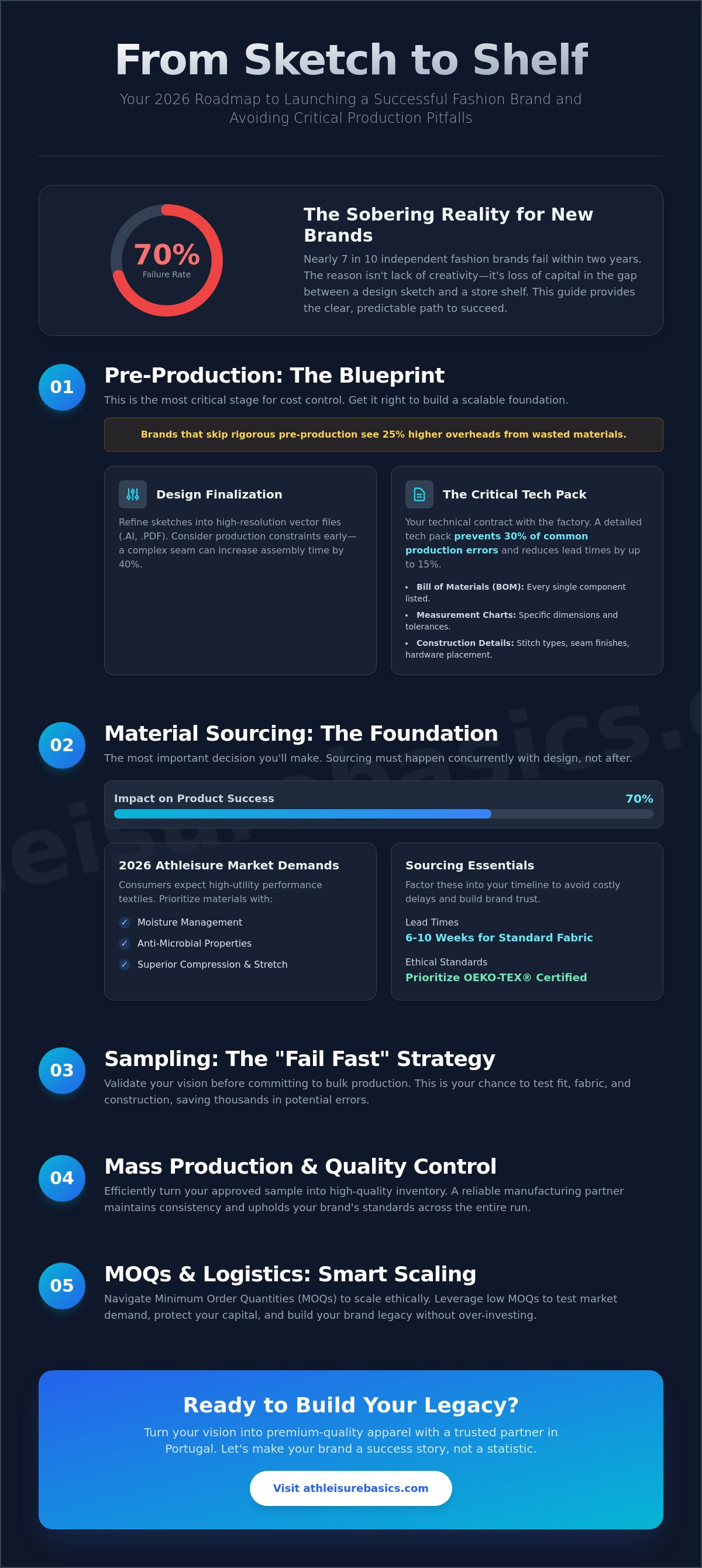
- Master the transition from creative sketches to technical blueprints to ensure your vision is factory-ready while maintaining strict cost control.
- Understand why premium fabric selection dictates 70% of your product's success, especially when sourcing performance textiles for the 2026 athleisure market.
- Use this expert from design to production clothing guide to adopt a "fail fast" sampling strategy, validating prototypes before mass manufacturing to save your brand thousands.
- Navigate the complexities of bulk production and quality control with a roadmap designed to turn approved samples into high-quality inventory efficiently.
- Learn how to scale your brand ethically by leveraging low MOQs to test market demand and protect your capital as you build your legacy.
The Pre-Production Phase: Turning a Sketch into a Technical Blueprint
The pre-production phase is the most critical stage for cost control in your brand's journey. While a creative sketch captures the mood, it's not enough for a factory to begin work. This from design to production clothing guide highlights why you must move beyond the "vision" to "technical feasibility" early. In 2026, brands that skip rigorous pre-production see 25% higher overheads due to wasted materials and excessive sampling rounds. You can't build a legacy on guesswork. The tech pack is the DNA of the garment.
To build a scalable brand, you need to understand the comprehensive overview of textile manufacturing, as this knowledge informs your fabric choices and construction methods. Relying on a partner who understands the transition from fiber to finished fabric ensures your designs aren't just beautiful but also durable and manufacturable.
Concept Development and Design Finalization
Refining silhouettes for performance and aesthetic appeal is a delicate balance. You must consider production constraints during the creative phase to avoid designing items that are impossible to manufacture at a profitable price point. For instance, a complex seam might look great on paper but could require a specific flatlock machine that increases assembly time by 40%. In 2026, many leading brands use 3D prototyping to test how a garment moves before cutting fabric. Prepare your design files as high-resolution vectors in .AI or .PDF formats. This allows manufacturers to review your work for structural integrity before you spend a single Euro on fabric.
The Critical Role of the Tech Pack
A tech pack serves as a legal and technical contract between you and your manufacturer. It ensures every detail is executed according to your standards, protecting your investment. A detailed tech pack prevents 30% of common production errors and ensures consistency across different batches. By 2026, digital tech packs that integrate directly with factory software have become the industry standard for reducing lead times by up to 15%.
- Bill of Materials (BOM): A comprehensive list of every component, including main fabric, lining, thread, zippers, and brand labels.
- Measurement Charts: Specific dimensions for every size in your range, including tolerances for quality control.
- Construction Details: Visual instructions on stitch types, seam finishes, and the exact placement of hardware.
If you're unsure where to start, follow our guide on how to create a tech pack for clothing. This document eliminates guesswork, allowing your production partner to deliver the premium quality your customers expect. It's the only way to ensure your from design to production clothing guide leads to a successful, high-quality launch.
Material Sourcing and Fabric Selection: The Foundation of Quality
Choosing your fabric isn't a secondary task; it's the most critical decision in your manufacturing journey. Industry data indicates that fabric selection dictates 60% to 70% of a garment's final success. If the material fails to perform, even the most innovative design will struggle to find a market. This from design to production clothing guide emphasizes that sourcing must happen concurrently with your design phase. Waiting until sketches are finalized to look for textiles often leads to delays or compromises in quality.
By 2026, the athleisure market will shift heavily toward high-utility performance textiles. Consumers are no longer satisfied with basic polyester blends. They demand materials that offer moisture management, anti-microbial properties, and superior compression. You must also account for significant lead times. Standard fabric procurement can take 6 to 10 weeks, while custom-dyed batches may take longer. Integrating sourcing into your early Garment Production Process ensures your timeline remains intact and your samples represent the final product accurately.
Sourcing OEKO-TEX® Certified Fabrics
OEKO-TEX® Standard 100 is a globally recognized certification that ensures textiles are free from harmful chemicals. For premium brands, this isn't just an "extra" feature; it's a non-negotiable standard for safety and quality. Ethical sourcing directly impacts your brand reputation. When you use certified materials, you tell your customers that you value their health and the environment. This transparency builds the kind of consumer trust that allows a brand to scale from a small startup to a legacy name. To better understand the materials available to you, read our guide on what is a textile.
Understanding Fabric Performance for Athleisure
Selecting the right fabric requires a deep dive into technical specifications. You'll need to evaluate three primary factors:
- GSM (Grams per Square Meter): This measures the weight and thickness. A higher GSM (250-320) is typically preferred for leggings to ensure they stay "squat-proof."
- Stretch Recovery: This determines if the garment holds its shape after repeated wear. 2026 standards require at least 10% to 15% elastane for high-performance gear.
- Breathability: Look for specific knit structures that allow air circulation without sacrificing durability.
Portuguese textile mills are currently at the forefront of this innovation. They specialize in developing performance blends that combine recycled fibers with high-tech synthetics. When you request fabric headers or swatches, don't just look at the color. Stretch them, wash them, and check for "pilling." If you want to build a brand that lasts, partner with a supplier who understands these technical nuances from day one.
Sampling and Prototyping: Validating Your Vision Before Mass Production
Sampling is where your tech pack meets reality. We advocate for a "fail fast" philosophy during this phase. It is far better to spend a few hundred dollars on a sample that identifies a structural flaw than to lose 20,000 dollars on a bulk production run that doesn't fit. This stage is the most critical part of any from design to production clothing guide because it transforms 2D sketches into 3D reality. You should view the sample room as the bridge between your creative vision and the factory's technical capabilities.
To get the best results, you must provide constructive, data-driven feedback to your pattern makers and seamstresses. Avoid vague comments like "it feels off" or "make it look cooler." Instead, use a measuring tape and specific terminology. If a sleeve is too tight, specify that the bicep circumference needs to increase by 1.5 centimeters. If the drape is stiff, suggest a lower GSM fabric. Clear communication often reduces the standard three-round sampling cycle down to two, saving you weeks of development time.
From Proto Samples to Salesman Samples (SMS)
The first proto sample focuses entirely on basic fit and silhouette. Don't worry about the exact color or final trim at this stage; focus on how the garment hangs on the body. Once the fit is perfected through one or two revisions, you move to the Salesman Samples (SMS). These are high-quality versions made with the final fabric and branding. Brands use SMS for marketing photoshoots and pre-order campaigns to secure revenue before the bulk order finishes. When reviewing these final prototypes, ensure you are already planning for legal compliance. Consult the U.S. Textile Labeling Requirements to confirm your fiber content and origin labels are positioned correctly on the final garment.
Why Portuguese Craftsmanship Excels in Prototyping
Portugal has built a reputation for top-notch craftsmanship that is difficult to replicate in high-volume, low-cost regions. The heritage of Portuguese ateliers centers on precision and technical expertise. Because these factories are often family-owned and located close to major European fashion hubs, communication is faster and more transparent. This proximity allows for rapid iteration. A revision that might take six weeks to ship back and forth from Asia can often be resolved in ten days when working with a partner in Portugal. For brands aiming for a premium market position, the made in portugal clothing seal represents a commitment to quality and ethical standards that resonates with modern consumers. Choosing the right partner here ensures your from design to production clothing guide leads to a product that is both profitable and durable.
The Mass Production Flow: Cutting, Sewing, and Quality Control
Once you approve your final "Golden Sample," the transition to bulk production begins. This phase is a high-stakes logistical operation where your vision scales from a single unit to hundreds or thousands. Effective production planning is vital during this shift. It ensures factory capacity aligns with your delivery timelines, preventing the bottlenecks that often plague new brands. Following a structured from design to production clothing guide helps you maintain the premium quality your customers expect in 2026.
High-performance athleisure requires more than standard sewing machines. Superior quality is achieved through specialized equipment like four-needle, six-thread flatlock machines. These create the durable, chafe-free seams necessary for luxury activewear. Quality control is a continuous process integrated into every stage of manufacturing rather than a final step performed before shipping.
Pattern Grading and Marker Making
Grading is the technical process of creating your full size run from your base size, which is usually a Medium. This step requires extreme precision with performance fabrics. Because compression and stretch ratios must remain consistent, technicians must calculate specific growth rates for every panel. Marker making then organizes these graded patterns on the fabric to optimize yield. Digital marker software can reduce fabric waste by 14% compared to manual layouts. This efficiency supports ethical manufacturing by minimizing environmental impact and lowering your cost per garment.
In-Line vs. End-Line Quality Control
- AQL Standards: EU factories, particularly those in Portugal, typically adhere to strict Acceptable Quality Levels (AQL) of 1.5 or 2.5. This is a significantly higher standard than the 4.0 levels often seen in mass-market regions.
- Stretch Consistency: Technicians test the recovery of the fabric after it has been sewn to ensure the needles didn't damage the elastane fibers.
- Seam Strength: Critical stress points are tested to withstand the high-intensity movements typical of modern fitness routines.
Choosing a partner who understands these technical nuances is the best way to scale your brand. We help you manage every detail of the manufacturing process to ensure your legacy starts with a perfect product.
Ready to start your journey? Explore our custom clothing options and see how we bring your vision to life with EU quality standards.
Navigating MOQs and Logistics: Scaling Your Brand Ethically
High Minimum Order Quantities (MOQs) represent the primary barrier for approximately 85% of emerging fashion entrepreneurs. This fear of being stuck with thousands of unsold units often stalls innovation before the first sample even arrives. In the 2026 market, agility is your greatest asset. You don't need massive inventory to prove a concept. Using low MOQs allows you to test specific designs, gather real-world customer feedback, and manage cash flow without overextending your capital. This strategic approach transforms the from design to production clothing guide into a roadmap for sustainable scaling rather than a financial gamble.
Managing Low MOQs for Startup Success
Athleisurebasics provides two distinct paths to help you enter the market with minimal risk. Our white label service starts at just 70 pieces per style and color, which is the fastest route to a professional launch. For brands seeking unique silhouettes and custom patterns, manufacturing thresholds begin at 250 pieces. To meet these factory requirements efficiently, smart brands often mix sizes across a single color block. For example, a 70-piece order can be split across XS to XL, ensuring you have a full size run for your customers without overproducing. To understand the nuances of this process, explore our guide on private label portugal to see how regional expertise impacts your bottom line.
Partnering with Athleisurebasics for a Seamless Launch
Our Full CMT (Cut, Make, Trim) production and sourcing support remove the traditional barriers to entry that plague new founders. By operating out of Portugal, we provide a massive strategic advantage for EU-based brands. You benefit from zero customs duties within the Schengen area and significantly reduced transit times compared to manufacturing hubs in Asia. The "Made in Portugal" label isn't just a mark of premium quality; it's a commitment to ethical standards and OEKO-TEX® certified materials.
We act as your bridge to profitable growth, handling the complexities of logistics and quality control so you can focus on marketing and community building. This completes your journey through the from design to production clothing guide with a partner who values your long-term legacy. We don't just produce garments; we guide you through every technical hurdle to ensure your brand is scalable from day one.
Ready to turn your vision into high-quality products?
Get a custom quote for your 2026 collection and start your journey with a trusted partner today.
Launch Your Apparel Legacy With Confidence
Building a profitable fashion brand in 2026 requires a disciplined transition from creative concept to physical reality. This from design to production clothing guide emphasizes that success hinges on precise technical blueprints and rigorous prototyping. By sourcing OEKO-TEX® Standard 100 certified materials, you ensure your products meet the highest safety and quality benchmarks from the very beginning. Manufacturing in Portugal provides access to a premier EU textile hub known for ethical labor practices and superior craftsmanship. You can mitigate early stage risks by utilizing low MOQs, starting at just 60 pieces per style, which allows for testing the market without excessive inventory overhead. Every decision, from the first sketch to the final quality control check, shapes your brand's reputation for excellence. It's time to turn your sketches into high quality products that stand out in a competitive marketplace. We're here to support your journey from the initial logo to a global legacy.
Ready to launch your brand? Get a custom manufacturing quote today.
Frequently Asked Questions
How long does the clothing production process take from start to finish?
A typical clothing production cycle takes between 12 to 24 weeks from the initial design phase to final delivery. This timeline includes 4 weeks for tech pack development, 6 weeks for sampling and revisions, and 10 weeks for bulk manufacturing. Choosing a European partner can reduce shipping times by 10 days compared to sea freight from Asia. Planning your collection 6 months in advance ensures you meet seasonal launch deadlines without stress.
What is a realistic budget for a first clothing production run in 2026?
Your budget depends on your Minimum Order Quantity (MOQ) and the complexity of your designs. Industry data from the Fashion Manufacturing Association indicates that startups often allocate 40% of their initial capital to production and 30% to marketing. Working with low MOQ providers allows you to launch with as few as 60 pieces per style. This strategy minimizes financial risk while maintaining the high quality standards required for a premium brand launch.
Do I need to be a trained designer to start a clothing brand?
You don't need a formal design degree to launch a successful brand if you have a clear vision and the right manufacturing partner. Many founders use detailed mood boards and reference samples to communicate their ideas to factory pattern makers. Our from design to production clothing guide emphasizes that technical designers can translate your concepts into professional tech packs. This collaborative approach allows you to focus on brand building while experts handle the technical craftsmanship.
What is the difference between CMT and Full Package Production (FPP)?
Cut, Make, Trim (CMT) means you provide the fabrics and patterns while the factory only handles the sewing and finishing. Full Package Production (FPP) is a comprehensive service where the manufacturer manages everything from fabric sourcing to final packaging. FPP is often the better choice for startups because it streamlines the supply chain and reduces logistics errors. We act as your partner in this process, ensuring every garment meets luxury standards through a simplified, end to end workflow.
Why should I choose a manufacturer in Portugal over one in Asia?
Manufacturing in Portugal offers superior quality control and adheres to strict EU ethical labor standards. Portuguese factories are renowned for their expertise in premium jersey and technical fabrics, often providing 30% faster lead times for European brands due to geographical proximity. Portugal focuses on high end craftsmanship and sustainable practices. This choice aligns your brand with "Made in Portugal" prestige, which 65% of luxury consumers associate with ethical manufacturing and durability.
What are the most common mistakes new brands make during production?
The most frequent mistake is skipping the sample revision stage to save time, which leads to 15% higher defect rates in bulk orders. Another error is failing to provide a comprehensive tech pack, resulting in fit inconsistencies across different sizes. New founders also often overlook the importance of low MOQ flexibility, over ordering stock that doesn't sell. Following a structured from design to production clothing guide helps you avoid these pitfalls by prioritizing precision and gradual scaling.
Can I start with white label and move to custom manufacturing later?
Yes, starting with white label products is an efficient way to test your brand concept with lower upfront costs and faster turnaround times. Our white label service starts at 60 pieces per style, allowing you to add custom branding to pre designed, high quality basics. Once you've validated your market fit and generated revenue, you can transition to custom manufacturing. This path provides the ultimate flexibility for founders looking to build a legacy without the initial risk of bespoke pattern development.
What documents do I need to provide to a factory to get an accurate quote?
You must provide a professional tech pack that includes a detailed Bill of Materials (BOM), graded size charts, and technical sketches. Clear specifications for fabric weight, pantone colors, and stitch types are essential for an accurate cost assessment. If you're using our custom services, including your logo files in vector format and embroidery placements will prevent pricing delays. Providing these documents upfront ensures we can deliver a precise quote within 3 to 5 business days.

Leave a comment
This site is protected by hCaptcha and the hCaptcha Privacy Policy and Terms of Service apply.