

How Much Does It Cost to Manufacture a Clothing Line in 2026?
Launching a clothing brand in 2026 is a calculated financial strategy where the "cheapest" factory often becomes your most expensive mistake. You've likely felt the frustration of vague quotes and the anxiety of hidden fees that appear at every stage of the production cycle. It's common to feel overwhelmed by how minimum order quantities (MOQs) dictate your per-unit price and your overall financial risk. Understanding exactly how much does it cost to manufacture a clothing line is the first step toward building a sustainable business model rather than just a one-off collection.
While Asian factories often provide a lower "sticker price" for high-volume orders, and brands may explore Bulk Garment Manufacturing Fees options to compare costs, Portuguese manufacturing frequently results in a lower "landed cost" for premium brands. Producing in Portugal eliminates EU import duties and reduces transit times to just 2 to 5 days by road. When you factor in the reduced inventory risk and higher garment consistency, regional production in Europe is often the more cost-effective choice for emerging labels.
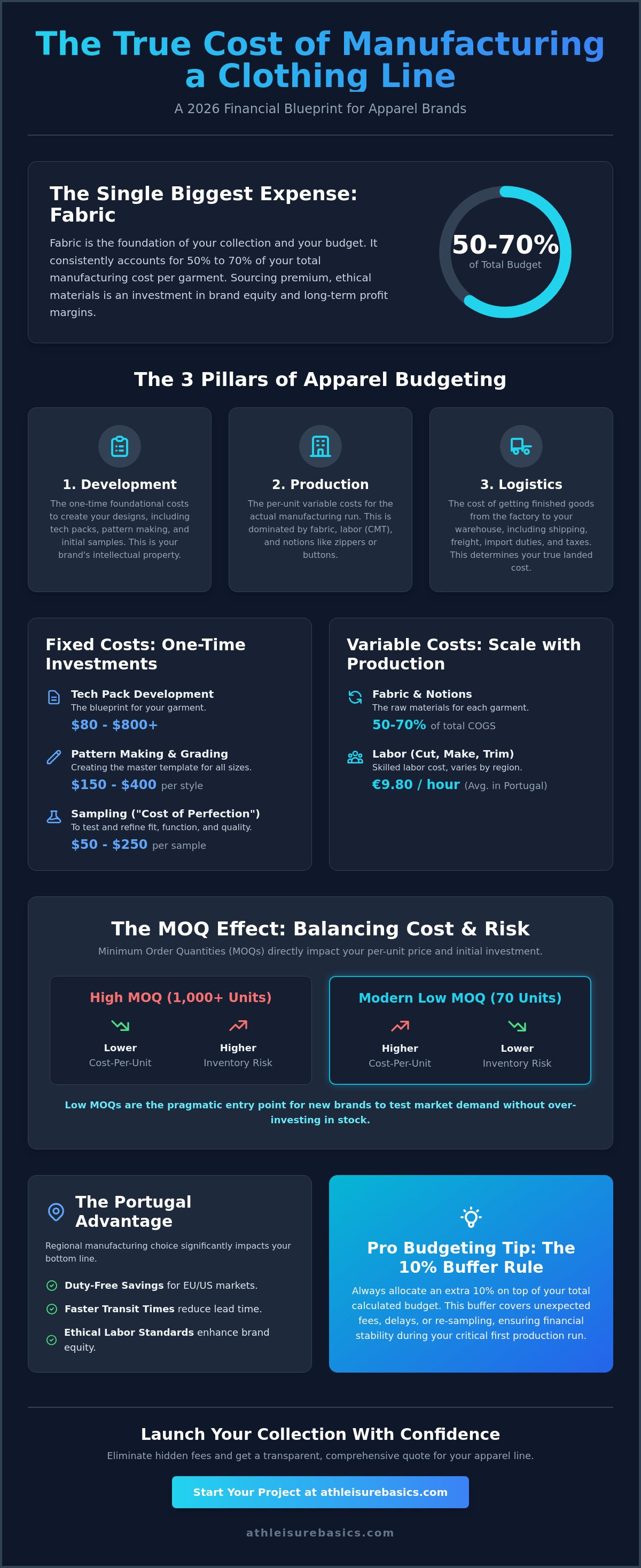
We agree that the lack of transparency in the textile industry makes it difficult to plan for long-term growth. This guide provides a comprehensive breakdown of the current apparel market, acknowledging that fabric alone typically accounts for 50% to 70% of your total manufacturing budget. You'll gain a clear framework to choose between custom CMT production and white-label options. We'll examine the critical drivers of your budget, including pattern making, tech pack development, and ethical labor standards, to ensure you can launch your first production run with absolute confidence.
Key Takeaways
- Identify the three foundational pillars of apparel budgeting, including development, production, and logistics, to eliminate the hidden fees that often derail new brands.
- Determine how much does it cost to manufacture a clothing line by analyzing the financial trade-offs between custom CMT production and low-MOQ white-label models.
- Calculate the true landed cost of your collection to see how regional manufacturing in Portugal offers duty-free savings and significantly faster transit times.
- Master the 10% Buffer Rule and a 5-step budgeting checklist to maintain financial stability during your brand's critical first production run.
- Evaluate the impact of premium fabric sourcing and ethical certifications on your long-term profit margins and brand equity.
Understanding the Baseline: What Influences Clothing Manufacturing Costs?
Calculating the Cost of Goods Sold (COGS) is the first financial hurdle for any fashion startup. In the apparel industry, COGS represents the total direct investment required to bring a finished garment to your warehouse. To accurately determine how much does it cost to manufacture a clothing line, you must categorize your expenses into three primary pillars: development, production, and logistics. Each pillar contains specific drivers that can either scale your business or drain your capital if not managed correctly.
The 2026 market has shifted toward agility. High-margin brands are moving away from mass-market volume and toward small-batch, high-quality production. This strategy prioritizes brand equity over the race to the bottom on price. Whether you position your brand as luxury or premium essentials will dictate your initial capital. Luxury lines require higher-grade materials and more complex construction, while essentials focus on operational efficiency and accessible price points. Your choice of positioning fundamentally changes your manufacturing roadmap.
To see how a specific identity can drive a brand's market position, you can explore E-commerce Apparel Sales from labels like Deepwater Crew Co. that focus on a dedicated lifestyle community.
Fixed vs. Variable Production Costs
Your budget consists of fixed costs that remain constant regardless of your order size and variable costs that scale with production. Fixed costs include technical services such as tech pack development, which can range from $80 for basic items to $800 for complex designs. Pattern making and grading also fall into this category, with initial development often costing between $150 and $400 per style. These are one-time investments in your brand's intellectual property and technical foundation.
Variable costs are driven by the textile manufacturing process. Fabric typically accounts for 50% to 70% of your total manufacturing budget. Other variable factors include notions like zippers or buttons and the Cut, Make, Trim (CMT) labor fee. For example, labor costs in the Portuguese textile industry average €9.80 per hour, reflecting a commitment to ethical standards and high-end craftsmanship. Garment complexity directly impacts these numbers; a structured jacket requires significantly more labor hours than a basic jersey t-shirt.
The Role of Minimum Order Quantities (MOQ)
Minimum Order Quantities (MOQs) are the smallest number of units a factory is willing to produce per style or color. MOQs create a volume discount effect; as your order size increases, your per-unit cost decreases because fixed setup costs are spread across more items. However, high MOQs, often exceeding 1,000 units in some global hubs, present a significant financial burden and inventory risk for emerging brands.
Modern manufacturing partners now offer more accessible thresholds. In 2026, a 70-piece MOQ is considered a pragmatic entry point for private label collections. Choosing lower MOQs helps you test market demand without tying up all your capital in unsold stock. While the per-unit price might be higher than mass-production rates, the reduction in inventory risk and the ability to scale operations gradually often lead to a more successful brand launch and healthier long-term profit margins.
The Technical Breakdown: From Fabric Sourcing to CMT
Transitioning from a creative concept to a physical collection requires a disciplined approach to technical logistics. When calculating how much does it cost to manufacture a clothing line, you must account for the granular expenses embedded in the garment production process. This journey starts with raw material acquisition and moves through technical development before reaching the factory floor. While U.S. apparel manufacturing statistics highlight the rising costs of domestic labor and operations, many emerging brands find that "Full CMT" (Cut, Make, Trim) services offer the most reliable path to a professional finish. This model ensures that every stitch, seam, and finish meets your brand's specific standards.
Sampling is often described as the "cost of perfection." It's the stage where your vision is tested against reality. Skipping or rushing this phase often leads to expensive errors during the main production run. A single sample for a new style can range from $50 to $250. This investment allows you to refine the fit and durability of the garment. Brands that prioritize this stage often achieve higher customer satisfaction and lower return rates, which protects their long-term profitability. For those seeking expert guidance through these technical hurdles, our clothing production consulting services can help streamline the transition from design to delivery.
Raw Materials and Sourcing Support
Your choice of fabric is the most significant variable in your budget. As of May 2026, the A-Index for cotton reached 92.8 cents per pound, reflecting a volatile market for raw fibers. Beyond the primary fabric, you must budget for trims such as zippers, buttons, and elastics, which can add complexity to your supply chain. Professional materials sourcing support is essential here; it helps you navigate these fluctuations and minimize fabric waste, which typically accounts for a large portion of lost revenue. In 2026, OEKO-TEX certified fabrics typically command a 10% to 15% premium over standard materials due to the rigorous testing required for environmental and safety standards.
Development Costs: Tech Packs and Sampling
Investing in professional tech pack development is a non-negotiable step for ambitious brands. A comprehensive tech pack acts as a blueprint, reducing the risk of costly misunderstandings with your factory. While a basic t-shirt tech pack might cost around $150, more detailed garments like trousers or hoodies often require an investment of $300 to $800. These documents ensure consistency across size sets and different production runs. To achieve the highest level of precision during this phase, many brands choose made in portugal clothing manufacturing for its reputation for technical excellence and high-end craftsmanship.
Comparing Production Models: Custom vs. White Label vs. POD
Choosing a production model is a pivotal decision that dictates your brand's financial health. To determine how much does it cost to manufacture a clothing line, you must weigh the benefits of total creative control against the speed of market entry. While Print-on-Demand (POD) often attracts beginners with its low entry barrier, the high per-unit costs and limited customization often lead to stagnant growth. Successful brands typically transition to custom or white-label models to secure the 40% to 60% profit margins required for sustainable scaling.
The financial roadmap for your collection depends on how much technical development you want to own. Upfront investment in custom patterns creates long-term value, while white-label models offer immediate operational agility. Both paths provide a level of quality and brand control that POD cannot match. As your brand grows, your ability to scale will depend on these early structural choices and your manufacturing partner's flexibility.
Custom Manufacturing (The Premium Path)
Custom manufacturing is the gold standard for brands aiming for a luxury or designer status. This path usually requires a 250-piece MOQ per style and color. It involves a significant investment in technical development, including the tech packs and sampling discussed earlier, but the payoff is a completely unique product. This "unique design premium" allows you to command higher retail price points because your customers cannot find your specific fits or silhouettes elsewhere. It is the ultimate tool for building a distinctive brand identity that survives beyond seasonal trends.
White Label and Luxury Blanks (The Fast Path)
White label and luxury blanks provide a faster, more accessible route for emerging entrepreneurs. By selecting pre-designed, high-quality styles, you eliminate the need for tech pack development and multiple sampling rounds for your first collection. A 70-piece MOQ for white label products makes it possible to launch a complete collection with a fraction of the capital required for custom work. You gain the advantage of premium materials without the lengthy development timelines.
For many emerging businesses, private label portugal represents the ideal middle ground. Portugal's factories are renowned for their technical skill and ethical labor standards, offering startups a way to access high-end craftsmanship without the massive volume requirements of global mass-production hubs. This model is particularly effective for testing market demand with premium products before transitioning into fully custom silhouettes as your brand's DNA becomes more defined. This pragmatic approach minimizes inventory risk while building the high-quality reputation necessary for long-term commercial success.
The Portugal Advantage: Why Regional Choice Impacts Your Bottom Line
When evaluating how much does it cost to manufacture a clothing line, many founders focus solely on the factory's quote. This is known as the "sticker price." However, the true metric for brand success is the "landed cost," which includes shipping, import duties, and the financial impact of transit delays. Choosing clothing manufacturers in Portugal often yields a lower landed cost than Asian alternatives, despite a higher initial unit price. This regional choice mitigates the "cost of error" through clear communication and shared business hours, preventing expensive production mistakes before they happen.
There is also a significant hidden cost in unethical production. In 2026, brand reputation is a tangible financial asset. Regulatory fines for supply chain non-compliance and the loss of consumer trust can bankrupt a startup overnight. Investing in a manufacturing hub with transparent labor standards and environmental certifications protects your brand equity. It ensures your collection is built on a foundation of integrity rather than just cost-cutting.
Landed Costs and Logistics
Proximity to your target market is a powerful financial lever. Transit time from Portugal to Western Europe is typically 2 to 5 days by road. In contrast, sea freight from Asia can take 4 to 6 weeks. This speed allows for agile manufacturing, where you can run smaller, more frequent production cycles based on real-time sales data. By keeping less capital tied up in inventory, you improve your cash flow and reduce the need for deep discounting on overstock. Additionally, manufacturing within the EU allows you to avoid the heavy import duties often associated with non-EU production, providing a predictable and stable pricing structure.
Quality Control as a Cost-Saving Measure
Rigorous quality control at the source is your best defense against the high cost of returns and unsellable stock. Portuguese factories are renowned for high-end craftsmanship, which leads to greater garment consistency and lower defect rates. This reliability is partly driven by Portugal's ethical labor standards; fair wages and regulated conditions result in lower worker turnover and a more skilled, stable workforce. Furthermore, the "Made in Portugal" label serves as a premium marketing asset. It allows you to justify higher retail margins because customers recognize the regional seal of quality and ethical integrity.
Ready to build a collection with a reliable European partner? Explore our custom clothing production in Portugal to secure your brand's future.
Budgeting for Success: How to Plan Your First Collection
Planning a successful launch requires moving beyond the simple question of how much does it cost to manufacture a clothing line and into the realm of strategic capital allocation. A realistic budget is your brand's strongest asset. It allows you to navigate the complexities of the apparel industry without compromising on quality or ethical standards. To ensure your first production run is financially sustainable, follow this 5-step checklist for creating a professional budget:
- Define your niche and collection size: Decide exactly how many styles and units you need to test your market.
- Develop professional tech packs: Secure your blueprints early to avoid expensive manufacturing errors.
- Request landed cost estimates: Factor in the factory quote, shipping, and any applicable duties.
- Allocate marketing funds: Set aside capital to ensure your target audience actually sees your finished product.
- Apply the 10% Buffer Rule: Always keep a reserve for unexpected production or shipping variances.
The 10% Buffer Rule is a non-negotiable standard for emerging brands. Even with meticulous planning, the global supply chain can present surprises. Shipping rates might fluctuate, or minor material adjustments may be required during the sampling phase. This buffer ensures your brand remains operational and agile through the unexpected. Ultimately, a total investment mindset focuses on spending more on high-end craftsmanship today to earn higher margins on retail tomorrow.
Allocating Your Capital
A balanced financial strategy often follows a specific percentage breakdown: 40% for production, 30% for marketing, 20% for development, and 10% for your buffer. Underfunding marketing is a frequent mistake for new founders. You don't want to spend your entire budget on a beautiful collection only to have it sit in a warehouse because you lack the funds to drive traffic. Athleisurebasics supports startups with flexible clothing production consulting services to help you optimize this roadmap and ensure every dollar is used efficiently.
Next Steps: Getting an Accurate Quote
To receive a precise cost estimate, a manufacturer needs specific technical details. Vague requests lead to vague pricing. Be prepared to provide fabric compositions, desired GSM (weight), detailed tech packs, and clear order quantities per size. We encourage founders to start with a narrow, clear niche and high-quality materials to build immediate brand authority. This focused approach reduces waste and simplifies your production lifecycle. Ready to transition from a concept to a commercial presence? Partner with Athleisurebasics for your custom production needs and let's build a collection that lasts.
Launch Your Collection with Financial Precision
Navigating the financial landscape of the fashion industry requires a shift from viewing manufacturing as a cost to seeing it as a strategic investment. You now understand that how much does it cost to manufacture a clothing line depends on your choice of production model and your commitment to quality materials. By prioritizing ethical standards and regional manufacturing in Portugal, you mitigate the risks of hidden fees and inventory waste that often hinder emerging brands. High-quality craftsmanship and transparent supply chains are the foundations of long-term commercial success.
We provide the technical expertise and operational support needed to transition your brand from a small idea to a lasting market presence. Our services include access to OEKO-TEX® certified fabrics and expert production consulting for startups designed to remove barriers to entry. With low 70-piece MOQs for White Label collections, you can test your market with premium products without the burden of excessive inventory.
Get a Custom Quote for Your Clothing Line today to start your journey with a reliable partner. Your vision deserves a production process that values integrity and precision as much as you do. We look forward to helping you scale your business with confidence.
Frequently Asked Questions
How much money do I need to start a clothing line in 2026?
The initial investment depends entirely on your chosen business model and production scale. A Print-on-Demand brand can be launched for as little as $1,000 to $3,000, while a professional cut-and-sew collection typically requires between $30,000 and $75,000. These figures cover the entire lifecycle from initial design and technical development to the first bulk production run and marketing launch.
Is it cheaper to manufacture clothing in Portugal or China?
While Asian factories often provide a lower "sticker price" for high-volume orders, Portuguese manufacturing frequently results in a lower "landed cost" for premium brands. Producing in Portugal eliminates EU import duties and reduces transit times to just 2 to 5 days by road. When you factor in the reduced inventory risk and higher garment consistency, regional production in Europe is often the more cost-effective choice for emerging labels.
What are the hidden costs of starting a clothing brand?
New founders often overlook the cumulative expenses of the development phase and logistics. Technical requirements like tech pack development can range from $80 to $800 per style, while physical samples often cost $50 to $250 each. Other common hidden costs include fabric waste, specialized packaging, shipping insurance, and import duties, all of which must be integrated into your calculation of how much does it cost to manufacture a clothing line.
How do MOQs affect my budget?
Minimum Order Quantities (MOQs) determine your upfront capital requirements and your per-unit profit margins. Higher MOQs allow factories to spread fixed setup costs across more garments, lowering the price per piece. However, choosing accessible MOQs, such as a 70-piece threshold for private label collections, reduces your inventory risk and preserves cash flow for marketing and growth operations.
Do I need a tech pack to get a manufacturing quote?
A professional tech pack is essential for receiving a precise and binding cost estimate from any reputable factory. This document acts as a technical blueprint that specifies every detail from measurements to stitch types. Without a tech pack, manufacturers can only provide vague estimates, which often lead to unexpected price increases or production errors during the main run.
How can I lower my manufacturing costs without sacrificing quality?
You can optimize your budget by utilizing white label or luxury blanks, which eliminate the high costs of pattern making and sampling for new silhouettes. Consolidating your fabric choices across multiple styles also allows you to benefit from bulk material pricing. Additionally, manufacturing in regional hubs like Portugal reduces logistics fees and duty payments while maintaining high ethical and craftsmanship standards.
What is the average cost per unit for a premium hoodie?
Industry benchmarks for 2026 show that premium white label hoodies typically cost between $15 and $25 per unit. If you choose a full custom cut-and-sew model, the Cut, Make, Trim (CMT) labor alone for a sweatshirt can range from $10 to $15. These costs vary based on the fabric weight, such as heavy French Terry, and the complexity of the garment construction.
How long does the manufacturing process take from budget to delivery?
The typical timeline for a professional clothing collection is 3 to 6 months. This schedule includes several weeks for technical development and sampling, followed by the bulk production phase. Choosing a regional manufacturer can significantly shorten this window; road transit from Portugal to major European markets takes less than a week, whereas sea freight from Asia can add 4 to 6 weeks to your delivery date.


Leave a comment
This site is protected by hCaptcha and the hCaptcha Privacy Policy and Terms of Service apply.