
DIY Clothing Brand vs Factory Production: Which Path for Your Brand in 2026?
Did you know that 65% of emerging fashion brands fail within their first three years; often because they underestimate hidden manufacturing fees by as much as 25%? Many founders struggle to decide between maintaining a DIY clothing brand vs factory production as they face the burnout of managing every production detail alone. You likely feel the weight of shrinking profit margins and the frustration of inconsistent quality that comes with small-scale, manual crafting.
We believe that scaling your business shouldn't be a source of stress. This guide will help you determine the right path for your brand in 2026 by highlighting how to transition from a hobbyist mindset to a scalable business infrastructure. You'll discover the critical differences between manual crafting and industrial factory production, providing you with a clear roadmap to lower per-unit costs and consistent, premium quality. We'll examine the financial thresholds for factory entry, the technical requirements for industrial-grade quality, and the logistical milestones needed to move from your studio to a professional factory floor.
Key Takeaways
- Learn how to identify the critical tipping point where manual labor becomes more expensive and less efficient than professional manufacturing.
- Evaluate the strategic trade-offs of a DIY clothing brand vs factory production to determine which model best supports your 2026 growth targets.
- Discover how industrial machinery and standardized quality assurance protocols protect your brand reputation and ensure garment consistency.
- Explore accessible entry points like White Label production and low-MOQ custom manufacturing to bridge the gap between creative concepts and commercial scale.
DIY Clothing Brand vs Factory Production: The Core Differences
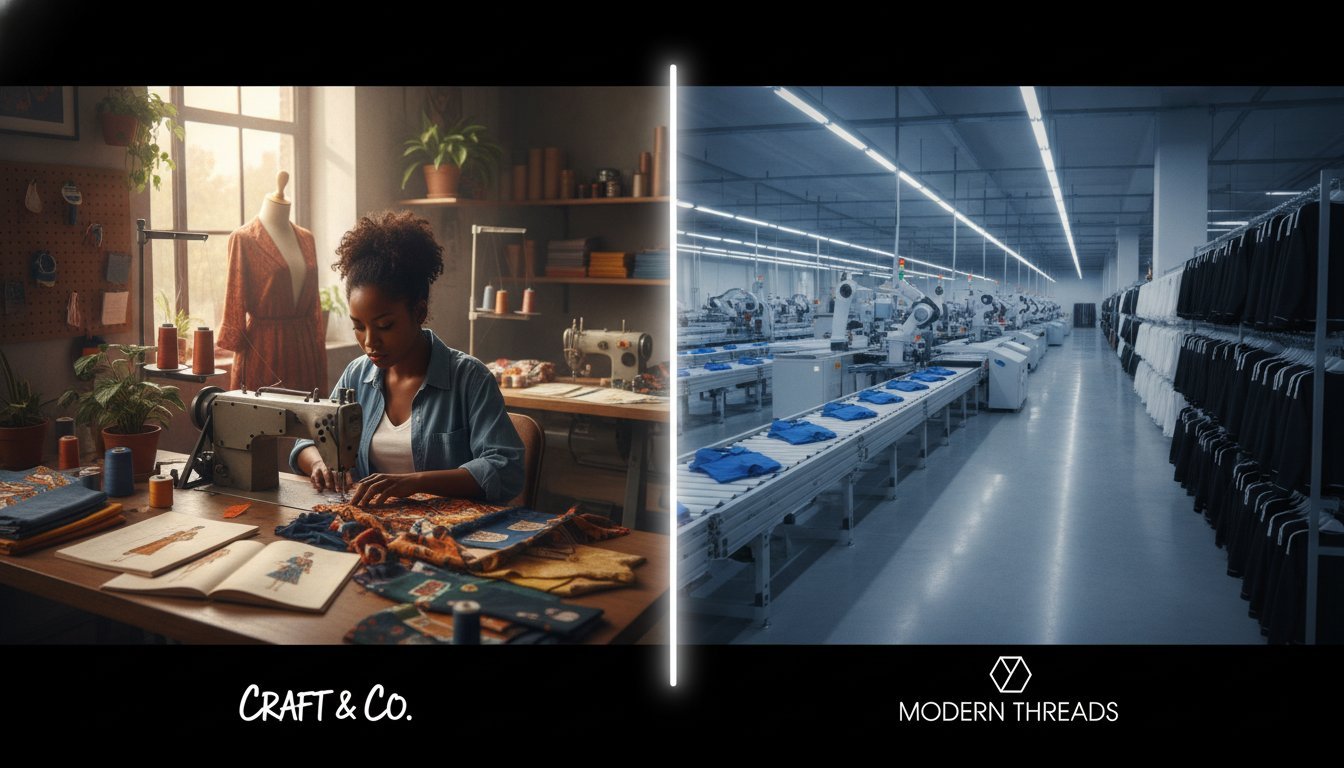
The choice between a DIY clothing brand vs factory production defines your business infrastructure from day one. DIY production involves a founder or a small local team handling every stitch, cut, and finish manually. It's an intimate process, but it's fundamentally limited by the number of hours in a day. In contrast, industrial manufacturing within the global clothing industry relies on specialized machinery, assembly lines, and rigorous quality control protocols. While DIY offers total creative autonomy, factory production offers the predictability required to build a sustainable commercial entity.
In 2026, the market has shifted. Consumers expect ethical transparency and premium durability. While "handmade" once suggested luxury, it now often signals a lack of technical precision in high-performance categories. Choosing factory production isn't just about making more clothes; it's about positioning your brand as a professional player capable of meeting modern retail standards. You're shifting from being a creator to being a CEO who manages a supply chain.
Key Metrics: DIY vs. Factory at a Glance
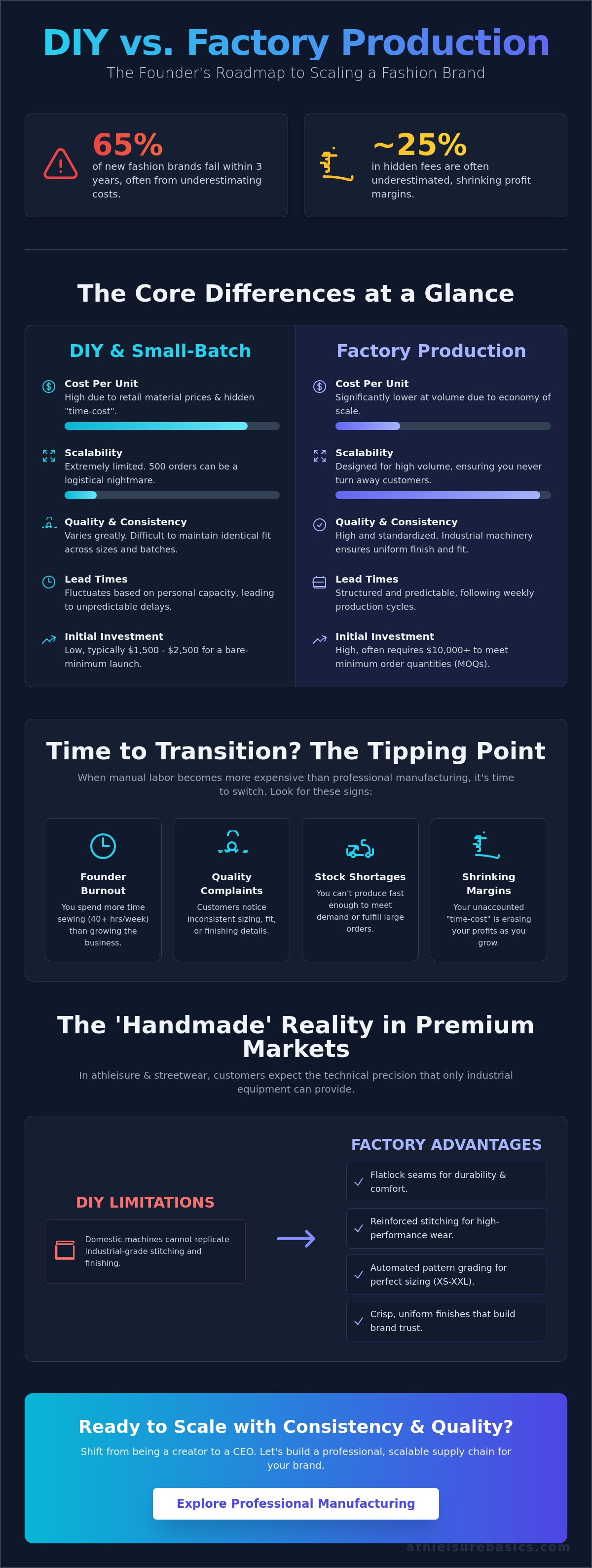
Understanding the logistical trade-offs is essential for any growing brand. The differences become most apparent when you look at the data:
- Lead Times: DIY production often fluctuates based on personal capacity, leading to delivery delays. Factory production follows a structured timeline, turning concepts into finished batches in predictable weekly cycles.
- Cost per Unit: DIY founders often ignore their own "time-cost," resulting in thin margins that vanish as the business grows. Factory production utilizes the economy of scale, where larger volumes significantly reduce the cost of materials and labor per garment.
- Scalability: Fulfilling 500 orders is a logistical nightmare for a DIY setup. Professional factories are designed for this volume, ensuring you never have to turn away customers due to stock shortages.
The Reality of 'Handmade' in the Premium Market
The "handmade" label carries weight in bespoke tailoring or artisanal jewelry. However, in the premium athleisure and streetwear sectors, it often creates friction. Technical garments require specialized finishing like flatlock seams and reinforced stitching that domestic sewing machines simply cannot replicate. Customers paying premium prices expect these industrial standards.
Consistency is the biggest hurdle for a DIY clothing brand vs factory production. Maintaining identical fits across a full size run, from XS to XXL, requires industrial pattern grading and automated cutting tables. Without these, your customers might find that a medium in one color fits differently than a medium in another. These small inconsistencies erode brand trust quickly. Modern shoppers expect the crisp, uniform finish that only professional factory equipment can provide.
The DIY and Small-Batch Approach: Pros, Cons, and Hidden Costs
Starting with a DIY model is the most accessible entry point for many new entrepreneurs. In 2026, a "bare-minimum" launch can cost as little as $1,500 to $2,500. This approach allows you to avoid the initial pressure of high minimum order quantities (MOQs). When evaluating a DIY clothing brand vs factory production, the ability to test designs without a $10,000 investment is a significant advantage. You maintain absolute control over the creative process, ensuring every garment aligns perfectly with your vision.
The Creative Freedom of DIY
DIY production thrives on agility. You can iterate on a design in a single afternoon, moving from a sketch to a finished sample without waiting for a factory schedule. This speed helps build a "maker" brand story that resonates with niche audiences who value transparency and artisan craftsmanship. Smaller runs also allow you to pivot quickly if a specific color or style doesn't perform as expected. By producing only what you need, you reduce the environmental impact of fast fashion, a key selling point for modern consumers. However, your material costs will be higher. Basic cotton jersey typically costs $3 to $6 per yard; premium French terry or organic cotton can reach $8 to $18 per yard at retail prices.
The Scalability Trap
The DIY model eventually hits a ceiling. Founders often fail to calculate their true hourly rate, acting as a sewer rather than a CEO. If you spend 40 hours a week at a sewing machine, you aren't growing your business. This "time-cost" is a hidden drain on profitability. As demand increases, the manual process leads to inconsistencies. Small-batch brands often struggle with uneven stitching or finishing errors, which cause high return rates and damage brand trust. If you find yourself overwhelmed by production details, our clothing production consulting services can help you identify the right time to transition.
Sourcing is another major hurdle. DIY brands rarely have access to the same supply chains as industrial players. It's difficult to find OEKO-TEX® certified fabrics or premium custom hardware in quantities under 50 units. Most high-end suppliers prioritize factory partners, leaving DIY founders to rely on local fabric stores with limited stock. This limitation prevents you from achieving the premiumization required for a luxury brand. Eventually, the manual labor required to fulfill growing orders becomes unsustainable, creating a growth plateau that only professional manufacturing can break.
The Factory Production Advantage: Scaling Your Brand with Consistency
While a DIY approach offers initial creative control, transitioning to industrial manufacturing introduces a level of precision that domestic setups cannot match. Professional factories utilize specialized machinery designed for high-performance apparel. In the debate between a DIY clothing brand vs factory production, the industrial route provides access to a comprehensive garment production process that includes rigorous quality assurance protocols at every stage. This infrastructure protects your brand reputation by ensuring that the 1,000th unit is identical to the first. You're no longer relying on individual stamina; you're leveraging a system built for repeatability.
Achieving Industrial-Grade Quality
Professional manufacturing relies on industrial flatlock machines and specialized coverstitch equipment. These tools are essential for the durability and comfort required in premium athleisure. Unlike domestic sewing machines, industrial tools handle high-tension seams without puckering or thread breakage. Factories also employ professional pattern makers to manage standardized sizing and grading. This ensures your fit remains consistent across all sizes, from XS to XXL. Your textile choice also benefits from factory partnerships. Industrial suppliers provide access to technical fabrics with moisture-wicking and anti-microbial properties that are rarely available to small-scale buyers.
Ethical and Sustainable Manufacturing
Modern consumers prioritize ethical origins and environmental responsibility. Choosing made in portugal clothing positions your brand within a region known for some of the world's highest labor and environmental standards. Portuguese factories often hold OEKO-TEX® certifications, guaranteeing that materials are free from harmful chemicals. Beyond certifications, professional manufacturing reduces environmental impact through efficiency. Factories use computerized marker making and automated cutting tables to maximize fabric yield. This precision is impossible to achieve in a DIY environment where manual cutting often results in 3% to 10% fabric waste.
Partnering with a factory also gives you access to a dedicated team of technical experts. These professionals offer material sourcing support and production consulting that can prevent costly mistakes. They understand how different fabrics react to heat or tension during the sewing process. This expertise ensures your final product meets the high standards your customers expect. By leveraging these industrial advantages, you transition from a small-scale venture to a commercial brand ready for global distribution. It's a shift from manual crafting to professional business management.
When to Transition from DIY to Professional Manufacturing
The 3 Signs You Are Ready for a Factory
- Sign 1: Production consumes more than 50% of your working hours. If you spend your days sewing instead of marketing, networking, or developing new collections, your growth will plateau. Your time is better spent as a CEO than as a seamstress.
- Sign 2: Your unit cost is higher than your competitors' retail prices. If it costs you $40 in materials and labor to make a basic hoodie that your competitors sell for $35, your DIY model isn't financially sustainable. Factory production will lower these costs through industrial efficiency.
- Sign 3: You have a validated design. When customers consistently ask for more sizes, colors, or restocks that you can't fulfill manually, your demand has officially outpaced your hands. This is the clearest indicator that you need a scalable partner.
How to Prepare for the Switch
Preparing for professional manufacturing requires technical documentation. You must move beyond hand-drawn sketches to professional tech packs. These documents act as the blueprint for the factory, ensuring every measurement and material specification is followed exactly. You also need to evaluate clothing manufacturing moq to see how they align with your current cash flow. While factories require upfront investment, the reduction in your per-unit Cost of Goods Sold (COGS) often offsets these initial fees within the first few production cycles.
The transition also demands a psychological shift. You are no longer just a creator; you are a business owner managing a supply chain. This means trusting a partner to handle the craftsmanship while you focus on brand development and sales strategy. You'll need to prepare your finances for larger upfront payments, but the reward is a consistent, high-quality product that builds long-term customer loyalty. If you're ready to make this leap, our clothing production consulting services can guide you through the logistics of your first industrial run.
Partnering with Athleisurebasics: The Bridge to Professional Production
Choosing between a DIY clothing brand vs factory production often feels like a choice between total control and overwhelming risk. At Athleisurebasics, we remove these barriers by acting as a professional bridge for ambitious founders. We don't just provide manufacturing; we offer a partnership that simplifies complex industrial processes. By providing accessible minimum order requirements and expert consulting, we help you transition from manual crafting to a scalable business model without the traditional high-entry hurdles. Our goal is to mitigate your perceived risks while maintaining the high standards your customers expect.
White Label: The Perfect First Step
For brands that want to enter the market quickly, our White Label Clothing service is the ideal solution. You can launch a collection with just 70 pieces per style using our premium luxury blanks. This approach, often referred to as private label portugal, allows you to focus entirely on your marketing and brand identity while we handle the technical quality. You can customize existing styles with your own labels and branding, ensuring a professional finish that builds immediate customer trust. It's an efficient way to validate your market presence before investing in full custom designs.
Custom Manufacturing for Unique Identities
If your brand requires entirely unique silhouettes, our Custom Clothing Manufacturing services support runs starting at 250 pieces per style. We offer full CMT production and materials sourcing support to bring your specific vision to life. Our process includes detailed technical oversight to ensure every garment meets industrial standards. Our facility is specialized in high-performance apparel, utilizing the machinery mentioned earlier to create durable, premium products.
- Tech Pack Development: We help refine your initial sketches into industrial-grade blueprints for the factory floor.
- Production Consulting: Our team offers detailed guidance to ensure your first industrial run is successful and cost-efficient.
- OEKO-TEX® Material Sourcing: We utilize certified, sustainable fabrics to ensure your athleisure line meets modern global safety standards.
Our location in Portugal serves as a quality seal for your brand. It offers ethical production standards that global consumers demand in 2026, positioning you favorably against competitors using less transparent supply chains. We prioritize material integrity and operational agility, ensuring your brand remains competitive and scalable. Whether you're ready for luxury blanks or full custom production, we provide the technical expertise and supportive partnership to secure your brand's future. Start your production journey with Athleisurebasics today and move beyond the limitations of DIY.
Building Your Brand Infrastructure for 2026
The journey from a creative concept to a commercial presence requires a strategic shift in how you produce your collections. Choosing between a DIY clothing brand vs factory production is a decision about your brand's future scalability and profitability. By moving toward professional manufacturing, you secure the consistent quality and lower unit costs necessary for long-term growth. You've learned that the right partner doesn't just make clothes; they provide the infrastructure for your success.
Athleisurebasics serves as your dedicated ally in this transition. We specialize in low MOQ production for startups, ensuring that high-end manufacturing remains accessible. Our facility is based in Portugal, which is Europe's premier textile hub. We utilize OEKO-TEX® certified premium fabrics to guarantee that your line meets the highest ethical and quality standards. This professional foundation allows you to step away from the sewing machine and focus on your role as a visionary leader.
Ready to scale? Request a custom manufacturing quote from Athleisurebasics and take the first step toward a professional, scalable future. Your brand's potential is limitless when backed by industrial excellence and a reliable partner.
Frequently Asked Questions
Is it cheaper to make clothes myself or use a factory?
Factory production is more cost-effective for batches of 50 units or more. While DIY production seems cheaper for individual samples, it doesn't account for your personal labor time or the higher retail prices of fabrics. Factories utilize industrial efficiency and bulk sourcing to lower the per-unit cost, which is essential for maintaining healthy profit margins as you scale.
What is the minimum order quantity (MOQ) for most clothing factories?
Minimum order quantities vary based on the factory's infrastructure. Traditional industrial facilities often require 500 to 1,000 pieces per style. However, partners specialized in emerging brands offer much lower thresholds. You can find options starting at 70 pieces for white label products or 250 pieces for fully custom designs, allowing for manageable growth without excessive inventory risk.
How do I know if my clothing brand is ready for factory production?
Your brand is ready when manual production consumes more than half of your working hours or you're unable to meet customer demand. If your analysis of a DIY clothing brand vs factory production shows that your manual costs are higher than competitor retail prices, it's time to transition. Validated sales and a need for consistent sizing are clear indicators of readiness.
Can I use a factory if I don't know how to sew or make patterns?
You don't need technical sewing or pattern-making skills to work with a professional manufacturer. Factories provide end-to-end services, including tech pack development and professional grading. Your role is to provide the creative vision and brand direction, while the factory's technical team handles the complex garment engineering and industrial assembly required for a premium finish.
What are the risks of moving from DIY to factory production?
The main risks involve the upfront financial investment and the potential for unsold inventory. Moving to a factory also means you aren't personally inspecting every stitch during the process. You can mitigate these risks by choosing a partner that offers low MOQs and by requesting multiple sample rounds to verify quality and fit before the bulk run begins.
Why should I choose a factory in Portugal over one in Asia?
Portugal provides superior ethical transparency, high labor standards, and OEKO-TEX® certifications. While unit prices in Asia might appear lower, the total landed cost often increases due to shipping, duties, and tariffs. Portugal's proximity to major markets also ensures shorter lead times and easier communication, which are vital for maintaining an agile and responsive clothing brand.
What documents do I need to provide to a clothing factory?
You must provide a detailed tech pack for each style in your collection. This document serves as a blueprint, containing flat sketches, specific measurements, material choices, and hardware requirements. If you're opting for a white label service, the requirements are simpler; you'll typically only need to provide your branding assets and label designs to customize existing premium blanks.
How long does the factory production process usually take?
The standard production timeline generally ranges from 8 to 12 weeks. This period covers material sourcing, sample creation, bulk sewing, and final quality control inspections. Lead times can vary based on design complexity and the factory's seasonal schedule. It's best to initiate contact early to ensure your production stays on track for your intended launch date.



Leave a comment
This site is protected by hCaptcha and the hCaptcha Privacy Policy and Terms of Service apply.