
How to Budget for Your First Clothing Line: A Strategic Guide for 2026
Most fashion entrepreneurs don't fail because of poor design. They fail because they treat their financial planning like a shopping list rather than a strategic blueprint. It's common to feel a sense of dread when faced with the complexity of manufacturing logistics. You're likely concerned about hidden fees from suppliers or how minimum order quantities will impact your unit margins before you've even launched. Mastering how to budget for your first clothing line is the critical step that separates a one-off collection from a scalable, lasting brand.
We're here to help you move past that uncertainty and gain full control over your capital. This guide provides a professional breakdown of the financial landscape for 2026, from initial tech pack development to the final production run. You'll gain a clear checklist of essential budget line items and learn the critical cost differences between custom manufacturing and white-label options. We'll also cover the impact of new sustainability regulations, such as the Responsible Textile Recovery Act, so you can approach partners with the confidence of an industry insider.
Key Takeaways
- Distinguish between your initial startup capital and your operational runway to ensure your business remains solvent throughout the entire production cycle.
- Learn how to budget for your first clothing line by prioritizing tech pack development and multiple sampling rounds to eliminate expensive manufacturing errors.
- Evaluate the financial benefits of custom manufacturing versus white-label solutions to find the most efficient path for your specific capital and speed-to-market needs.
- Identify the "hidden 30%" of fashion costs, including 2026 logistics requirements like eco-friendly packaging and professional digital brand assets.
- Understand how choosing a strategic production partner in Portugal can lower long-term risks through superior craftsmanship and flexible minimum order quantities.
The Foundational Pillars of a 2026 Clothing Line Budget
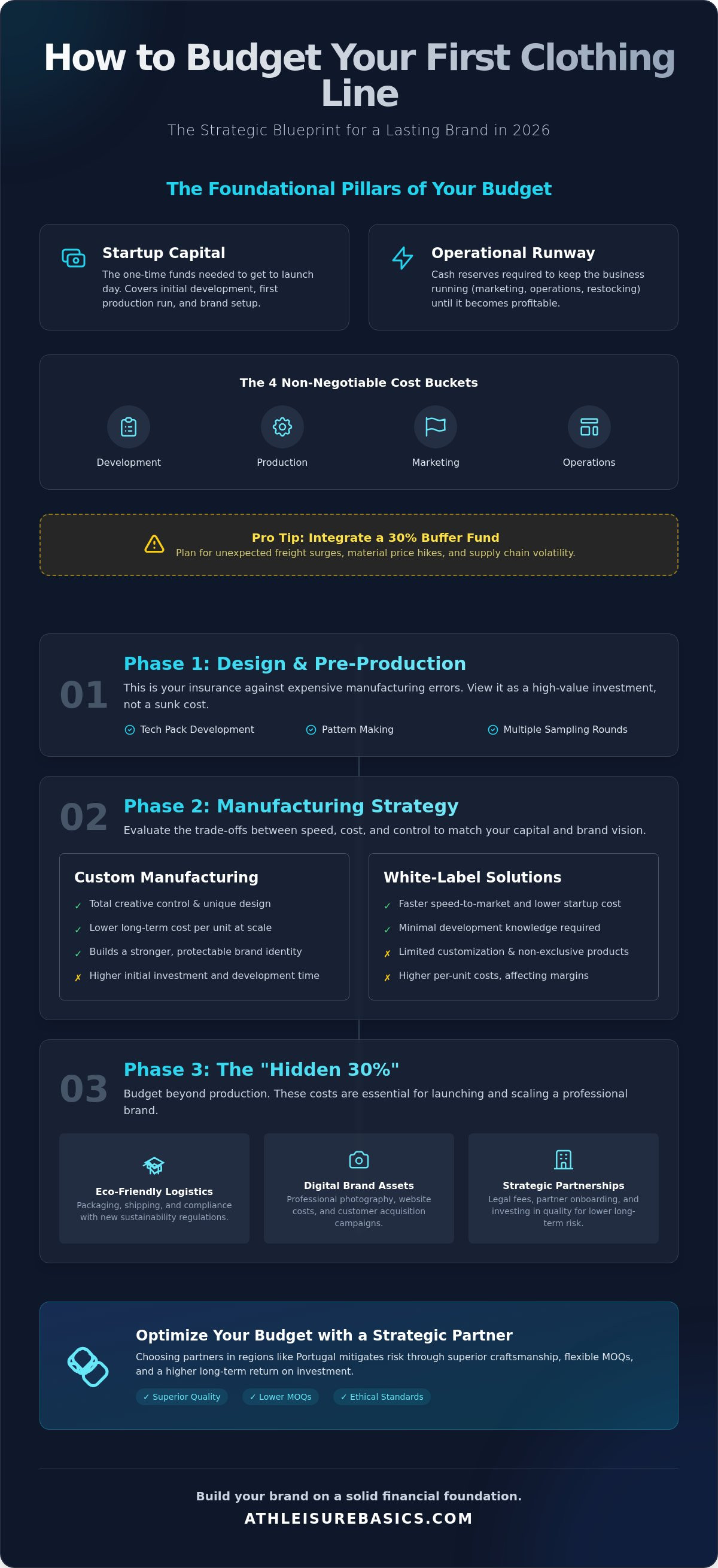
Successful brands are built on financial clarity. Understanding how to budget for your first clothing line requires more than just a spreadsheet of fabric prices. You must distinguish between your startup capital, the one-time funds needed to reach launch day, and your operational runway, the cash reserves required to keep the business moving until it becomes profitable. Many entrepreneurs exhaust their funds on the first production run and find themselves unable to afford the marketing needed to actually sell the product.
Every strategic budget for 2026 centers on four non-negotiable cost buckets:
- Development: This includes tech packs, pattern making, and multiple sampling rounds.
- Production: This covers raw material sourcing, trims, and manufacturing labor.
- Marketing: You must account for brand identity, professional photography, and customer acquisition costs.
- Operations: This involves legal fees, digital storefront subscriptions, and shipping logistics.
Learning how to budget for your first clothing line also involves preparing for the unexpected. Integrating a 30% buffer fund into your total projection is essential. Global supply chains remain volatile. Unexpected freight surges or sudden material price hikes can easily derail a tight budget if you haven't planned for flexibility. Treating quality as a risk-mitigation strategy rather than an expense ensures you don't lose your initial investment to high return rates or brand-damaging defects.
Fixed vs. Variable Costs in Apparel
Fixed costs remain constant regardless of how many garments you produce. These include your legal entity formation and your monthly Shopify store subscription. Variable costs are those that fluctuate based on your production volume, such as fabric consumption and tiered manufacturing labor rates. Variable costs change based on fabric yield per garment and the bulk discounts available at different production tiers.
The "Cost of Quality" Framework
Choosing your manufacturing partner is the most significant financial decision you'll make. While low-cost imports might seem attractive on a per-unit basis, they often carry hidden risks like poor ethical standards or high defect rates. Transitioning to premium European manufacturing, specifically in regions like Portugal, often yields a higher return on investment because of superior craftsmanship and reliability.
Using OEKO-TEX® certified fabrics might increase your initial material spend, but it aligns your brand with 2026 regulatory standards and justifies a premium retail price. Additionally, lower Minimum Order Quantities (MOQs) in Portugal allow you to test the market without tying up all your capital in massive inventory. This "Buy Less, Sell More" approach is a core part of a formal business plan for any modern fashion startup. It reduces the risk of deadstock and keeps your cash flow agile for future growth.
Phase 1: Budgeting for Design and Pre-Production
The pre-production phase is where your creative vision transforms into a technical reality. This stage is the most critical for risk mitigation. Every dollar spent here serves as insurance against future manufacturing errors. When you're determining how to budget for your first clothing line, you must view design and development as a high-value investment rather than a sunk cost. Skipping steps in pre-production often leads to expensive "budget leaks" during bulk manufacturing that can cripple a young brand.
Your journey begins with a comprehensive clothing line business plan that prioritizes technical precision. This plan should account for the meticulous process of sourcing materials, developing blueprints, and refining fit through physical prototypes. Managing these moving parts requires a structured approach to ensure your capital is used efficiently.
Tech Pack Development Costs
A tech pack is the technical blueprint of your garment. It's a comprehensive document that ensures your manufacturer understands every detail of your design. A professional tech pack includes your Bill of Materials (BOM), size grading, construction notes, and stitching specifications. Investing in expert tech pack development prevents thousand-dollar production mistakes by removing ambiguity. Costs vary depending on whether you hire a freelance designer or utilize factory-integrated support, but the clarity provided is worth every cent. Precision at this stage ensures your first production run matches your vision exactly.
The Reality of Sampling Fees
Sampling is a labor-intensive process because each garment is handmade outside the efficient bulk assembly line. Because of this, sample prices are typically two to three times higher than the projected bulk production unit price. You'll need to budget for at least two distinct rounds of prototypes:
- Fit Samples: These are used to perfect the silhouette, drape, and sizing of the garment.
- Salesman Samples (SMS): These are high-quality finished pieces used for professional photography and marketing before your bulk order arrives.
Don't overlook the logistical costs of international courier services. Shipping prototypes from manufacturing hubs like Portugal to your office adds up quickly. You'll also need to budget for material sourcing costs, such as "headers" (fabric swatches) and the sample yardage required to create your initial prototypes. Utilizing clothing production consulting services can help you navigate these costs by identifying the most efficient materials and manufacturing paths early on. If you're ready to start building your technical foundation, reaching out to a specialized production partner can help clarify your specific pre-production needs.
Phase 2: Manufacturing Strategy — Custom vs. White Label
Your choice of manufacturing model is the single largest variable in your financial projections. When deciding how to budget for your first clothing line, you must weigh the benefits of total creative control against the speed and accessibility of pre-existing silhouettes. This decision dictates your Minimum Order Quantities (MOQs) and your initial capital outlay. It's the point where your creative vision meets the reality of industrial production.
Custom manufacturing typically requires a higher upfront investment with MOQs starting around 250 pieces per style. In contrast, white label solutions offer a lower entry barrier with MOQs often as low as 70 pieces. This significantly reduces the "Time-to-Market" cost. White label allows you to skip months of pattern development and fabric testing. For a deeper dive into these strategies, our guide on private label Portugal offers essential context for emerging brands looking for premium European quality with flexible volumes.
You also need to choose between a "Fully Factored" model and "CMT Only" (Cut, Make, Trim) budgeting. A fully factored model includes sourcing and fabric procurement within the manufacturer's fee. CMT only requires you to source and deliver all materials to the factory yourself. Most new entrepreneurs find the fully factored model more predictable. It consolidates material and labor costs into a single, transparent invoice, which simplifies the process as you build a brand in 7 steps.
Custom Manufacturing Financials
Custom production allows for unique fabric knits and proprietary dyes, often referred to as lab dips. These customizations increase the per-unit cost and require higher volume commitments from textile mills. Custom hardware, such as branded zippers or embossed buttons, also adds to the development budget. In Portugal, 250 pieces per style is often the "sweet spot" for custom athleisure. This volume balances premium craftsmanship with manageable inventory levels for a growing business.
White Label and Luxury Blanks Efficiency
Utilizing luxury blanks or white label garments eliminates the need for expensive design and pattern-making fees. You're essentially buying a proven, high-quality silhouette and making it your own. Your budget here should focus on relabeling and decoration costs, such as custom screen printing or high-density embroidery. This model provides a massive cash flow advantage. Starting with just 70 pieces allows you to test market demand before committing to larger production runs. Understanding how to budget for your first clothing line means selecting the model that matches your current capital without sacrificing your brand's premium positioning.
Phase 3: Marketing, Logistics, and the Hidden "30%"
Once your production order is finalized, the focus shifts to the marketplace. Understanding how to budget for your first clothing line requires a realistic look at the costs associated with moving products from the factory floor to the customer's doorstep. This phase, often referred to as the "hidden 30%," covers the essential infrastructure of your brand. It's the difference between having inventory and having a business. Many founders underestimate these operational expenses and find themselves with a finished product but no capital left to sell it.
Manufacturing in Portugal offers a strategic advantage for European brands. It simplifies EU logistics and significantly reduces or eliminates the complex duty costs associated with importing from outside the region. This regional proximity allows for faster replenishment and lower freight costs compared to long-haul shipping from Asia. By keeping your supply chain close to home, you protect your margins from the volatility of global shipping rates and international trade tariffs.
Content and Visual Identity
Shipping and Fulfillment Logistics
Fulfillment costs extend beyond the initial freight. You must factor in the "Last Mile" delivery from your warehouse to the final customer. Packaging also presents a new budgetary consideration due to shifting regulations like the California Textile EPR Program. Sustainable packaging, such as compostable mailers, typically carries a higher price point than standard recycled polybags but is now a baseline consumer expectation. If you're manufacturing outside your home region, always account for VAT and import duties to avoid unexpected cash flow interruptions.
Building a sustainable brand requires more than just great garments; it requires a calculated operational plan. If you need help structuring your operational costs, our production consulting services can provide a clear roadmap for your logistics strategy.
Optimizing Your Budget with a Strategic Partner
Choosing a manufacturing partner is more than a logistical choice; it's a financial commitment to your brand's longevity. When you're refining how to budget for your first clothing line, you must account for the "cost of quality." Cheap production often leads to high return rates and customer dissatisfaction, which can destroy a marketing budget faster than any paid ad campaign. Partnering with clothing manufacturers in Portugal provides a safeguard against these risks through industry-leading craftsmanship and ethical reliability.
The "Buy Less, Sell More" philosophy is central to modern fashion success. By utilizing low MOQ production, you avoid tying up critical capital in massive inventory that may not sell. This approach allows you to remain agile, reinvesting profits from small, successful batches into your next collection. Athleisurebasics supports this growth by offering a clear path from white label entry points to fully custom manufacturing. This scalability ensures that your production partner grows with you, reducing the friction and "re-learning" costs associated with switching factories as you scale.
Leveraging OEKO-TEX® certified materials also serves as a strategic financial tool. In 2026, consumers and regulators are increasingly focused on chemical safety and environmental impact. These certifications justify premium retail pricing and position your brand as a principled leader in the market. It's a proactive investment that prevents future rebranding costs or legal hurdles related to shifting textile regulations.
Why Portugal is the Smart Budget Choice
Portugal offers significant logistical advantages for brands targeting the European market. Shipping costs are lower, and there are zero import duties within the EU, which protects your unit margins. The country's high ethical standards also act as a form of insurance. You avoid the catastrophic PR costs and brand damage associated with unethical labor practices. Proximity also makes factory visits and quality checks more accessible and affordable; this ensures that your final product meets your exact standards before it ever leaves the facility.
Getting Your First Quote
To get an accurate price, you must arrive prepared. Before contacting a manufacturer, ensure your tech packs are finalized and you have a clear understanding of your desired fabric weights and trims. Your inquiry should include your estimated order volume per style, your target launch date, and any specific certifications you require. Providing this level of detail allows for a transparent quote and sets the stage for a professional collaboration. If you are ready to secure your financial future in fashion, partner with Athleisurebasics for your first premium production run.
Building Your Fashion Legacy with Financial Precision
Financial clarity is the bridge between a creative concept and a commercially viable brand. By distinguishing your initial startup capital from your long-term operational runway, you protect your business from the common pitfalls of the apparel industry. You now have the framework to navigate tech pack development, sampling fees, and the strategic choice between custom and white-label production. Mastering how to budget for your first clothing line ensures that your capital is invested in quality and scalability rather than lost to manufacturing errors or inefficient logistics.
Success in 2026 requires a partner who understands the needs of emerging brands. We specialize in supporting startups with accessible minimum order requirements starting at just 70 pieces. Our production is based in Portugal, ensuring high ethical standards and the use of OEKO-TEX® certified premium fabrics that justify your brand's luxury positioning. Launch your brand with premium Portuguese manufacturing — Explore our services and take the first step toward a lasting market presence. Your journey from a small idea to a commercial reality starts with a single, well-planned production run. We are ready to help you scale with confidence.
Frequently Asked Questions
How much money do I need to start a clothing line in 2026?
An initial investment for a clothing line in 2026 typically ranges from $2,000 for print-on-demand to over $75,000 for a full cut-and-sew launch. Research indicates that small-batch production with private label manufacturing generally requires $10,000 to $30,000. These figures cover your initial production run, tech packs, and basic marketing. Larger custom launches require more capital to sustain operations until the brand becomes profitable.
Can I start a clothing brand with only $1,000?
Launching a professional brand with only $1,000 is extremely difficult and often results in poor quality or limited visibility. While this amount might cover a few basic luxury blanks or a very limited print-on-demand experiment, it won't sustain a brand through technical development and professional marketing. Most successful entrepreneurs find that a larger initial investment is required to ensure high quality and professional brand positioning from day one.
What is the biggest hidden cost in clothing manufacturing?
Logistics and shipping represent the most significant hidden costs in the clothing manufacturing industry. Beyond the factory gate price, you must account for freight, import duties, and the "Last Mile" delivery to your final customer. These expenses often account for an additional 30% of your total production budget. Understanding these variables is a key part of how to budget for your first clothing line effectively to avoid cash flow shortages.
Is it cheaper to manufacture clothing in Portugal or China?
Portugal is often more cost-effective for premium startups due to zero duties within the EU and lower shipping costs. While China might offer lower labor costs for massive volumes, Portugal provides faster lead times and easier quality control. This reduces the risk of expensive production errors and high return rates that can quickly drain your initial capital. The regional proximity also simplifies factory communication and long-term partnership development.
How many pieces should I order for my first collection?
You should aim to order between 70 and 250 pieces per style for your first collection to balance risk and production efficiency. For white label or luxury blanks, starting with 70 pieces is a strategic way to validate your designs with minimal financial risk. If you are moving into custom manufacturing, 250 pieces per style is often the standard minimum. This approach allows you to "Buy Less, Sell More" while maintaining healthy cash flow.
Do I need to pay for samples?
Yes, you must pay for samples because they are labor-intensive, handmade prototypes that cost more than bulk units. Industry data shows that physical samples typically cost between $50 and $250 each. Most manufacturers charge 2x to 3x the estimated bulk unit price for these items. Budgeting for at least two rounds of sampling is essential to ensure your final fit and material choices are perfect before you commit to bulk production.
How much should I spend on marketing for a new clothing brand?
You should allocate roughly 20% to 30% of your total budget to marketing to account for high customer acquisition costs. With Customer Acquisition Costs (CAC) for apparel brands ranging from $40 to $80 per customer, a small budget will struggle to gain traction. Many successful brands use this allocation for a mix of paid social ads, professional photography, and influencer seeding to ensure their inventory moves efficiently once it arrives in the warehouse.
What is the difference between a tech pack and a design sketch in terms of cost?
A tech pack is significantly more expensive than a design sketch because it serves as a technical blueprint for production. Tech pack development costs typically range from $80 for basic items to $800 for complex designs. While a sketch is cheaper to produce, a professional tech pack is a non-negotiable investment. It prevents thousand-dollar errors during the production phase by providing exact measurements and construction details that a factory needs.

Leave a comment
This site is protected by hCaptcha and the hCaptcha Privacy Policy and Terms of Service apply.