

Dropshipping vs. Private Label Manufacturing: Choosing the Right Model for Your Brand in 2026
With customer acquisition costs rising by approximately 40% between 2023 and 2025, can your apparel brand truly thrive on the thin profit margins offered by a reseller model? You've likely felt the pressure of escalating ad spend and the persistent frustration of handling customer complaints about fabric quality or shipping delays that you simply can't control. It's a common challenge for entrepreneurs weighing the merits of dropshipping vs private label manufacturing in a market that increasingly demands transparency, quality, and brand identity.
This guide provides the professional clarity you need to choose the right path for your business growth in 2026. You'll discover how to move beyond low-margin sales and transition toward a high-reward manufacturing model that offers full control over your ethical standards and product integrity. We'll compare the logistical realities of both systems, from upfront investments to long-term scalability, so you can build a unique brand that customers trust and return to. By understanding these critical differences, you can secure your profit margins and establish a lasting presence in the global e-commerce landscape.
Key Takeaways
- Identify the core functional differences between acting as a third-party reseller and building a dedicated brand through custom production.
- Recognize the hidden risks of thin margins and quality control issues that often limit the growth potential of a standard dropshipping model.
- Learn how to secure higher profit margins and brand loyalty by investing in the premium craftsmanship and ethical standards of Portuguese manufacturing.
- Evaluate the financial and operational trade-offs of dropshipping vs private label manufacturing to determine the most sustainable scaling strategy for your 2026 business plan.
- Master the transition process by using market data to identify winning products and partnering with experts to develop your own high-quality collections.
What is the Difference Between Dropshipping and Private Label Manufacturing?
Understanding the fundamental split in dropshipping vs private label manufacturing is essential for any apparel entrepreneur looking to scale. In 2026, the e-commerce market has matured beyond simple arbitrage. Success now requires more than just a digital storefront; it requires a defensible brand asset. The choice you make today determines whether you're building a temporary income stream or a lasting commercial presence.
Dropshipping remains a common starting point for those testing the waters. It's a fulfillment method where the merchant doesn't keep products in stock. Instead, when you sell a product, you purchase the item from a third party who ships it directly to the customer. For a deeper look at the mechanics and history of this model, you can explore What is Dropshipping? on Wikipedia. While this removes the burden of inventory management, it also removes your control over the customer experience and product integrity.
Private label manufacturing represents the move from reseller to brand owner. This model involves designing or selecting specific apparel items to be produced by a manufacturing partner under your own label. You hold the inventory and manage the distribution. In 2026, the 'middle ground' of private label dropshipping, where logos are applied to generic, mass-produced items, is losing ground. Customers now demand authentic manufacturing and verified quality. The shift from a passive income mindset to one of brand equity is no longer optional for those who want to survive rising acquisition costs.
Dropshipping: The Low-Barrier Entry
This model appeals to beginners because it eliminates the need for significant upfront capital. You don't have to worry about warehouse space or unsold stock. However, the reality of 2026 is that generic products are everywhere. With 2.86 billion online shoppers globally, competition for attention is fierce. Relying on a supplier's standard catalog makes it difficult to stand out. You're often competing solely on price, which leads to a race to the bottom that erodes your profit margins, which typically sit between 15% and 30%.
Private Label Manufacturing: The Brand-Building Path
True private label manufacturing allows you to own the physical product from the first thread to the final stitch. You aren't just a vendor; you're a creator. This path positions the manufacturer as a strategic partner. When you work with experts in regions like Portugal, you gain access to premium materials and ethical production standards that become your competitive edge. Benefits of this model include:
- Full Customization: Control over fabric weight, composition, and technical fit.
- Quality Assurance: Direct oversight of CMT production and luxury finishing.
- Ethical Transparency: Certainty regarding labor standards and environmental certifications.
Holding your own inventory also solves the modern demand for speed. You can guarantee shipping times and inspect every garment to ensure it meets your brand's high standards. Evaluating dropshipping vs private label manufacturing ultimately comes down to your long-term goals. If you want to build a unique product that customers love and return to, owning the production process is the gold standard.
The Hidden Realities of the Dropshipping Model
While the low entry barriers of dropshipping are attractive, the model carries systemic risks that often remain hidden until a brand attempts to scale. In the current market, selling generic products creates a "race to the bottom." When you and hundreds of other retailers offer the exact same garment sourced from the same global marketplaces, your only lever for competition is price. This commoditization erodes your ability to build a premium brand identity and forces you into unsustainable price wars that destroy profitability.
Operational security is another growing concern. By 2026, major e-commerce platforms and payment gateways have implemented stricter oversight for accounts using a reseller model. High chargeback rates, often triggered by long shipping durations and inconsistent product quality, can lead to frozen funds or permanent account bans. When you don't physically inspect your inventory, you're essentially gambling with your brand's reputation and your financial stability.
Thin Margins and High Ad Spend
The math of dropshipping is becoming increasingly difficult to justify. Customer acquisition costs rose by approximately 40% between 2023 and 2025, making it nearly impossible to turn a profit on thin margins of 15% to 30%. Many entrepreneurs find they're effectively "donating to Meta" or TikTok, as their entire gross profit is consumed by advertising spend just to secure a single sale. Without a unique product, it's challenging to build a loyal community that drives organic, commission-free growth. If you're feeling stuck in this cycle, seeking clothing production consulting services can help you transition toward a more sustainable, high-margin model.
The Lack of Supply Chain Transparency
Modern consumers demand to know where their clothes are made and who made them. Dropshipping often leaves you in the dark regarding labor standards and fabric safety. This lack of transparency is no longer just a branding issue; it's a legal one. New regulations, such as the EU's EmpCo directive effective September 2026, require specific certifications for any environmental claims. If you're dropshipping from unverified factories, you cannot legally claim your products are "eco-friendly" or "ethically made" without risking significant fines. Transitioning to a model with direct factory oversight is the only way to ensure your brand remains compliant and principled.
Finally, consider the impact on Customer Lifetime Value (CLV). It costs 5 to 25 times more to acquire a new customer than to retain an existing one. Long shipping times and poor fabric quality ensure that a customer will never buy from you a second time. By prioritizing short-term ease over long-term quality, dropshipping models often sacrifice the very foundation of a lasting business: a product that customers actually love.
Why Private Label Manufacturing is the Gold Standard for Apparel
While dropshipping serves as a low-cost entry point, private label manufacturing is the definitive path for those committed to building a defensible business. In the debate of dropshipping vs private label manufacturing, the primary differentiator is the ability to create something that doesn't exist on mass-market platforms like AliExpress. Genuine private labeling involves more than just adding a logo to a generic product; it's about owning the technical specifications and the aesthetic identity of your collection.
Securing full control over the garment production process allows you to implement rigorous quality standards from the outset. By choosing "Made in Portugal" manufacturing, your brand benefits from a globally recognized seal of excellence. This regional origin signals ethical labor practices and high-end craftsmanship, which are critical for capturing the attention of modern, conscious consumers. This model transforms your business from a marketing experiment into a sellable brand asset with tangible equity and long-term growth potential.
Premium Materials and OEKO-TEX Standards
The physical experience of a garment often dictates whether a customer becomes a repeat buyer or a return statistic. High-quality fabric hand-feel is essential for reducing return rates, which frequently plague lower-tier apparel models. By understanding what a textile is and how specific certifications like OEKO-TEX protect the consumer, you can use material integrity as a powerful marketing tool. Premium manufacturing justifies a higher retail price point because the value is evident in every stitch. This shift in quality allows your brand to move away from price-driven competition and toward value-driven loyalty.
Customization vs. White Label Services
One of the most significant barriers to traditional manufacturing used to be the requirement for massive orders. Modern production facilities have removed this obstacle by offering flexible service models that suit emerging brands. These accessible thresholds mean you don't need to risk six-figure investments to launch a professional collection. You can choose the level of involvement that fits your current stage of development:
- Custom Manufacturing: Develop unique tech packs and bespoke silhouettes with minimum order quantities (MOQs) typically starting at 250 units.
- White Label/Luxury Blanks: Access high-quality, pre-designed styles that you can brand as your own, often with MOQs as low as 70 units per style.
These pragmatic options allow you to start with luxury blanks to test your brand's aesthetic and then transition to fully custom designs as you scale. This approach mitigates the perceived risks of manufacturing while providing the high-end results that dropshipping simply cannot replicate. By owning your supply chain, you ensure that every piece of clothing reflects your brand's commitment to quality and ethical standards.
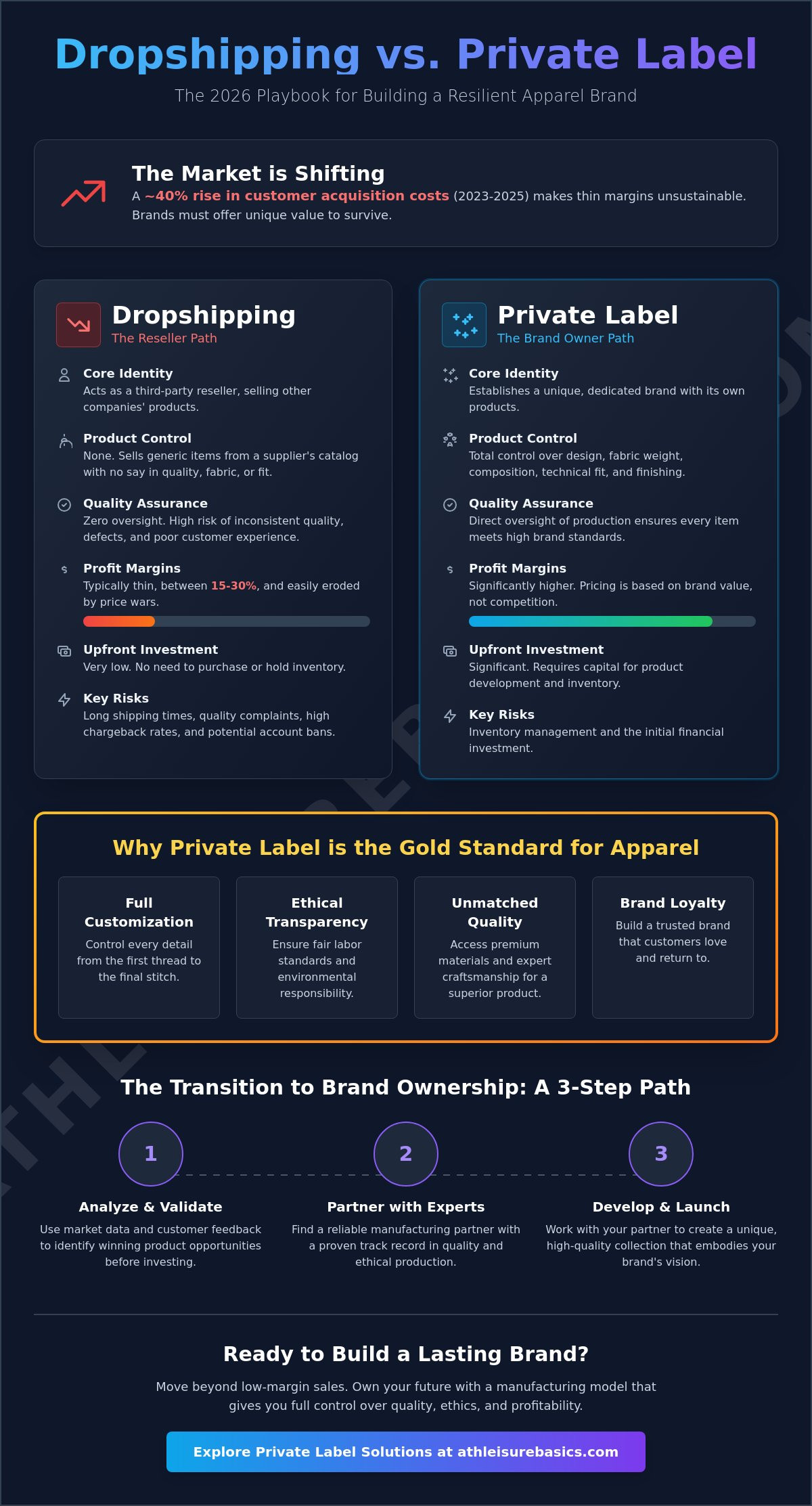
Direct Comparison: Dropshipping vs. Private Label Manufacturing
Choosing between these two paths requires a professional evaluation of your long-term commercial goals. While many beginners focus on "ease of use," established brands prioritize defensibility and financial stability. The choice of dropshipping vs private label manufacturing fundamentally changes your role from a digital marketer to a genuine brand architect. A direct comparison reveals the structural differences that impact your daily operations and your bottom line.
- Upfront Investment: Dropshipping requires minimal capital, primarily covering platform fees like the Shopify Basic plan at $39 per month. Private label manufacturing requires a moderate initial investment for stock, though low MOQs have made this more accessible.
- Profit Margins: Dropshipping margins typically fluctuate between 15% and 30% and are highly sensitive to ad spend. Manufacturing offers stable margins often exceeding 50% due to lower per-unit costs.
- Brand Control: Dropshipping offers almost no control over the product or packaging. Manufacturing provides total authority over every detail, from fabric composition to custom labels.
- Scalability: Scalability in dropshipping is often capped by rising customer acquisition costs. Manufacturing scales through production efficiency and the creation of a sellable business asset.
- Customer Loyalty: Reselling generic items fosters a single-purchase mindset. Owning a unique product allows you to build a community and increase customer lifetime value.
Risk Assessment: Inventory vs. Marketing Waste
The common myth that dropshipping is "risk-free" ignores the reality of marketing waste. With customer acquisition costs rising by 40% in recent years, spending thousands on failed ad campaigns for a generic product is a significant financial risk. Conversely, you can mitigate inventory risk by utilizing private label Portugal strategies that favor small-batch production. Holding stock in your target market also drastically improves conversion rates. With average shopping cart abandonment rates sitting at 70.19%, offering fast, local shipping is often the deciding factor in securing a sale.
Control Over the Customer Experience
The first physical touchpoint with your brand shouldn't be a generic plastic mailer. Private labeling allows for custom packaging and a curated unboxing experience that reinforces your brand's premium positioning. This control ensures consistency; the 100th customer receives the exact same high-quality garment as the first. Handling returns also becomes a streamlined process when you manage your own local stock, rather than dealing with the logistical nightmare of international dropshipping returns. If you're ready to move beyond the limitations of reselling, explore our custom clothing manufacturing options to start building your own high-margin collection today.
How to Transition from Dropshipping to Private Labeling
Transitioning from a reseller model to a manufacturer-backed brand is a strategic evolution that requires data-driven decision-making. You don't need to overhaul your entire catalog overnight. Instead, use your existing sales history to identify "winners" that have already proven market demand. By focusing on your best-selling items, you minimize the risk associated with inventory and ensure your first manufacturing run is backed by actual consumer interest. This shift allows you to move away from the volatility of dropshipping vs private label manufacturing and toward a more stable, high-margin business structure.
The first step is identifying products with high sales volume but consistent quality complaints or long shipping delays. These are your primary candidates for a private label upgrade. Once you've selected your core products, you need to find a clothing manufacturer in Portugal that supports emerging brands. Portugal is an ideal choice for this transition due to its reputation for craftsmanship and strict adherence to EU ethical standards. As your manufactured inventory arrives, you can begin phasing out dropshipped items, gradually replacing generic goods with premium, branded alternatives.
Leveraging Low MOQs for a Safe Transition
Many entrepreneurs hesitate to make the switch because they fear the financial burden of large inventory orders. Athleisurebasics removes this barrier by offering accessible entry points for growing businesses. We support startups with minimum order quantities (MOQs) as low as 70 units for our white label services. This allows you to test the market with our premium Luxury Blanks before you commit to the complexity of bespoke tech packs. Utilizing our clothing production consulting services during this phase is essential. We help you refine your brand's aesthetic and ensure your first batch meets the high standards your customers expect.
Scaling Your Brand with Athleisurebasics
As your brand gains momentum, you can transition from 70-unit white label runs to full custom production with 250+ units. This level of manufacturing gives you total authority over bespoke silhouettes, unique fabric blends, and proprietary fits. Producing in Portugal ensures your brand remains principled and quality-conscious, providing a clear differentiator against global competitors who rely on opaque supply chains. This progression from a small idea to a lasting commercial presence is the most reliable way to secure your brand's future in 2026. Ready to build a real brand? Contact Athleisurebasics for a production quote today and take the first step toward owning your supply chain.
Securing Your Brand's Future in 2026
Choosing between dropshipping vs private label manufacturing is a defining decision for your brand's trajectory. While the reseller model provides a low-cost entry point to test market demand, building a sustainable and high-margin brand requires the quality and control only found in direct manufacturing. Success in 2026 depends on your ability to offer unique, ethically produced garments that differentiate your label from the sea of generic products found on global marketplaces.
By moving toward private labeling, you secure your profit margins and establish long-term customer loyalty. Athleisurebasics simplifies this transition by offering professional support and accessible production volumes. Our services include low MOQs starting at 70 pieces, ensuring you can scale without the risk of massive inventory overhead. Every collection we produce features premium OEKO-TEX® certified fabrics and is crafted with ethical manufacturing based in Portugal.
It's time to stop competing on price and start competing on value. Start Your Premium Clothing Line with Athleisurebasics today and transform your vision into a lasting commercial presence. Your brand's evolution begins with a single, high-quality stitch.
Frequently Asked Questions
Is dropshipping still profitable in 2026?
Dropshipping remains a viable entry point, though profit margins are increasingly compressed by rising customer acquisition costs. With ad spend increasing by approximately 40% between 2023 and 2025, success requires a highly optimized marketing strategy and a specific niche. Most professional entrepreneurs now use this model primarily for market testing rather than long-term brand building, as thin 15% to 30% margins make scaling difficult compared to the higher returns of manufacturing.
What is the minimum budget needed for private label manufacturing?
The budget required for private label manufacturing depends on your chosen production volume and material complexity. While dropshipping has low entry costs, manufacturing requires a moderate upfront investment to secure physical inventory. Modern facilities have lowered these barriers by offering accessible minimum order requirements, such as 70 pieces for white label collections. This shift allows emerging brands to launch professional lines without the massive capital traditionally associated with industrial production.
Can I do private label manufacturing with no experience?
You can absolutely start private label manufacturing without prior industry experience by partnering with a supportive production collaborator. Expert manufacturers offer end-to-end consulting services, including tech pack development and materials sourcing, to guide you through the technical complexities. This collaborative approach mitigates the perceived risks for new entrepreneurs, allowing you to transition from a conceptual idea to a finished, high-quality product while learning the industrial process in a secure environment.
How do I find a reliable clothing manufacturer in Europe?
Finding a reliable clothing manufacturer in Europe involves researching regional hubs known for craftsmanship, such as Portugal. You should prioritize partners who offer transparent communication and hold recognized certifications like OEKO-TEX for material safety. Evaluating a collaborator's ability to handle low minimum order volumes is also essential for emerging brands. A reputable European partner will act as a dedicated ally, ensuring your production meets high ethical and quality standards.
What are the biggest risks of switching from dropshipping to manufacturing?
The primary risk when switching from dropshipping to manufacturing is managing physical inventory and the associated upfront capital. Unlike a reseller model, you must hold stock, which carries the risk of unsold items if market demand isn't accurately predicted. However, this is often offset by the elimination of the "marketing waste" common in dropshipping. By using sales data from your reseller phase, you can make informed production choices that stabilize your profit margins.
Does private label manufacturing include shipping to customers?
Private label manufacturing typically focuses on the production of goods, while shipping to individual customers is handled through a third-party logistics provider or your own warehouse. Once the factory completes your order, the inventory is shipped in bulk to your distribution center. This model gives you full control over the unboxing experience and shipping speed, which are critical for improving customer lifetime value and reducing the return rates often seen with international dropshipping.
How long does the manufacturing process take compared to dropshipping?
The manufacturing process generally requires a longer lead time, often around 90 days from design to delivery, compared to the instant availability of dropshipping products. However, once your inventory is produced and stored locally, your shipping time to the end customer is significantly faster. In the dropshipping vs private label manufacturing debate, this initial time investment is a trade-off for the ability to provide a consistent, high-quality product that arrives at the customer's door in days rather than weeks.
What is the difference between white label and private label in clothing?
White label clothing involves adding your branding to pre-designed, high-quality styles, which is ideal for testing a brand aesthetic with low minimums. Private label manufacturing involves creating unique products from scratch using custom tech packs and bespoke silhouettes. While white label offers speed and accessibility, full private labeling provides total differentiation. Both models offer significantly higher profit margins and better quality control than standard dropshipping models by allowing you to own the physical inventory.



Leave a comment
This site is protected by hCaptcha and the hCaptcha Privacy Policy and Terms of Service apply.