
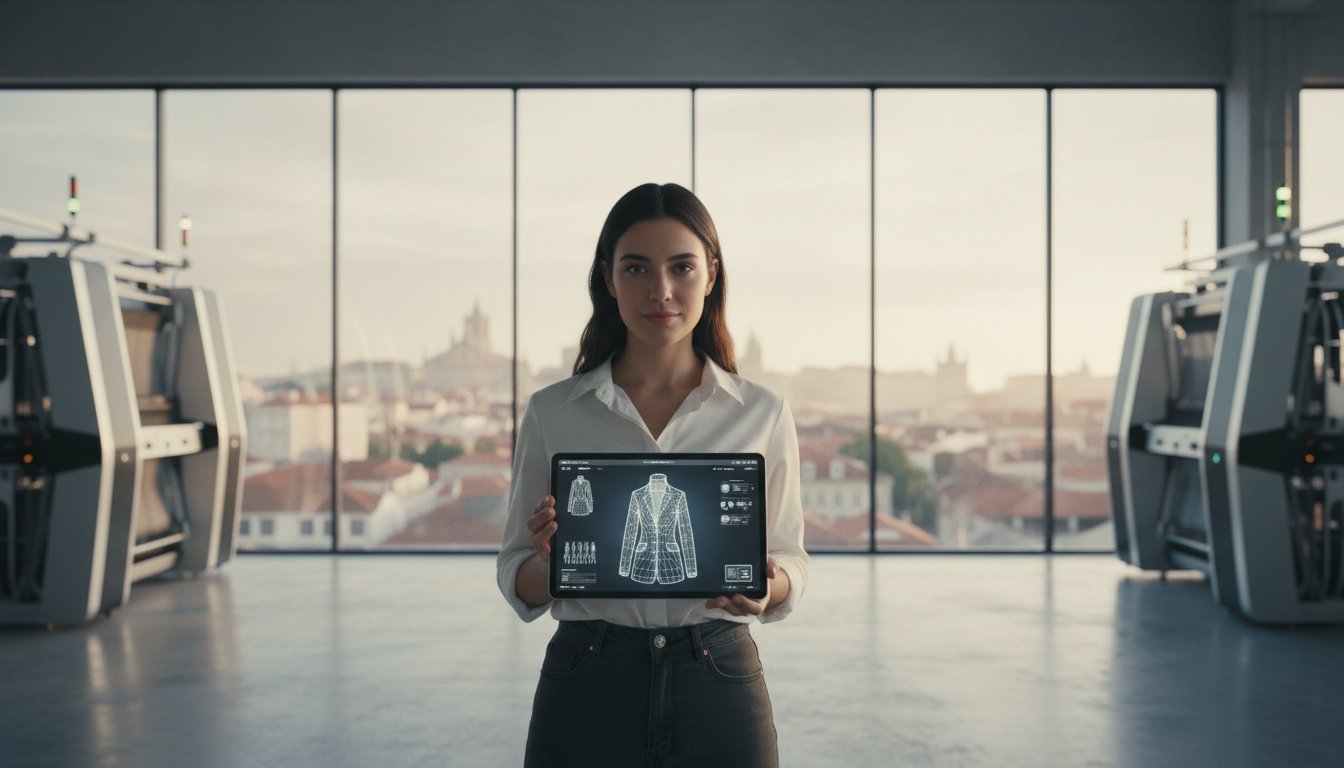
How to Avoid Getting Scammed by Manufacturers: A 2026 Guide for Apparel Brands
What if the factory you just wired a $5,000 deposit to doesn't actually exist? In 2026, scammers use sophisticated AI to create "ghost factories" with deepfake videos, making it harder than ever to distinguish a legitimate partner from a digital mirage. You've likely spent months perfecting your vision. The anxiety of receiving "trash" samples or losing your hard-earned capital is a heavy burden for any startup founder. Learning how to avoid getting scammed by manufacturers is no longer just about checking a website; it's about understanding the legal and regulatory landscape that protects your brand.
We understand that you want to build a legacy, not a list of expensive mistakes. We'll show you how to identify red flags, manage the 15% U.S. global import tariff effective since February 24, 2026, and use EU regulations like the Digital Product Passport to your advantage. This guide provides a clear checklist to secure your designs. It introduces you to manufacturing standards and transparent partners that turn your creative vision into high-quality products without the risk.
Key Takeaways
- Identify the warning signs of "ghost manufacturers" and quality fade to ensure your investment results in premium products rather than lost deposits.
- Explore why the legal protections and transparency of manufacturing in Portugal provide a safer, more accountable environment for growing brands.
- Implement a professional defense strategy and learn how to avoid getting scammed by manufacturers by using detailed tech packs as your primary legal safeguard.
- Utilize low MOQs to test factory reliability and craftsmanship quality before committing your capital to larger production runs.
- Transition from a simple logo to a lasting legacy by choosing a partner that prioritizes EU ethical standards and long-term brand support.
Why New Clothing Brands Are Primary Targets for Manufacturing Scams
A manufacturing scam is any intentional deception regarding product quality, production lead times, or the actual legitimacy of a business. For many fashion entrepreneurs, the first lesson in how to avoid getting scammed by manufacturers is realizing that fraud isn't always about a disappearing deposit. It often involves subtle "quality fades" where the first batch meets your standards, but subsequent orders use inferior materials to pad the factory's margins. Startups are particularly vulnerable because they bring high emotional investment and limited industry experience to the table. Scammers recognize this enthusiasm and use it to bypass a founder's logical defenses.
The role of digital anonymity has evolved significantly by 2026. Fraudsters now use Generative AI to build sophisticated "ghost factories" complete with fake staff profiles and deepfake facility tours. This makes digital verification complex. While researching common types of scams, you'll find that the most effective ones rely on a sense of urgency and unrealistic pricing to cloud your judgment.
Choosing the lowest quote is often the most expensive mistake a brand can make. With the average U.S. apparel import tariff reaching 35.1% in December 2025, and the additional 15% global tariff implemented in February 2026, manufacturing costs have a clear floor. If a factory offers a price that seems to ignore these economic realities, they're likely cutting corners on labor standards or planning to deliver "trash" instead of premium garments. Understanding how to avoid getting scammed by manufacturers starts with accepting that quality has a non-negotiable price point.
The Psychology of the 'Perfect Sample' Trap
Scammers often secure bulk deposits by sending high quality "bought" samples. They purchase luxury items from retail stores, remove the labels, and claim them as their own craftsmanship. If a sample arrives and looks too good for the quoted price, it's a major red flag. There's a massive difference between a sales sample designed to close a deal and a production ready prototype built on your specific tech pack.
Identifying Red Flags in Initial Communication
Professionalism is your first line of defense. Watch for unprofessional email domains or a refusal to provide a verifiable physical address in a region with high legal accountability, like the EU. Pressure tactics are another warning sign. If a representative claims "special pricing ends today" or "MOQ is rising next week," they're trying to force a rushed decision. Legitimate partners who prioritize your legacy will always provide references and valid OEKO-TEX® certifications upon request.
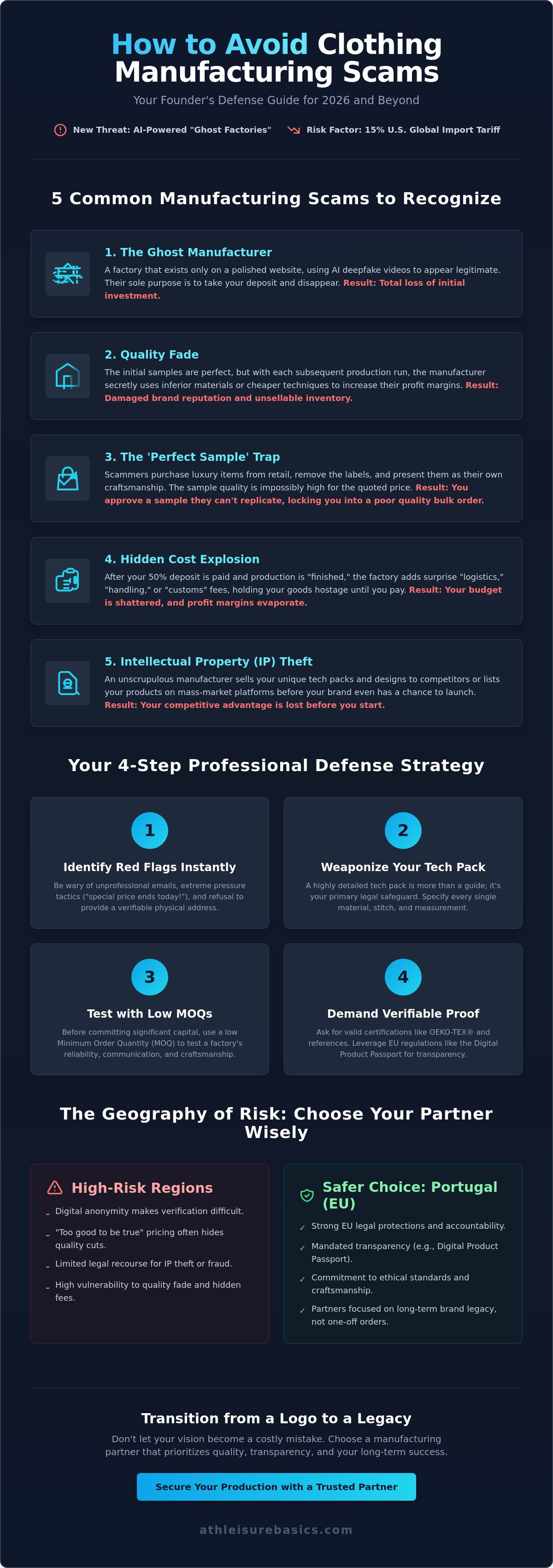
5 Common Manufacturing Scams Every Fashion Founder Must Recognize
The landscape of apparel production is more complex in 2026 than ever before. While digital tools make global sourcing accessible, they also provide cover for sophisticated fraudulent schemes. Understanding the mechanics of these traps is essential for anyone learning how to avoid getting scammed by manufacturers. Fraud in this industry rarely looks like a simple "robbery"; it's often a calculated series of deceptions designed to exploit your brand's growth and capital.
One of the most damaging issues is the Hidden Cost Explosion. Scammers wait until your production is finished and your marketing is live before adding "logistics" or "handling" fees that weren't in the initial contract. Because your capital is already tied up in the 50% deposit and you have customers waiting, they know you're likely to pay. Similarly, Intellectual Property (IP) theft has surged alongside "dupe" culture. Unscrupulous factories may sell your unique tech packs to competitors or list your designs on mass-marketplaces before you even launch your first collection.
Manufacturers often use origin labels to justify higher prices, but the Federal Trade Commission has finalized orders against companies for deceptive claims that mislead founders about where their goods are actually produced. If you are looking for a transparent partner that respects your designs, you can explore our custom clothing options to see how we document every step of the production journey.
The Ghost Manufacturer and Deposit Disappearance
The Ghost Manufacturer is a factory that exists only on a polished website or a deepfake video. They disappear the moment you wire a deposit. To verify a factory's existence, use Google Earth to check for a physical facility at their listed address. You should also cross-reference their business name with the VIES (VAT Information Exchange System) or local EU registries. Never wire money to personal bank accounts; legitimate Portuguese or EU manufacturers will always have a corporate account that matches their registered business name.
Quality Fade and Fabric Substitution
Quality Fade is the gradual decline in garment standards between sampling and bulk production. This often happens alongside Fabric Substitution, where a factory swaps premium Portuguese cotton for low-grade synthetics to save on costs. To combat this, you must keep "Control Samples" from the initial prototyping phase to hold the manufacturer accountable during bulk delivery. Always demand third-party certifications, such as OEKO-TEX® or GOTS, to verify that the materials used in your production match the premium standards you paid for.
Knowing how to avoid getting scammed by manufacturers requires a mix of digital due diligence and physical verification. By identifying these five common scams early, you protect your brand's reputation and your financial future.
The Geography of Risk: Why Manufacturing in Portugal Minimizes Scams
Most advice on how to avoid getting scammed by manufacturers focuses on vetting individual factories. However, the geographic location of your partner is often the strongest predictor of security. In 2026, the structural differences between manufacturing hubs are stark. Sourcing from regions with high legal accountability, like the European Union, provides a layer of protection that simply doesn't exist in traditional sourcing hubs where legal recourse is nearly impossible for small brands. Geography isn't just about shipping times; it's your first line of defense against fraud.
EU Legal Recourse vs. Global 'Wild West' Sourcing
Contracts signed with EU based manufacturers are enforceable under a unified legal framework. If a dispute arises, you have clear paths for mediation and legal action within a transparent system. Distance and language barriers are a scammer's best friends. They rely on the fact that you won't fly across the world to pursue a $10,000 deposit. By keeping your production within the EU, you effectively use international trade laws as a shield. Learning how to detect and prevent business fraud is significantly easier when your partner operates under the same ethical and legal standards you do. This structural accountability is why many startups are moving away from high risk regions and toward the stability of Europe.
The Transparency of Portuguese Manufacturing
Portugal has emerged as a premier hub because of its strict adherence to EU Regulation 1007/2011. This regulation dictates that the "Made in Portugal" label requires the final, most substantial transformation to happen locally. This isn't just about a label; it's about a culture of craftsmanship. Portuguese factories exported €5.5 billion in textiles in 2024 because they prioritize long-term partnerships over "churn and burn" production. You can find more details on these standards in our guide to made in portugal clothing. Unlike factories in regions that prioritize volume above all else, Portuguese producers often maintain open door policies. They welcome visits and provide transparent updates that eliminate the "digital anonymity" scammers crave.
With the EU's Digital Product Passport becoming enforceable in 2026, Portuguese manufacturers are already equipped to provide the "digital twin" data required for supply chain credentials. OEKO-TEX® certification is a baseline here, not a premium add-on. This level of ethical oversight, combined with the fact that the industry employs over 130,000 people, means factories are unlikely to risk their reputation on a short term scam. Understanding how to avoid getting scammed by manufacturers requires looking at the regulatory environment. When you choose a partner in a region that bans the destruction of unsold goods, effective as of July 19, 2026, you're choosing a partner that values transparency and long term brand success.
Your Step-by-Step Defense Strategy for 2026
Establishing a proactive defense is the most effective way to address how to avoid getting scammed by manufacturers. It transitions your brand from a vulnerable target to a professional operator. In 2026, scammers specifically target brands that lack a documented paper trail or technical knowledge. By implementing a structured five step system, you create an environment where deception becomes nearly impossible to execute. This strategy focuses on technical accountability and financial safeguards to protect your capital from the start.
- Step 1: Create a Comprehensive Tech Pack. This is your legal insurance policy. It defines every stitch, fabric weight, and measurement.
- Step 2: Start with Low MOQs. Use a small initial run to test the factory's reliability and communication before committing to large scale production.
- Step 3: Approve Multiple Sample Stages. Never skip the Proto, Fit, or Pre-Production Sample (PPS) stages. Each stage is a checkpoint for quality.
- Step 4: Use Structured Payment Terms. Stick to a 50/50 or 30/70 split. Never wire 100% of the capital upfront.
- Step 5: Conduct a Pre-Shipment Inspection (PSI). Verify the bulk order matches your "Golden Sample" before the final balance is paid and the goods leave the factory.
The Tech Pack: Your Legal Insurance Policy
If a manufacturer delivers a collection with incorrect sizing or the wrong fabric blend, your tech pack is the only document that proves a breach of contract. Most founders view these as design tools, but in 2026, they serve as your primary legal defense. A tech pack must include tolerances for measurements to be legally binding. These +/- margins ensure that any deviation beyond the agreed limit is a documented failure on the factory's part. You can see how this technical documentation integrates into the wider journey by reviewing the garment production process.
Low MOQs and Sampling Protocols
A factory that refuses a small test run of 60 to 70 pieces might be hiding production issues or prioritizing volume over partnership. Professional manufacturers in Portugal often support Low MOQs for startups because they want to grow with you. During this phase, implement the "Golden Sample" rule. Keep one approved PPS locked away in your office. This sample is your benchmark for bulk production. Communicating with technical precision signals that you aren't an easy target for scammers. If you are ready to build a secure supply chain, you can submit your project for a professional review to ensure your brand is protected.
Building a 'Logo to Legacy' Partnership with Athleisurebasics
Choosing a production partner is the most critical decision you'll make for your brand's future. While previous sections detailed the technical defenses you need, the ultimate strategy for how to avoid getting scammed by manufacturers is to align with a partner that values your long term legacy over a single transaction. Athleisurebasics operates within the strict regulatory framework of the European Union, providing the transparency and legal security that digital "ghost factories" simply cannot replicate. We don't just produce garments; we act as a trusted partner to ensure your vision reaches the market with superior quality.
Our 70 piece Low MOQ for white label testing is specifically designed to lower the barrier to entry for startups. Scammers typically pressure founders into high volume orders to maximize their illicit gain from a single deposit. By offering a low risk starting point, we allow you to verify our craftsmanship and efficiency without overextending your capital. This approach turns manufacturing from a high stakes gamble into a scalable, predictable process. Every garment we produce meets the highest industry standards, utilizing OEKO-TEX® certified materials and ethical Portuguese production methods.
Our Transparent Custom Manufacturing Process
We guide startups through the complexities of tech pack development and materials sourcing to ensure every detail is documented. This level of technical precision is your best defense. Working with a Lisbon based manufacturer provides you with a verifiable track record in a region known for luxury craftsmanship. You can learn more about the structural advantages of our location in our guide to clothing manufacturers portugal. We eliminate the "digital anonymity" that scammers rely on by providing clear communication and documented production milestones.
Why Proximity and Communication Eliminate Risk
Proximity and real time updates are essential for maintaining quality control. We encourage partner like transparency, providing you with the insights needed to scale with confidence. For larger projects, our full CMT production services handle quality control at every stage of a 250 piece custom run. This hands on approach ensures that the "Quality Fade" mentioned earlier never affects your brand. We prioritize your growth by removing the barriers of international trade confusion and providing a reliable, ethical supply chain. Start your risk-free production journey with Athleisurebasics today.
Secure Your Brand's Future and Scale with Confidence
Turning a creative vision into a profitable legacy requires more than just design talent. It demands a secure supply chain built on technical precision and geographic accountability. By implementing rigorous sampling protocols and prioritizing the legal protections of the European Union, you've learned exactly how to avoid getting scammed by manufacturers. These defensive strategies are your best insurance against the evolving risks of 2026. You now have the knowledge to protect your capital and focus on what matters most: growing your brand.
Athleisurebasics is here to be the reliable partner your brand needs to thrive. We offer OEKO-TEX® Certified premium fabrics and the security of Low MOQs starting at 70 pieces, all produced under strict Portuguese ethical standards. We're ready to help you move from a single logo to a global brand quickly and efficiently. Launch your brand with a trusted Portuguese partner and get a quote today. You've done the work to protect your vision; now it's time to build it with a partner you can trust.
Frequently Asked Questions
Is it safe to pay a manufacturer via wire transfer?
It's safe to pay via wire transfer if you've verified the bank account is a corporate account matching a registered business name in a high-accountability region. Scammers often request transfers to personal accounts or third-party entities to bypass legal tracing. Before sending capital, cross-reference the beneficiary details with the factory's official business registration to ensure you aren't falling for a common redirection tactic.
What should I do if my manufacturer sends a bad bulk order?
Immediately document the discrepancies using photos and video, then compare them against the specific tolerances defined in your tech pack. If the goods fail to meet these pre-agreed standards, you have the technical grounds to demand a remake or a refund of the final balance. This documentation is the most effective way to resolve disputes when learning how to avoid getting scammed by manufacturers.
How do I verify if a manufacturer is actually in Portugal?
Request the factory's NIF (Tax Identification Number) and verify their physical presence via satellite imagery. A legitimate production facility will be visible in an industrial zone rather than a residential address or a virtual office. You can also request a live video tour of the cutting and sewing floors to confirm the facility is operational, staffed, and producing goods locally.
Can I protect my clothing designs without a patent?
Yes, you can utilize unregistered community design rights, which offer protection within the EU for three years after the design is first made public. Maintaining a clear trail of dated tech packs, prototypes, and communication logs is vital for proving ownership in the event of IP theft. These records serve as your primary defense if a factory attempts to sell your unique designs to other brands.
What is a reasonable deposit for a first-time production run?
A 50% deposit is the industry standard for custom manufacturing in 2026, with the remaining 50% paid after a successful pre-shipment inspection. This split ensures the factory has the capital for materials while you retain leverage over the final quality. Never agree to pay 100% upfront, as this removes all incentive for the manufacturer to meet your quality standards and increases your financial risk.
Why do some manufacturers refuse to work with startups?
Many large-scale factories prioritize high-volume orders to maintain machinery efficiency and find the administrative work for small brands too costly. They often view first-time founders as a higher risk for production delays or payment issues. Specialized partners like Athleisurebasics address this by offering Low MOQs starting at 70 pieces, specifically to support new brands during their critical testing and launch phases.
How do I know if a factory is truly ethical and OEKO-TEX certified?
You should verify the authenticity of any claim by entering the certificate number into the OEKO-TEX Label Check tool. This provides immediate confirmation of whether the certification is valid and which specific materials it covers. Relying on verified digital credentials is a key part of how to avoid getting scammed by manufacturers who use fake sustainability labels to attract premium clients.
What is the difference between a scam and a simple production error?
A scam is defined by intentional deception, such as a factory disappearing after a deposit or knowingly substituting fabrics to pad margins. A production error is an accidental deviation from the tech pack that a legitimate partner will actively work to correct. The hallmark of a reliable manufacturer is their willingness to provide a solution, such as a credit or repair, rather than cutting off communication.


Leave a comment
This site is protected by hCaptcha and the hCaptcha Privacy Policy and Terms of Service apply.