
How to Justify Premium Manufacturing Costs for Your Apparel Brand
What if the most expensive line item in your budget was actually your most effective insurance policy against brand failure? As of February 2026, the trade-weighted average U.S. tariff rate has climbed to 13.0%. With the elimination of the de minimis rule, every shipment now faces duties and customs clearance. You're likely worried about how to justify premium manufacturing costs when rising expenses threaten to erode your margins or alienate price-sensitive customers. Chasing the lowest bid often leads to hidden risks that far outweigh the initial savings. We understand the pressure to keep costs low while trying to build a reputation for excellence.
The impact of this narrative is amplified when every touchpoint reflects these standards, from the garment itself to the unboxing experience; in the luxury sector, high-quality Drinks packaging often serves as a benchmark for how premium presentation can validate a higher price point.
This article provides a clear framework to help you manage these financial choices and transform your production strategy into a driver of customer loyalty. By utilizing precise tech packs to reduce sampling rounds and preparing for upcoming standards like the EU’s Digital Product Passport, you build a foundation of trust that supports a higher retail price. You'll discover how to use superior material integrity and ethical production to mitigate risk, lower your long-term costs, and position your brand for sustainable growth in an increasingly regulated market. We'll show you how to turn a higher initial investment into your brand's greatest competitive advantage.
Key Takeaways
- Learn how to shift your brand narrative from price to value by understanding the psychological impact of premium craftsmanship on customer loyalty.
- Identify the technical components, such as flatlock stitching and specialized bill of materials (BOM), that differentiate luxury apparel from mass-market goods.
- Discover how to justify premium manufacturing costs by analyzing the true landed cost and the long-term profitability of low-volume, high-margin production.
- Understand why regional manufacturing hubs like Portugal are considered the gold standard for high-performance athleisure and luxury garments.
- Master the art of radical transparency to turn your ethical supply chain and production standards into your most powerful marketing assets.
The Price vs. Value Paradox: Why Premium Manufacturing Costs More
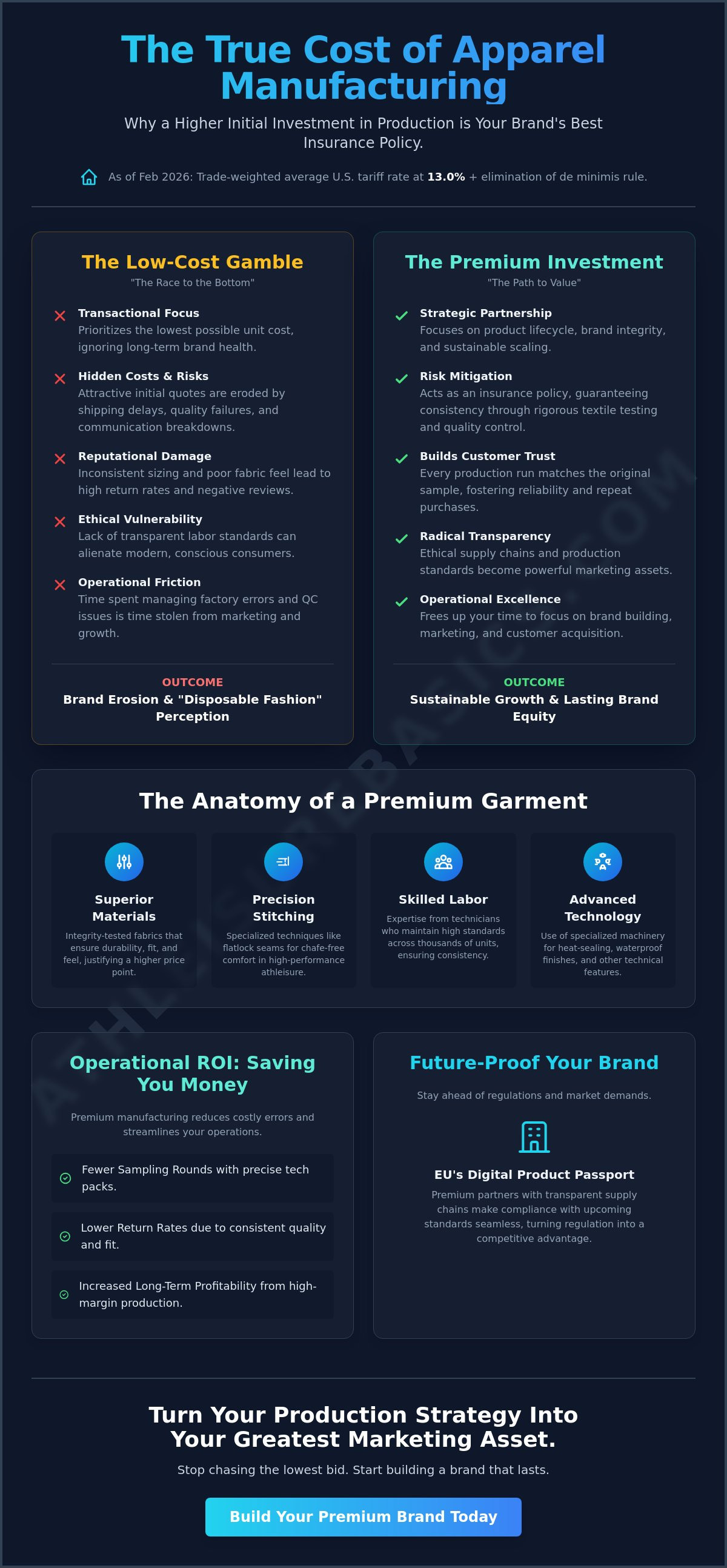
Price signals quality before a customer even touches the fabric. In the competitive apparel market, price isn't just a number; it's the most powerful signal of your brand's intent and positioning. When you understand how to justify premium manufacturing costs, you stop viewing production as a liability and start seeing it as a core marketing asset. Many emerging brands fall into the trap of the "race to the bottom." They prioritize the lowest possible unit cost, assuming that higher margins will automatically follow. However, this approach often destroys long-term brand equity by creating a perception of "disposable" fashion.
The True Cost of 'Cheap' Production
Cheap production is often a gamble with your brand's future. While the initial quote might look attractive, hidden costs frequently erode your margins. Shipping delays, poor communication, and quality control failures can lead to missed seasonal launches and customer dissatisfaction. In 2026, the regulatory environment is stricter than ever. With the elimination of the de minimis rule and rising tariffs, the logistical complexity of managing low-cost, distant hubs has increased significantly. One bad batch that fails to meet your specifications or arrives six weeks late can bankrupt a startup brand's reputation before it even has a chance to scale.
- Reputational Risk: Inconsistent sizing or poor fabric feel leads to high return rates.
- Ethical Vulnerability: Low-cost hubs often lack the transparent labor standards consumers now demand.
- Operational Friction: Time spent managing factory errors is time taken away from marketing and growth.
Premium as a Risk Mitigation Strategy
Investing in premium manufacturing is an insurance policy for your business. Reliable partners ensure consistency by adhering to rigorous textile testing standards during the development phase. This process guarantees that every production run matches the quality of your original sample. You aren't just paying for labor; you're paying for the expertise required to maintain high standards across thousands of units. This consistency is what builds customer trust and drives repeat purchases.
Proximity and transparency have become vital differentiators. This is why many established brands are reshoring their operations to European hubs. Working with clothing manufacturers in Portugal provides a level of craftsmanship and logistical agility that global hubs often lack. These partners offer end-to-end service models that simplify the transition from concept to finished product, allowing you to focus on building a brand that lasts. By choosing quality over cost-cutting, you position your brand as a principled and reliable choice for discerning consumers.
The Anatomy of Quality: What You Are Actually Paying For
Understanding how to justify premium manufacturing costs requires looking beyond the unit price to the technical Bill of Materials (BOM). A premium garment isn't just about the fabric; it's about the precision of the construction. Specialized machinery, such as flatlock stitching machines for chafe-free seams and heat-sealing technology for waterproof finishes, involves higher operational costs. These technical features are non-negotiable for high-performance athleisure. By investing in these processes, you embrace the Cost of Quality (CoQ) framework. This model demonstrates that spending on prevention and appraisal—using the right machines and skilled technicians—dramatically reduces the expensive internal failures found in low-cost alternatives.
Skilled labor in the EU commands a higher wage because it represents a commitment to ethical standards and technical mastery. When brands ask how to justify premium manufacturing costs to their stakeholders, the answer lies in the tangible durability and technical superiority of the finished product. Expert labor ensures that complex designs are executed with a level of precision that cheap, high-volume factories simply cannot replicate. This investment in human capital results in garments that maintain their integrity long after the first wear.
Fabric Integrity and OEKO-TEX® Standards
Certification isn't just a badge; it's a guarantee of safety and performance. While generic polyester may look identical on a screen, it often lacks the breathability and skin-safety of OEKO-TEX® certified textiles. Choosing Portuguese cotton fabric provides a global benchmark for luxury that customers can feel instantly. These materials are engineered to survive 100+ wash cycles without losing shape or pilling. This longevity transforms a simple purchase into a long-term investment for the consumer, justifying the higher retail price through reduced replacement frequency.
Craftsmanship and Technical Expertise
Skilled technicians in premium facilities understand how to manage complex fabric tensions and grain lines. When you opt for Full CMT (Cut, Make, Trim) production, you're hiring experts who oversee every stitch. The garment production process in a premium facility includes multiple quality checkpoints that high-speed factories typically bypass. Expert pattern makers are the unsung heroes here; they minimize fabric waste while ensuring a perfect drape across all sizes. This precision reduces your environmental footprint and ensures that your brand's fit is consistent and reliable. If you're ready to elevate your brand, exploring professional custom clothing manufacturing is the next logical step in your growth journey.
Operational ROI: How Premium Manufacturing Saves You Money
Many entrepreneurs mistakenly prioritize the lowest unit price, ignoring the total financial impact of their production choices. This approach often leads to the "Inventory Trap." Buying 5,000 cheap units might lower your per-item cost on paper, but it ties up massive amounts of capital in unproven stock. If those items don't sell, your brand faces a liquidity crisis. In contrast, producing 250 premium units allows you to test the market with significantly less risk. When you calculate how to justify premium manufacturing costs, you must look at the total outlay rather than just the individual price tag. High-volume, low-quality orders often result in hidden storage fees and aggressive discounting that erodes your brand's perceived value.
Calculating the true landed cost is essential for long-term profitability. Beyond the factory invoice, you must account for freight, insurance, and the current 13.0% average U.S. tariff rate. With the elimination of the de minimis rule in late 2025, every shipment now incurs duties. Premium partners often provide more transparent logistics and shorter lead times, which reduces the capital locked in transit. This speed-to-market is a critical advantage in 2026. It allows your brand to react to emerging trends within weeks rather than months, ensuring you aren't left with outdated styles that require deep markdowns.
Low MOQs and Cash Flow Management
Flexible production volumes are the foundation of a healthy startup. Utilizing private label Portugal services allows you to launch with lean, high-quality collections. This strategy preserves your cash flow for marketing and customer acquisition. Deadstock is the silent killer of fashion ventures. By maintaining lower inventory levels, you eliminate the pressure to liquidate stock at a loss. You can reinvest that saved "inventory capital" into scaling your digital presence or developing your next collection. This iterative approach lowers your entry barrier and builds a more resilient business model.
The Proximity Advantage: Portugal to the World
Logistical agility is a core component of how to justify premium manufacturing costs in a turbulent market. EU-based manufacturing offers faster lead times and a significantly reduced carbon footprint compared to long-haul global shipping. Communication is simpler, and the ability to visit the facility ensures a collaborative relationship. "Made in Europe" isn't just a label; it's a seal of regulatory compliance that simplifies customs procedures. These partners act as consultants, helping you navigate complex 2026 sustainability requirements like the EU’s Digital Product Passport. This proximity reduces operational friction and allows you to focus on the entrepreneurial journey of scaling your brand.
Marketing the Margin: Communicating Value to Your Customers
Your supply chain is no longer a back-end operation; it's your most powerful marketing asset. In a market where 59% of sustainability claims are found to be vague or misleading, providing concrete proof of your production standards builds immediate trust. When you understand how to justify premium manufacturing costs to your audience, you transform a potential price barrier into a compelling reason to buy. Transparency isn't just a trend; it's a requirement in the 2026 trust economy. By sharing the specific details of your production journey, you move the conversation away from "How much does it cost?" to "What does this support?"
Handling "Price Shock" requires a proactive strategy in your customer service and FAQ pages. Instead of being defensive about your retail prices, use these touchpoints to educate. Explain the mathematical reality of "Cost Per Wear" versus "Purchase Price." A premium garment that lasts for years is significantly more economical than a "disposable" alternative that loses its shape after three washes. This educational approach empowers your customers to make informed, principled decisions that align with their own values.
Storytelling Through Ethical Production
The "Made in Portugal" label serves as a recognized seal of quality and ethical integrity. Use your brand narrative to highlight the fair wages and safe working conditions of the technicians who craft your collections. Capturing behind-the-scenes content of the actual manufacturing process creates an authentic connection that stock photos cannot replicate. Showing the faces of the people in the factory and the high standards of the facility provides the transparency that modern consumers, especially Gen Z, demand. This storytelling justifies your margins by proving that your brand values human dignity over aggressive cost-cutting.
Building Brand Equity through Durability
Position your brand as the antidote to fast fashion. By encouraging a "Buy Less, Buy Better" philosophy, you align your business with the growing movement toward circularity and sustainability. The physical "hand-feel" of a premium garment is your best tool for securing repeat customers. When a buyer experiences the weight and texture of high-end craftsmanship, the value proposition becomes self-evident. This tactile proof of quality reduces return rates and builds long-term brand equity. If you're ready to start building a brand based on these high standards, you can explore our production consulting services to align your manufacturing with your marketing goals.
Strategic Selection: Choosing the Right Manufacturing Partner
Selecting a production ally is the final step in understanding how to justify premium manufacturing costs. A vendor simply executes a purchase order. A manufacturing partner, however, invests in your brand's long-term viability. This distinction is critical for emerging entrepreneurs who need more than just a sewing service. True partners offer consulting that helps you refine your tech packs and source materials that align with 2026 sustainability standards. For brands focused on high-performance gear, clothing manufacturers in Portugal represent the global gold standard. This region combines centuries of textile heritage with cutting-edge technical innovation, particularly in seamless and compression technologies.
Evaluating a factory's communication and consulting capabilities is just as important as inspecting their machinery. You need a partner who provides transparency regarding lead times and production thresholds. A reliable partner acts as a dedicated ally, simplifying complex industrial processes so you can focus on scaling your business. Before your first run, ensure your partner can handle full CMT production and sample creation. This ensures that the transition from a small idea to a lasting commercial presence is seamless and secure.
The Athleisurebasics Difference
We've built our reputation on being a knowledgeable collaborator for ambitious brands. Our commitment to premium custom clothing manufacturing means we don't just take orders; we provide a framework for success. We specifically tailor our message to those new to the industry by offering accessible minimum order requirements (MOQs). This allows you to launch luxury blanks or custom designs without the fear of low margins or excessive inventory risk. Our end-to-end service model includes professional materials sourcing support and production consulting, removing the barriers to entry that often stall new ventures.
Next Steps for Your 2026 Collection
Your journey toward a successful launch begins with defining your production goals. Decide whether your brand identity is best served by Custom CMT production or high-end White Label collections. Both paths require a professional Tech Pack development phase to ensure sizing consistency and material integrity. As you finalize your budget, account for the "premium" growth factor. This isn't just an expense. It's a strategic choice that builds higher brand equity and lowers your long-term risk. Use these steps to guide your next move:
- Define your model: Choose between custom development or leveraging luxury blanks for speed.
- Develop your blueprint: Invest in professional tech packs to reduce sampling rounds and waste.
- Verify standards: Ensure your partner meets 2026 ethical and environmental certifications.
- Initiate contact: Start the conversation with a partner who values quality over cost-cutting.
When you prioritize craftsmanship and principled production, you don't have to worry about how to justify premium manufacturing costs to your customers. The quality of the finished product will speak for itself. It's time to move from concept to reality with a partner who shares your high standards.
Build a Resilient Brand for the Future
Choosing quality over cost-cutting is the most significant decision you'll make for your brand's longevity. We've explored how a strategic production partner helps you avoid the inventory trap while building deep customer trust through radical transparency. By shifting your focus from the unit price to the total operational ROI, you understand how to justify premium manufacturing costs as a catalyst for high-margin growth. Your 2026 collection deserves a foundation of integrity. Our facility in Portugal provides the regional advantage of ethical production and technical mastery that discerning customers demand.
We support your growth with OEKO-TEX® Certified Fabrics and accessible low MOQs starting at 70 pieces. This ensures you can scale with confidence and precision without the burden of excessive deadstock. Ready to elevate your brand? Get a custom manufacturing quote today. It's our mission to simplify the transition from concept to finished product. Your journey from a small idea to a lasting commercial presence starts with a single, principled choice. We look forward to building this partnership with you.
Frequently Asked Questions
Why is manufacturing in Europe more expensive than in Asia?
Higher costs in Europe stem from stricter labor laws, fair living wages, and rigorous environmental compliance. Manufacturers must adhere to the EU’s Ecodesign for Sustainable Products Regulation (ESPR), which prohibits destroying unsold goods starting July 2026. These standards ensure ethical production and material integrity. While the initial price is higher, you gain a transparent supply chain that mitigates the risks of modern slavery or toxic chemical usage often found in low-cost hubs.
How do I explain my high prices to customers who are used to fast fashion?
Shift the conversation from the purchase price to the "cost per wear" and garment longevity. Educate your audience on the superior hand-feel and durability of premium textiles that survive 100+ wash cycles. Highlight the fair wages and safe conditions of the artisans involved. Transparency about your manufacturing journey serves as the primary way how to justify premium manufacturing costs to a discerning customer base that values quality over quantity.
Can low minimum order quantities (MOQ) actually save my brand money?
Yes, low MOQs protect your brand from the "Inventory Trap" and the liquidity crises caused by deadstock. Producing 70 premium pieces allows you to test market demand without tying up massive capital in unproven stock. This lean approach reduces storage fees and the need for aggressive discounting. By preserving your cash flow, you can reinvest saved capital into marketing and growth rather than liquidating excess inventory at a loss.
What certifications should I look for in a premium manufacturer?
Look for globally recognized standards like OEKO-TEX® for chemical safety and GOTS 8.0 for organic fibers and social responsibility. By September 2026, bluesign® certified products will also transition to the "bluepass" mark to comply with EU directives. These certifications provide verifiable proof of your brand’s commitment to safety and environmental ethics. They're essential for complying with upcoming regulations like the Digital Product Passport, which requires material traceability for every garment sold.
How does the 'Made in Portugal' label affect my brand's market value?
The "Made in Portugal" label acts as a prestigious seal of quality and ethical craftsmanship. It signals to your customers that the garment was produced in a world-renowned textile hub known for technical innovation and fair labor. This regional origin increases perceived value, allowing you to position your brand alongside luxury leaders. It differentiates your products from mass-market apparel and builds immediate trust in the integrity of the materials used.
Is it better to start with white label or custom manufacturing for a premium brand?
White label manufacturing is often the best entry point for brands looking for speed and lower initial investment. It allows you to launch high-quality luxury blanks while focusing your resources on marketing. Custom manufacturing is ideal once you've established your brand identity and require unique patterns or proprietary fits. Both models are effective strategies for how to justify premium manufacturing costs if the partner maintains high craftsmanship standards.
What are the hidden costs of choosing the cheapest manufacturer?
Hidden costs include high return rates due to inconsistent sizing, shipping delays, and the loss of brand reputation from poor quality. You also face rising logistical expenses; as of February 2026, the trade-weighted average U.S. tariff rate reached 13.0%. The elimination of the de minimis rule means every low-cost shipment now incurs duties and customs fees. These unforeseen expenses often make "cheap" production more expensive than premium alternatives in the long run.
How do lead times impact the profitability of a startup clothing line?
Shorter lead times allow you to react to 2026 fashion trends within weeks, ensuring your stock remains relevant. Long lead times from distant factories tie up your capital for months and increase the risk of receiving outdated styles. Rapid production cycles improve your cash flow by shortening the time between manufacturing and sales. This agility is a competitive advantage that enables you to capture market interest before competitors can even restock.


Leave a comment
This site is protected by hCaptcha and the hCaptcha Privacy Policy and Terms of Service apply.