
How to Convince Your Boss to Manufacture in Portugal: The 2026 Business Case
The lowest per-unit price on your spreadsheet might be the most expensive mistake your brand makes this year. If you're currently struggling with high defect rates and stockouts caused by 120-day lead times, you know that "cheap" production often comes with a hidden, heavy price tag. You're likely feeling the heat from leadership to hit strict sustainability targets while managing the logistical nightmare of distant time zones. It's a common challenge for production managers who want to scale without sacrificing integrity.
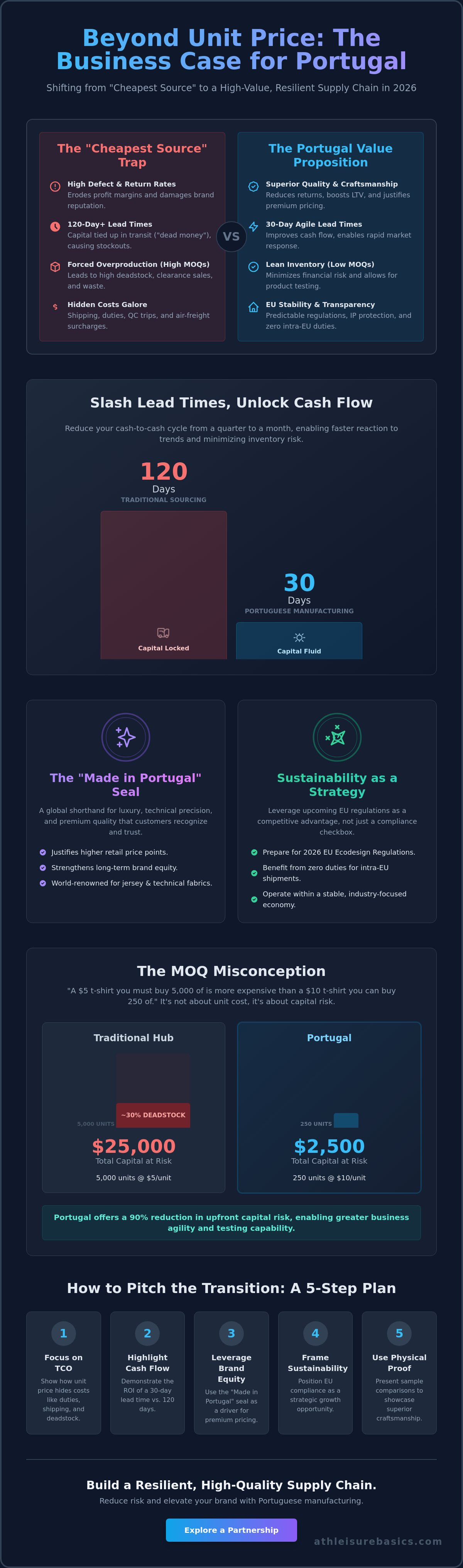
To convince my boss to manufacture in portugal, you need to shift the conversation from simple unit costs to the Total Cost of Ownership. This guide provides a data-driven framework to help you build a winning pitch for Portuguese manufacturing in 2026. We'll show you how to use the new EU Ecodesign for Sustainable Products Regulation as a competitive advantage and demonstrate the ROI of a supply chain that responds in 30 days instead of four months. You'll gain a clear risk-mitigation strategy and the evidence needed to prove that the "Made in Portugal" seal is a powerful driver of brand equity and long-term commercial growth.
Key Takeaways
- Identify the hidden expenses in your current supply chain to prove that a lower per-unit cost often results in a higher Total Cost of Ownership.
- Discover how the "Made in Portugal" seal acts as a premium quality marker that justifies higher retail price points and strengthens brand equity.
- Utilize our data-driven framework to convince my boss to manufacture in portugal by highlighting the cash-flow benefits of reducing lead times to just 4-8 weeks.
- Learn how to leverage upcoming 2026 EU sustainability regulations as a strategic growth tool rather than a simple compliance requirement.
- Follow a structured action plan to build an internal business case, including the use of physical sample comparisons to demonstrate superior technical craftsmanship.
Beyond the Unit Price: Why the "Cheapest Source" Strategy is Failing
The "unit price" is a seductive metric. It looks excellent on a spreadsheet, but it rarely accounts for the full financial reality of modern apparel production. When you look at the total cost of ownership (TCO), the traditional "cheapest source" model often collapses under the weight of logistical friction and capital inefficiency. TCO includes everything from international shipping and import duties to the cost of quality control inspections and air-freight surcharges when things go wrong. To effectively convince my boss to manufacture in portugal, we must look at the capital tied up in transit. Goods sitting on a ship for 12 weeks are effectively dead money. This delay doesn't just hurt cash flow; it increases the risk of stockouts and missed market trends.
The High Price of Low MOQs
Traditional manufacturing hubs often require massive minimum order quantities to maintain their low unit costs. This forces brands into a cycle of overproduction and waste. You might save three dollars per unit, but if 30% of that stock ends up in a clearance bin or sitting in a warehouse as deadstock, your actual cost per sold item skyrockets. "A $5 t-shirt you must buy 5,000 of is more expensive than a $10 t-shirt you can buy 250 of." By utilizing private label Portugal services, brands can maintain leaner inventories and significantly higher sell-through rates. This agility allows you to test new designs without the catastrophic financial risk of bulk over-ordering.
Risk Mitigation in a Volatile Global Market
Supply chain resilience is now a boardroom priority. Geopolitical instability, port strikes, and fluctuating trade tariffs can turn a profitable season into a loss overnight. Portugal offers a sanctuary of stability. As a member of the European Union, the country benefits from predictable trade regulations and zero duties for intra-EU shipments. A quick look at Portugal's economic overview confirms its status as a mature, industry-focused economy with a robust legal framework that protects intellectual property and ensures contract enforcement.
The reliability of the garment production process in the region is unmatched. You aren't just paying for sewing; you're paying for proximity and transparency. When you convince my boss to manufacture in portugal, you're pitching a strategy that eliminates the need for expensive, long-distance quality control trips and reduces the likelihood of high defect rates that often plague distant suppliers. You're trading the illusion of a low price for the reality of a high margin and a more predictable operational workload.
The Quality Advantage: Leveraging the "Made in Portugal" Seal
The "Made in Portugal" label has evolved into a global shorthand for luxury and technical precision. For decision-makers, this isn't just about prestige; it's about building a product that survives the scrutiny of a discerning customer base. Just as premium luggage brand ALEON uses aerospace-grade aluminum to define high-end durability, Portuguese manufacturers use advanced techniques to set the gold standard for apparel. By choosing a partner in the Portuguese cluster, you're investing in a legacy of craftsmanship that naturally reduces return rates and boosts customer lifetime value (LTV). When you attempt to convince my boss to manufacture in portugal, focus on the "quality premium" that allows for higher retail price points and significantly lower post-purchase friction.
Technical Excellence in Athleisure
Portuguese factories are world-renowned for their expertise in jersey, complex knits, and technical fabrics. This regional specialization is reflected in Portugal's manufacturing sector performance, which consistently demonstrates high-value output in the textile industry. Premium brands gravitate toward this hub because of the precision in flatlock stitching and finishing techniques that cheaper alternatives simply cannot replicate. Understanding the fundamental textile innovations in the region, such as high-stretch recovery and moisture-wicking properties, is essential for any brand aiming for the luxury-performance market. The technical gear produced here doesn't just look better; it performs better under industrial-grade testing.
Compliance and Ethical Certification
Modern consumers demand transparency and ethical accountability. Portugal provides a safe harbor through strict EU labor law compliance, acting as a shield against potential PR scandals associated with unethical production in less regulated regions. Certifications like OEKO-TEX® Standard 100 and GOTS are standard practice in many Portuguese facilities, ensuring that every garment is free from harmful substances and produced under fair conditions. These aren't just badges. They are evidence of a principled supply chain that prioritizes material integrity over short-term savings. If you need help evaluating these standards for your next collection, our production consulting services can help simplify the transition. This level of transparency is a powerful tool to convince my boss to manufacture in portugal, as it mitigates long-term brand risk and aligns with the ESG goals of modern corporations.
Speed to Market: How Portugal Shortens Your Cash-to-Cash Cycle
Speed is no longer just a luxury; it's a fundamental requirement for staying competitive. Traditional sourcing models in Asia typically demand lead times of 12 to 16 weeks. When you factor in shipping delays and port congestion, your capital can be locked away for nearly half a year. In contrast, Portuguese manufacturing offers a streamlined timeline of 4 to 8 weeks. This drastic reduction allows your brand to operate with in-season reactivity. Instead of guessing what will sell six months in advance, you can respond to real-time data and reorder bestsellers while the trend is still peaking. To effectively convince my boss to manufacture in portugal, you must highlight how this speed impacts the bottom line by freeing up liquid capital.
Logistics and Proximity
Proximity changes everything for a production manager. The ease of visiting clothing manufacturers Portugal means you can oversee final samples or troubleshoot production issues in person within a single day of travel. This cultural and geographic closeness eliminates the friction of opposite time zones and long-distance communication barriers. Shorter shipping routes also provide a dual benefit. They significantly reduce your brand's carbon footprint and eliminate the need for expensive air-freight surcharges often required to meet deadlines when sea freight from Asia falls behind. Logistics between the EU and the US or UK are remarkably simple, with predictable customs procedures and established transit corridors.
Inventory Agility and Cash Flow
In the context of apparel, the cash-to-cash cycle represents the duration between the moment you pay your supplier for production and the moment your customer completes their purchase. A shorter cycle means your money works harder and faster. By opting for smaller, more frequent drops rather than one massive seasonal shipment, you keep your inventory fresh and your warehouse costs low. This agility is the key to 2026 business resilience.
| Metric | Asia Sourcing | Portugal Sourcing |
|---|---|---|
| Production Lead Time | 12-16 Weeks | 4-8 Weeks |
| Transit Time (to EU/UK) | 4-6 Weeks | 3-7 Days |
| Inventory Risk | High (Bulk MOQs) | Low (Flexible Batches) |
| Cash-to-Cash Cycle | 150+ Days | 50-70 Days |
Reducing the time your capital is tied up in transit allows for more aggressive reinvestment into marketing or new product development. When you convince my boss to manufacture in portugal, you're pitching a strategy that prioritizes financial health and operational flexibility over the outdated pursuit of the lowest possible unit cost.
Sustainability as a Revenue Driver, Not a Cost Center
Sustainability isn't a corporate charity project; it's a fundamental market requirement that drives top-line growth. Modern consumers are increasingly willing to pay a premium for products that prove ethical origins and environmental responsibility. Highlighting this shift in consumer behavior is a powerful way to convince my boss to manufacture in portugal. By 2026, the EU Ecodesign for Sustainable Products Regulation (ESPR) requires brands to provide verifiable data on product durability and traceability. Choosing made in portugal clothing ensures your brand is compliant with these strict standards before they become a barrier to market entry.
Portuguese textile mills are global leaders in green energy adoption. With the national goal of generating 80% of electricity from renewable sources by 2030, production in this region offers a verified defense against greenwashing claims. This isn't just about ethics; it's about protecting the brand from the legal and reputational risks associated with less transparent supply chains. You aren't just buying a garment; you're buying a documented, low-carbon production history that resonates with today's principled shopper.
Transparency and Traceability
Modern shoppers frequently ask, "Who made my clothes?" and they expect an immediate, honest answer. Portuguese manufacturing provides the high-level documentation needed for the 2026 Digital Product Passport (DPP) requirements, making transparency a core marketing asset rather than a back-end burden. It's significantly easier to obtain social audit reports and material certifications from a factory in the Porto region than from a multi-tiered supply chain in a distant, less regulated hub. This level of openness builds deep trust with your audience and simplifies your annual ESG reporting.
The Durability Factor
Quality is the most effective form of sustainability. Garments that don't lose their shape or pill after three washes reduce the overall environmental footprint and build intense brand loyalty. This alignment with the "Slow Fashion" movement creates a product that lasts, which justifies a higher retail price and increases customer lifetime value. When you manufacture in a hub known for material integrity, you're investing in the longevity of the garment and the reputation of your brand. If you're ready to transition to a more principled production model, contact our consulting team to build your 2026 sustainability roadmap.
How to Pitch the Transition: A Step-by-Step Action Plan
Moving from a strategic concept to operational reality requires a structured presentation. To successfully convince my boss to manufacture in portugal, you must frame the transition as a solution to existing frustrations rather than a disruptive change. Start by identifying a specific, recent production failure. Whether it was a three-week shipping delay that caused a stockout or a high defect rate in the last bulk order, use concrete data to highlight the cost of the status quo. This anchors your proposal in risk mitigation rather than just a preference for quality.
Nothing communicates quality faster than a physical comparison. Prepare a "Sample Comparison" session where you place a current production piece next to a Portuguese-made sample. Point out the precision in the stitching, the superior hand-feel of the technical fabric, and the consistency of the finishing. Visual and tactile evidence often bypasses budget objections by demonstrating immediate value that justifies the shift. Don't propose an overnight flip of your entire supply chain. Instead, suggest a "Pilot Run" for a single high-performing category. This reduces perceived risk and allows leadership to see the speed-to-market advantages firsthand.
The CFO-Ready Spreadsheet
Your pitch needs a financial backbone that speaks to the bottom line. Create a comparison model that focuses on the Total Cost of Ownership (TCO) framework discussed earlier in this guide. Ensure your data includes:
- Landed costs including shipping and current import duties.
- The cost of capital saved by reducing lead times from 16 weeks to 6 weeks.
- The "Discounted Revenue" saved by avoiding the overstock typical of high-MOQ suppliers.
- A reduction in quality control travel expenses and third-party inspection fees.
Use a clear, business-focused email subject line to secure the initial meeting, such as: "Proposal: Reducing Supply Chain Risk and Improving Cash Flow for 2026."
Finding the Right Partner
The easiest way to prove the concept is through a white label clothing run. This allows you to test the market with premium, pre-developed styles before moving into full custom CMT production. We offer accessible entry points with MOQs ranging from 70 to 250 pieces, which is the perfect scale for a low-risk pilot program. This small-scale start provides the concrete proof of concept needed to convince my boss to manufacture in portugal for larger, more complex collections in the future. It demonstrates operational agility without requiring a massive upfront investment.
Ready to build your business case? Book a consultation to get your comparison data and start your transition to a more resilient, high-standard supply chain today.
Secure Your Brand’s Strategic Future in Portugal
Transitioning your supply chain is a calculated investment in brand longevity. You've seen how the Total Cost of Ownership framework reveals the hidden expenses of distant, low-cost hubs. By prioritizing speed to market and the prestige of European craftsmanship, you align your business with the regulatory and consumer demands of 2026. These data-driven insights provide the professional leverage you need to convince my boss to manufacture in portugal while mitigating operational risk and improving your cash-to-cash cycle.
We're ready to act as your dedicated ally in this journey. Our team specializes in premium athleisure and streetwear, providing high-end construction with OEKO-TEX® certified fabrics. We remove traditional barriers to entry by offering accessible low MOQs starting at just 70 pieces. Partner with Athleisurebasics for your first Portuguese production run and experience the ease of a transparent, high-standard partnership. It's time to trade the uncertainty of long lead times for the reliability of a world-class manufacturing hub. Your brand's next level of growth starts here.
Frequently Asked Questions
Is manufacturing in Portugal really more expensive than China?
While per-unit labor costs are higher, the Total Cost of Ownership is often lower when you factor in reduced duties, lower shipping fees, and fewer quality rejects. Portugal's proximity to major European and North American markets eliminates many of the hidden logistics costs associated with Asian sourcing. Presenting this comprehensive financial reality is the most effective way to convince my boss to manufacture in portugal during annual budget reviews.
What are the typical MOQs for Portuguese clothing factories?
Typical minimum order quantities range from 300 to 500 pieces per style, though specialized workshops may accept as few as 50 units. Our own production models are designed for operational agility, supporting volumes between 70 and 250 pieces. This flexibility allows brands to test new technical collections without the burden of excessive inventory or the risk of tied-up capital.
How long does shipping take from Portugal to the UK or USA?
Shipping to the UK typically takes 3 to 7 days by road, while transit to the USA generally ranges from 7 to 14 days via air or sea freight. These timelines are significantly faster than the 4 to 6 weeks required for sea freight from major Asian hubs. Reduced transit times mean your brand can restock bestsellers in a fraction of the usual time, preventing costly stockouts.
What certifications should I look for in a Portuguese manufacturer?
Prioritize manufacturers with OEKO-TEX® Standard 100, GOTS (Global Organic Textile Standard), and GRS (Global Recycled Standard) certifications. These labels provide essential third-party verification of material safety and ethical production. As the EU transposes the Pay Transparency Directive in 2026, working with compliant European factories also ensures your brand meets emerging legal requirements for supply chain accountability.
Can I visit the factories in Portugal easily?
Yes, the concentrated textile hubs in Northern Portugal, including Porto, Braga, and Guimarães, are highly accessible for international visitors. Most major production facilities are within a 60-minute drive of Porto International Airport. This geographic density allows your team to conduct in-person quality checks and technical reviews without the logistical strain or high cost of long-haul travel. For professionals who wish to extend their European business trip into a leisure experience, custom Greece travel itineraries offer a perfect way to explore the broader Mediterranean region.
Does Portugal offer sustainable and recycled fabric options?
Portugal is a global leader in sustainable textile innovation, offering a wide array of recycled cotton, polyester, and organic fibers. Local mills invest heavily in closed-loop water systems and renewable energy to support "Green Textile" initiatives. These material choices help your brand comply with the 2026 Ecodesign for Sustainable Products Regulation and meet the demands of eco-conscious consumers.
How do I handle quality control when manufacturing in Portugal?
Quality control is handled through a combination of standardized sampling processes and rigorous in-factory inspections. Because the local manufacturing culture emphasizes high-end craftsmanship, defect rates are typically much lower than in high-volume global hubs. You can also utilize our production consulting services to manage the entire oversight process, from initial tech pack development to final shipment delivery.
Is Portugal better for startups or established brands?
Portugal serves both startups and established brands by offering scalable production models and high-quality standards. Startups benefit from accessible MOQs and expert guidance, while established brands leverage the region's technical expertise for premium streetwear and athleisure collections. It's an ideal hub for any business aiming to convince my boss to manufacture in portugal based on long-term brand equity and supply chain resilience.


Leave a comment
This site is protected by hCaptcha and the hCaptcha Privacy Policy and Terms of Service apply.