
The Ultimate Apparel Quality Assurance Checklist for Premium Brands in 2026
In 2026, a single production oversight is no longer just a minor defect; it is a direct risk to your brand's regulatory compliance and retail reputation. You understand that maintaining premium standards requires more than just a visual check. It demands a rigorous apparel quality assurance checklist that aligns with the latest global standards, such as the ISO 2859-1:2026 updates for sampling and the early adoption of GOTS 8.0 traceability requirements. High return rates and inconsistent stitching shouldn't be the price you pay for scaling your business.
It is frustrating to feel like you lack the technical leverage to hold factories accountable for fabric performance. You deserve a production process that feels like a reliable partnership, especially when working with high-end Portuguese manufacturing. This article provides the professional framework you need to secure your supply chain and lower defect rates. You will learn the exact technical standards and inspection steps required to ensure every garment meets premium retail expectations. We will cover everything from tech pack development to final pre-shipment inspections, giving you the tools to scale your operations with total confidence.
Key Takeaways
- Distinguish between proactive quality assurance and reactive quality control to prevent defects before they impact your bottom line.
- Identify the three critical stages of inspection, from the initial Pre-Production meeting to In-Line monitoring of the first 20% of your run.
- Implement a technical apparel quality assurance checklist to audit fabric integrity and ensure every garment matches the precise measurements in your tech pack.
- Utilize AQL tables and defect classification systems to establish clear, professional benchmarks for factory accountability.
- Leverage premium manufacturing standards and certified materials to maintain consistency across every production batch as your brand scales.
Why an Apparel Quality Assurance Checklist is Your Brand’s Insurance Policy
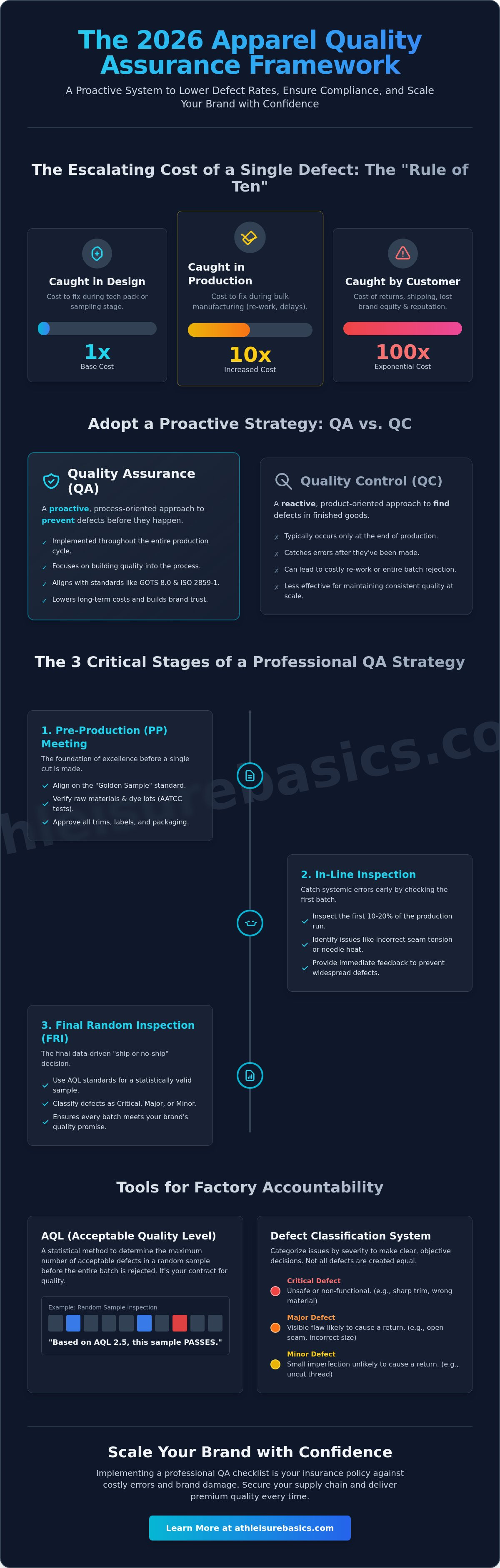
Quality in the apparel industry is often misunderstood as a final inspection. However, true excellence is built through proactive systems rather than reactive corrections. Implementing a rigorous apparel quality assurance checklist acts as your brand’s first line of defense, shifting the focus from catching errors to preventing them entirely. While many new entrepreneurs confuse Quality Assurance (QA) with Quality Control (QC), the distinction is vital for your bottom line. QC is the reactive process of inspecting finished goods to find defects. In contrast, QA involves the systematic implementation of quality assurance principles throughout the production cycle to ensure those defects never occur.
The financial logic for this proactive approach is best summarized by the "Rule of Ten." In manufacturing, a defect caught during the design or sampling stage costs ten times less to fix than one discovered during bulk production. If that same defect reaches your customer, the cost can escalate to 100 times the original correction price when you factor in shipping, returns, and lost brand equity. High-end brands rely on these standards to protect their customer lifetime value (CLV). When a garment arrives exactly as promised, you reduce the logistical burden of returns and build the trust necessary for repeat purchases.
The Real Cost of Poor Quality in 2026
The modern retail environment is unforgiving. In 2026, social media "de-influencing" trends mean that a single batch of poorly constructed leggings can go viral for the wrong reasons, damaging a startup's reputation before it can scale. Beyond the digital risk, there is a significant environmental cost. Defective garments that cannot be sold often end up in landfills, directly contradicting the sustainability goals that premium customers now demand. Premium brands cannot operate with the high defect tolerances common in fast fashion. You need a professional framework to ensure your production remains ethical, efficient, and consistent.
Setting the Standard: The Tech Pack as Your Contract
A professional apparel quality assurance checklist is only as effective as the data supporting it. This process begins long before the sewing machines start, requiring a deep understanding of how to create a tech pack for clothing. Your tech pack serves as the technical foundation for every inspection. By defining specific measurements and strict tolerances, which is the allowed margin of error for a seam or hem, you remove ambiguity from the production floor. The Tech Pack is the ultimate blueprint that holds both the brand and the factory accountable for the physical reality of the garment.
The Three Stages of a Professional Apparel QA Strategy
A successful apparel quality assurance checklist requires a structured timeline to be effective. It's not enough to look at garments once they're already in shipping boxes. You need a strategy that monitors quality from the initial thread to the final carton. These stages are integrated directly into the garment production process to ensure total transparency and minimize the risk of systemic errors.
The Pre-Production (PP) Meeting is the first critical gate. During this phase, you and your factory partner align on the "Golden Sample." This sample represents the absolute standard for bulk production. Once production begins, the In-Line Inspection takes place. By checking the first 10-20% of the run, you can identify issues like incorrect seam tension or needle heat damage before they affect the entire batch. Finally, the Final Random Inspection (FRI) uses AQL (Acceptable Quality Level) standards to provide a statistically significant "ship or no-ship" decision based on your specific defect tolerances.
Pre-Production: The Foundation of Excellence
Verification of raw materials and dye lots is a technical necessity. Professional manufacturers often reference AATCC test methods to validate fabric performance, such as shrinkage and colorfastness, before the first cut is made. This stage also includes approving trims and ensuring that all care, size, and brand labels meet the strict regulations of your target market. A "Sealed Sample" must remain at the factory as a physical reference point to resolve any potential disputes during the bulk run.
During and Post-Production: Maintaining Consistency
During-Production (Du-Pro) checks focus on the structural integrity of the garment. Inspectors verify seam strength and stitch density while the items are still on the line, allowing for immediate machine adjustments if necessary. As production concludes, the role of the packing list becomes central to ensuring that the correct size breakdowns and quantities reach your warehouse. Manufacturers specializing in made in Portugal clothing often maintain high internal benchmarks, which provides an extra layer of security for premium brands. If you're looking to refine your current oversight, our production consulting services can help you establish these professional benchmarks.
The Ultimate Apparel Quality Assurance Checklist for 2026
Executing a technical apparel quality assurance checklist is the only way to move from a design concept to a premium retail product. This list ensures that the "Golden Sample" approved during your pre-production meeting is replicated exactly across your entire bulk run. Quality isn't just the absence of holes. It is the presence of excellence in every stitch, seam, and fiber. To maintain luxury standards, your inspection must be granular and data-driven.
A professional inspection covers five core categories of garment integrity:
- Fabric Integrity: Inspect for shading (color consistency across panels), pilling, and specific textile defects like slubs, holes, or skewed weaves.
- Measurement Accuracy: Verify every point of measure against the size chart and tolerances defined in your tech pack.
- Construction & Workmanship: Evaluate the hand-feel and ensure the structural integrity matches high-end craftsmanship expectations.
- Functional Testing: Confirm that zippers glide smoothly, buttons are securely attached, and drawstrings perform under stress without fraying.
- Aesthetics & Branding: Check that logo placement is precise, embroidery tension is balanced, and prints show no signs of cracking or peeling.
Technical Athleisure Specifics
Performance wear requires specialized oversight that generic checklists often ignore. You must verify stretch and recovery to ensure the fabric returns to its original shape after being pulled. Seam elasticity is also critical. Reference AATCC testing standards to confirm that flatlock or overlock stitches don't "pop" when the garment is under tension. For bottoms, the "squat test" is a mandatory check to ensure the fabric maintains total opacity and doesn't become sheer when stretched over the hips or knees.
Finishing and Packaging Standards
The final presentation is what defines your brand's perceived value. Your apparel quality assurance checklist must include a strict thread-trimming requirement. No loose threads longer than 3mm should remain on the garment. Pressing must be uniform, with no visible iron marks, scorches, or improper folding lines. In 2026, premium brands must also verify that their sustainability claims are physically met. This involves checking that compostable polybags or recycled packaging materials are used exactly as specified in the production contract. These final details prevent "de-influencing" risks and ensure your product arrives in showroom condition.
How to Implement Your Checklist with Your Factory Partner
Implementing an apparel quality assurance checklist requires a shared technical language between your brand and your production partner. This framework is built on the Acceptance Quality Limit (AQL), specifically the updated ISO 2859-1:2026 standard. AQL tables provide the statistical boundaries needed to decide if a production lot is acceptable or requires rejection. For premium brands, the standard threshold is typically 2.5% for major defects and 4.0% for minor defects. For critical defects involving safety or legal compliance, the tolerance is usually 0%.
To use this system effectively, you must categorize errors using a Defect Classification system. Critical defects include safety hazards like broken needles or the presence of restricted substances. Major defects are functional or visible errors, such as a hole or a garment measuring outside of the tech pack tolerances, which would result in a customer return. Minor defects are small aesthetic issues that don't impact the garment's usability. When a batch fails inspection, your communication should stay focused on these data points. Professional clothing manufacturers in Portugal value this level of technical detail because it removes emotional bias from the quality discussion and fosters a true partnership.
Choosing Between Self-Inspection and Third-Party Audits
Deciding who conducts the inspection depends on your production volume and proximity to the facility. For startups, flying to the factory for a final check provides invaluable hands-on experience. However, as you scale, hiring a local third-party agency is often more efficient. You can also conduct remote "video inspections" with your production manager to review top-of-production samples in real time. Working with factories that maintain their own internal QA departments provides an extra layer of security, as they often catch systemic errors before an external auditor even arrives.
Negotiating Corrective Action Plans (CAP)
When an inspection reveals that defects exceed your AQL limits, you must initiate a Corrective Action Plan (CAP). This plan outlines whether the factory will perform a 100% re-inspection, rework the defective items, or provide replacements. It is essential to set a clear timeline for a "re-inspection" once the factory claims the errors are fixed. You should always include a "right to reject" clause in your initial manufacturing agreement to protect your brand from paying for sub-standard goods. If you need help establishing these professional boundaries, our production consulting services can guide you through the negotiation process.
Scaling with Confidence: The Athleisurebasics Quality Promise
Success in the premium apparel market is built on consistency. At Athleisurebasics, we integrate every step of your apparel quality assurance checklist directly into our CMT (Cut, Make, Trim) production line in Portugal. We don't view quality as a final hurdle. Instead, it's a continuous thread that runs from initial material sourcing to the moment your garments are packed for shipping. This integrated approach allows emerging brands to scale without the fear of systemic defects or batch inconsistencies.
Why Portugal is the Global Standard for Premium QA
Portugal has earned its reputation as a global leader in high-end textile manufacturing through a unique blend of heritage craftsmanship and modern industrial efficiency. Choosing clothing manufacturers in Portugal gives your brand a significant advantage in quality oversight. The regional focus on ethical production and strict EU labor protections ensures a stable, skilled workforce that takes pride in every seam. Our proximity to major European markets also reduces shipping risks and allows for faster quality interventions if adjustments are needed during the production cycle. Ethical manufacturing isn't just a checkbox; it's a powerful narrative that builds lasting consumer trust.
Our facility prioritizes chemical safety and material integrity. We utilize OEKO-TEX® certified materials to ensure your products pass the most rigorous safety checks, including the tightened 2026 limits for Bisphenols and other restricted substances. We believe that high-end standards should be accessible to growing ventures. This is why our low minimum order quantities (MOQs) start at just 70 units for white label clothing. You receive the same precision and oversight as a large-scale luxury run, regardless of your current volume.
Start Your Journey with a Reliable Partner
We support startups by removing the technical barriers to entry. From professional tech pack development to expert materials sourcing support, we ensure your quality framework is robust from day one. We treat manufacturing as a long-term partnership rather than a simple transaction. Whether you are launching with our luxury blanks or building a unique vision through custom manufacturing, we provide the industrial expertise you need to succeed. Your growth is our primary objective. Request a production quote or consulting session with Athleisurebasics today to secure your brand's future.
Secure Your Brand’s Future Through Technical Excellence
Proactive quality management is the only reliable way to safeguard your reputation in a high-stakes retail market. By mastering the three stages of inspection and utilizing a technical apparel quality assurance checklist, you eliminate the risks associated with systemic defects and high return rates. You now have the professional framework required to hold production partners accountable and ensure every batch meets premium expectations.
Success comes from choosing a collaborator that understands these industrial nuances. Athleisurebasics combines Portuguese manufacturing heritage with rigorous modern standards to protect your commercial interests. We provide OEKO-TEX® certified fabrics, accessible low MOQs for premium startups, and expert production consulting to guide your journey from concept to finished product.
Partner with a manufacturer that prioritises your brand’s quality. Contact Athleisurebasics today.
It's time to transition from a small idea to a lasting commercial presence with total confidence in your supply chain. We are ready to help you scale.
Frequently Asked Questions
What is the most common defect in apparel manufacturing?
Untrimmed threads and open seams are the most frequent defects found during final inspections. While loose threads are often categorized as minor issues, they significantly impact the perceived value of a premium garment. Material-related defects, such as shading or color variation between different fabric panels, are also common and often require a 100% inspection of the affected batch.
How do I calculate the AQL for my clothing order?
You calculate your AQL by using the ISO 2859-1:2026 tables to cross-reference your total order quantity with your chosen inspection level. First, identify your lot size to find the corresponding sample size code letter. This letter tells you exactly how many garments to pull for a statistically valid check. You then use the AQL limit, typically 2.5 for major defects, to determine the maximum number of errors allowed before the batch is rejected.
Can I perform a quality check remotely if my factory is in Portugal?
Yes, you can manage your apparel quality assurance checklist remotely through high-definition video inspections and digital reporting. Many professional facilities in Portugal have internal QA departments that provide live feeds and detailed photo documentation of the "Du-Pro" and final stages. This transparency allows you to verify seam tension and fabric hand-feel without the need for international travel.
What is the difference between a major and a minor defect?
A major defect is a failure that makes the garment unsellable or likely to be returned by a customer, such as a broken zipper or a measurement outside of tolerance. A minor defect is a slight departure from the standard that does not affect the garment's function or overall appearance, such as a single skipped stitch in a non-visible area. Critical defects, like a broken needle fragment, result in an immediate fail for the entire lot.
How much does a third-party apparel inspection typically cost?
Third-party inspection costs are generally calculated based on a "man-day" rate, which covers the time an inspector spends at the factory. These rates depend on the geographic location of the facility and the complexity of the apparel quality assurance checklist being performed. You should also factor in travel expenses if the factory is located in a remote manufacturing hub.
What should be included in a pre-production sample check?
A pre-production check must verify that all raw materials, dye lots, and trims match the approved tech pack. It's the final opportunity to confirm that care labels meet the specific legal requirements of your target market before bulk cutting begins. This stage ensures that the factory has the correct "Golden Sample" on-site to serve as the physical reference for the entire production run.
How does a tech pack help with quality assurance?
The tech pack serves as the definitive technical contract between your brand and the manufacturer. It provides the exact measurements, stitch types, and material specifications used to audit the production line. Without a comprehensive tech pack, an inspector has no objective benchmark to determine if a garment is defective or meets your premium standards.
What are the specific QA requirements for OEKO-TEX certified garments?
OEKO-TEX Standard 100 requirements for 2026 include strict limit values for substances like Bisphenols, which are now capped at 200 mg/kg. To maintain certification, every component of the garment, including threads, buttons, and linings, must be tested for harmful chemicals. Additionally, all wet processes within the supply chain must be certified to ensure the product meets the latest environmental and safety regulations.


Leave a comment
This site is protected by hCaptcha and the hCaptcha Privacy Policy and Terms of Service apply.