
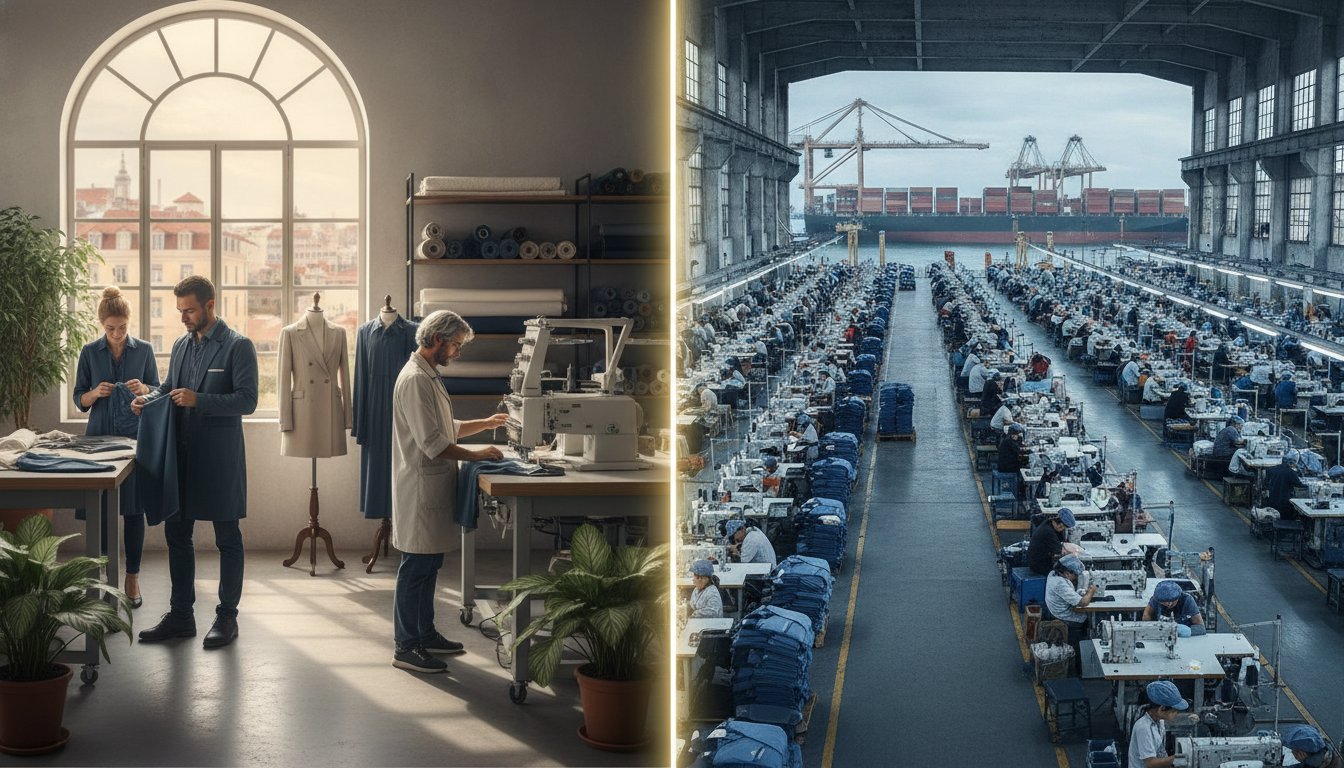
Portugal vs China Clothing Manufacturing: The 2026 Guide for Emerging Brands
Choosing China to save money might actually be the most expensive mistake your emerging brand makes in 2026. While the per-unit price in Asia looks attractive on a spreadsheet, the "China Discount" has largely vanished for smaller labels. When evaluating portugal vs china clothing manufacturing, you have to look beyond the initial factory quote. High U.S. tariffs of up to 35% and sea freight lead times that can exceed 100 days often leave your capital trapped in transit while market trends pass you by.
You probably started your brand to create something premium and ethical, yet you're likely tired of managing quality issues from thousands of miles away. It's frustrating to see your cash flow locked in massive inventory blocks before you've even proven the demand. This guide provides a clear comparison of the Total Landed Cost, lead times, and craftsmanship standards of both regions. You'll discover how Portugal’s lower minimum order quantities and 1.5% defect rates can actually yield a higher return on investment than high-volume Chinese production. We'll explore the logistics, ethical certifications, and agility you need to build a resilient, premium brand this year.
Key Takeaways
- Learn why "Total Landed Cost" is the only metric that matters for your margins. This figure accounts for the tariffs and shipping that often erode the initial savings of overseas production.
- Understand the strategic shift in portugal vs china clothing manufacturing for 2026. Low MOQs and proximity to market now provide a higher ROI for emerging labels.
- Discover the technical precision required for premium athleisure. Portuguese material standards help justify a higher retail price point for your brand.
- Use our step-by-step decision framework to audit your capital and "speed to market" needs. This helps determine the ideal manufacturing hub for your current growth stage.
- Identify how flexible production models protect your cash flow. Avoid trapping your capital in massive inventory runs that don't match market demand.
The Manufacturing Landscape in 2026: Why the Portugal vs China Debate has Shifted
Global supply chains have undergone a fundamental transformation. Emerging brands no longer view distant, high-volume hubs as the default choice. Instead, they're prioritizing regional agility and ethical security. While China maintains its dominance in the global textile export rankings, the strategic calculation for portugal vs china clothing manufacturing has shifted. In 2026, the decision hinges on mitigating geopolitical risk and meeting new sustainability reporting requirements that demand total transparency.
The End of the 'Cheap China' Era
Manufacturing wages in Chinese coastal hubs have climbed significantly. This narrows the historical cost gap that once made Asia the only viable option. Beyond labor, the hidden multipliers of Asian production are becoming harder to ignore. U.S. tariffs on Chinese apparel have reached 35%, while EU duties remain at 12%. These costs, combined with rising energy prices and strict environmental compliance mandates, mean the "cheap" unit price is often an illusion. Additionally, high-volume factories in Asia are increasingly deprioritizing smaller orders. If you aren't ordering tens of thousands of units, you risk being pushed to the back of the production queue, missing critical seasonal windows.
The Rise of the Portuguese Textile Powerhouse
Portugal has emerged as the premier hub for brands that prioritize technical precision and craftsmanship. The country's "fabrica textil" ecosystem is highly integrated. Spinning, knitting, and finishing often occur within the same regional cluster. This proximity allows for tighter quality control and a much lower carbon footprint. For brands targeting the EU market, road shipping from Portugal takes only 3 to 5 days. This speed is essential for maintaining high standards and ensuring your latest collection reaches customers while demand is peaking.
Capital Velocity is a core concept for 2026. It measures how quickly you can convert your cash into inventory and then back into revenue. A lower unit price in China is irrelevant if your capital is trapped in a shipping container for 100 days. By choosing Portuguese manufacturing, you benefit from lower minimum order requirements. This keeps your cash flow liquid. It allows you to respond to market trends in real time without the risk of overstocking. The "Made in Europe" label isn't just a marketing asset; it's a structural advantage for brand scaling. Consumers now actively look for ethical origins, and Portugal provides the documentation to prove it.
This approach is particularly effective for luxury streetwear labels like Ex Club, where limited-edition releases depend on the high-end craftsmanship and ethical transparency that European manufacturing provides.
Calculating the Real Cost: Unit Price vs. Total Landed Cost
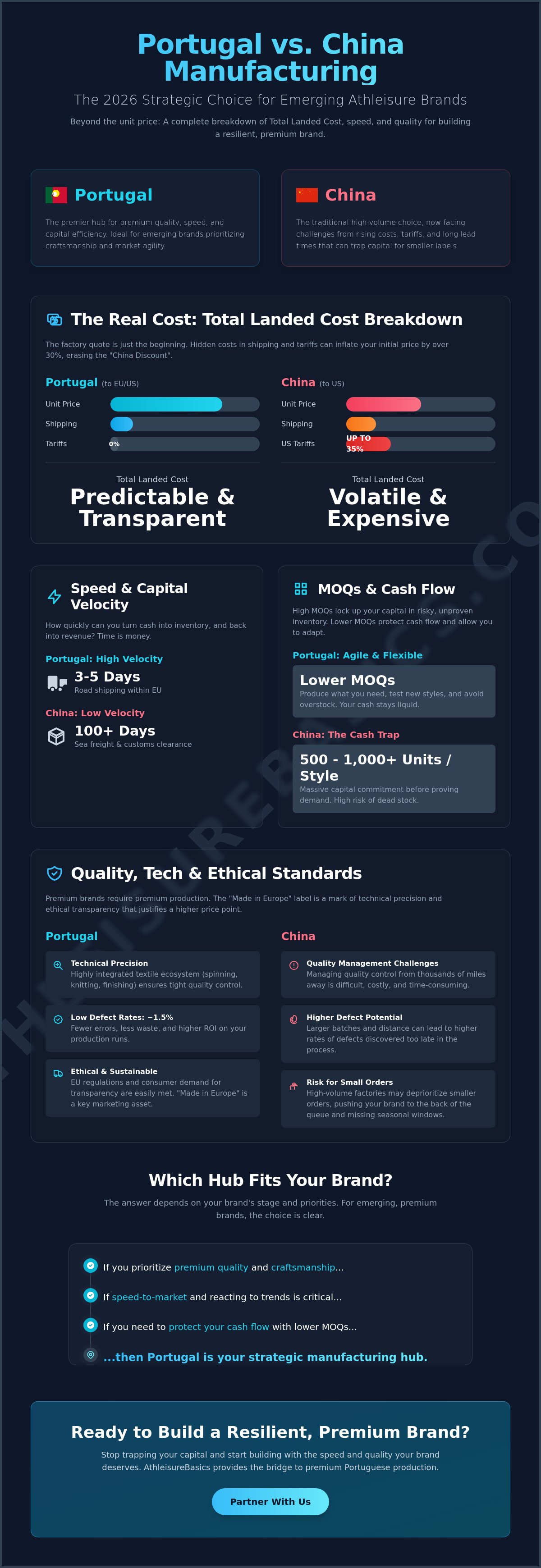
Many brand owners focus solely on the factory gate price. This is a dangerous oversight. When comparing portugal vs china clothing manufacturing, the only number that dictates your success is the Total Landed Cost. This includes the unit price, shipping, insurance, customs duties, and local transport. According to World Trade Organization data, the complexities of international merchandise trade can add 30% or more to your initial quote. For a startup, these hidden multipliers aren't just line items; they're margin killers.
Shipping, Duties, and the 2026 Tariff Reality
Importing from China into the EU currently carries an average 12% duty. If you're shipping to the U.S., tariffs on Chinese apparel are as high as 35%. Conversely, Portuguese manufacturing benefits from the EU Customs Union, meaning zero duties for trade within member states. Beyond the tax, you must factor in freight. Ocean freight from Shanghai to Rotterdam reached approximately $3,200 per 40-foot container in early 2026. When you add the administrative cost of clearing customs and third-party quality inspections, the "cheap" Asian unit price often evaporates.
The Cash Flow Trap: MOQs and Capital Lock-up
The biggest risk for an emerging brand isn't a high unit price; it's dead stock. The strategic choice between portugal vs china clothing manufacturing often comes down to how much risk you can tolerate. Chinese factories typically require MOQs of 500 to 1,000 units per style. If you pay $5 for a hoodie but have to buy 1,000 units, you've just locked up $5,000 in a single design. If that trend fades or the fit isn't perfect, that capital is gone. Portugal offers a more agile alternative with MOQs often between 50 and 200 units. This allows for data-driven production runs. You can test the market, gather feedback, and restock quickly. It's about Capital Velocity. Your money stays in your bank account, not in a shipping container for 10 weeks. If you're ready to escape the MOQ trap, exploring clothing production consulting services can help you map out a leaner supply chain.
Quality control is another hidden cost. A 5% to 8% defect rate in mass-tier Chinese production requires expensive third-party inspections. Portuguese factories report much lower defect rates, often around 1.5%. You spend less on oversight and more on growth. This reliability justifies the slightly higher initial unit cost, as it protects your brand reputation from the start. High standards in the factory mean fewer returns in your warehouse.
Quality, Tech, and Ethics: The Athleisure Manufacturing Standard
Athleisure demands a level of technical precision that standard streetwear doesn't. When you're designing garments that must withstand high-intensity movement, the choice between portugal vs china clothing manufacturing becomes a question of engineering. Performance apparel requires four-way stretch fabrics, moisture-wicking properties, and specialized flatlock stitching to prevent chafing. While mass-market textiles are abundant in Asia, Portuguese factories have carved out a niche in high-end technical knitwear. They utilize advanced machinery specifically designed for the complexities of modern activewear.
The sourcing of these materials is also evolving. A recent global textile supply chain analysis from the University of Delaware highlights that while China remains a dominant raw material supplier, the value-added finishing of high-performance garments is shifting. Portugal’s localized ecosystem means that fabric development and garment construction often happen in the same region. This proximity allows for faster sampling and more accurate fit iterations. You can receive a prototype, test its performance, and send feedback within days, rather than waiting weeks for international air freight.
Technical Construction and Performance Fabrics
Ensuring color consistency and fabric durability across multiple production runs is a common pain point for emerging brands. Portuguese manufacturers excel in small-batch technical innovation, offering access to premium synthetics and organic cotton blends that maintain their shape after repeated washing. They often use specialized machinery for seamless construction and compression zones. This technical edge is difficult to replicate in the high-volume, low-cost environments of mass-tier Asian production where speed often takes precedence over precision.
Certifications and Sustainable Credentials
Modern consumers don't just buy a product; they buy the story behind it. The "Ethics Gap" has become a significant differentiator in the market. In 2026, transparency isn't optional. Portuguese factories operate under strict EU labor laws and environmental regulations, providing a level of security that is harder to verify from a distance. Certifications like OEKO-TEX® and GOTS are standard in the region, ensuring that your garments are free from harmful chemicals and produced under fair conditions.
Building a brand on these principles allows you to justify a premium retail price. Choosing Made in Portugal clothing acts as a shorthand for quality and ethical integrity. It tells your customers that your supply chain is clean, your workers are respected, and your fabrics are safe. This trust is a foundational asset for any brand aiming for long-term growth in the premium athleisure sector. When you prioritize these standards, you aren't just making clothes; you're building a reputable brand identity.
Decision Framework: Which Manufacturing Hub Fits Your Brand Stage?
The right manufacturing partner depends on where your brand stands today. There's no one-size-fits-all answer in the portugal vs china clothing manufacturing debate. Instead, your choice should align with your current financial health and long-term brand identity. Before signing a production contract, you must evaluate five critical pillars of your business model.
- Audit your current capital: Determine how much cash you can afford to lock up in a single run. If you can't survive a $10,000 inventory mistake, China's high MOQs represent a significant risk.
- Define your 'Speed to Market': Identify if you're following fast-moving trends or building a permanent collection. Trend-driven brands require the agility that only nearshoring can provide.
- Evaluate brand DNA: Decide if 'Premium' or 'Ethical' origins are central to your marketing. If your customers expect European craftsmanship, a 'Made in China' label may dilute your value proposition.
- Analyze design complexity: Determine if you need custom technical patterns or simple white label blanks. High-performance athleisure often requires the specialized machinery found in Portuguese technical hubs.
- Calculate risk tolerance: Assess if you can handle a 12-week delay. Communication gaps and long lead times can be devastating for a startup with limited seasonal windows.
When China Still Makes Sense
China remains a powerful option for brands with high-volume, 'evergreen' basics. If your designs don't change for years and you have established global distribution outside of Europe, the high MOQs become manageable. It is also the primary hub for highly specialized hardware, such as custom plastic zippers or rare synthetic blends that aren't yet common in European mills. For brands that have reached a massive scale where a $0.50 saving per unit equals thousands in profit, the Asian mass-market model is still difficult to beat.
Why Startups and Premium Brands Choose Portugal
Emerging labels often adopt the 'Agile Brand' model. This strategy prioritizes small batches and frequent drops to minimize waste and maximize cash flow. Experienced clothing manufacturers in Portugal are built for this journey. They provide the flexibility to scale from 50 units to 500 as your demand grows. Working within similar time zones also eliminates the 12-hour communication lag. This allows for real-time problem solving and faster sampling cycles. If you're ready to build a leaner, more responsive supply chain, we invite you to explore our custom solutions at athleisurebasics.com.
Partnering with Athleisurebasics: The Bridge to Premium Production
Transitioning your production is a strategic move that requires a reliable partner. We understand that the choice between portugal vs china clothing manufacturing isn't just about geography; it's about finding a collaborator who respects your brand's growth stage. Athleisurebasics serves as a dedicated ally for emerging labels, offering the high-end craftsmanship of Portugal without the prohibitive barriers of traditional mass-market factories. We've structured our services to remove the risks associated with distant, high-volume production, ensuring your capital remains focused on growth rather than sitting in a warehouse.
Our Lisbon-based consulting team helps you navigate the complexities of the industry. We bridge the gap between your initial design concepts and a shelf-ready product. By providing localized expertise and materials sourcing support, we ensure that your brand meets the high ethical and quality standards that 2026 consumers demand. Whether you're scaling an existing line or launching your first collection, our end-to-end service model is designed to simplify the industrial process.
Custom vs. White Label: Finding Your Entry Point
We offer two distinct pathways to help you enter the market with confidence. Each is tailored to different levels of design complexity and capital availability:
- Custom Manufacturing: This service is ideal for brands with unique garment production process needs. If you've developed proprietary patterns or require specific technical features, our custom CMT production supports runs starting at 250 units.
- White Label Clothing: For brands that need to launch quickly, our white label service provides access to luxury blanks with low MOQs of just 70 units. This allows you to test the market with premium essentials in a matter of weeks.
- Sourcing Support: We identify the best OEKO-TEX® certified textiles for your specific niche, ensuring your garments offer the durability and performance your customers expect.
The Athleisurebasics Advantage
Working with us means you get direct access to premium Portuguese craftsmanship without the 'big factory' gatekeeping. We prioritize transparency in our pricing and production consulting, giving you a clear view of your costs before you commit to a run. Our commitment to ethical production isn't just a marketing claim; it's a core part of our identity. We use regional manufacturing as a quality seal, positioning your brand in favorable contrast to global competitors who prioritize cost-cutting over integrity. It's time to move beyond the uncertainty of portugal vs china clothing manufacturing and start building a lasting commercial presence. Start your premium production journey with Athleisurebasics today.
Secure Your Brand’s Future with Strategic Sourcing
Building a successful label in 2026 requires more than just a great design; it demands a supply chain that protects your capital and reputation. The debate between portugal vs china clothing manufacturing has moved beyond simple unit prices. Success now hinges on Total Landed Cost, speed to market, and the ethical transparency that modern consumers expect. By prioritizing nearshoring, you eliminate the risks of massive inventory blocks and long-distance quality issues that often derail emerging labels.
Choosing a partner that understands the startup journey is essential for scaling without the typical industrial gatekeeping. Athleisurebasics provides the infrastructure you need to transition from a concept to a commercial presence with confidence. We utilize OEKO-TEX® Certified Fabrics and Premium Portuguese Craftsmanship to ensure your garments justify a premium price point. With low 70-unit MOQs for White Label, you can test new collections without trapping your cash flow in ocean freight or dead stock.
Launch your premium athleisure brand with Athleisurebasics today. We're here to help you navigate every step of the production process and turn your vision into a lasting reality. Your journey toward a resilient and ethical brand starts with a single strategic choice.
Frequently Asked Questions
Is it really more expensive to manufacture in Portugal than China?
No, not when you calculate the Total Landed Cost rather than just the factory gate price. While the initial unit cost is higher in Europe, the absence of EU import duties and lower shipping fees narrows the gap significantly. When evaluating portugal vs china clothing manufacturing, you must factor in the 12% to 35% tariffs and high minimum order requirements that often make Asian production more capital-intensive for emerging brands.
What are the typical lead times for clothing production in Portugal?
Total lead times from a Portuguese factory to an EU warehouse average 29 to 54 days. This provides a 6 to 8 week advantage over Chinese production, which typically requires 68 to 107 days. Road transport within the EU takes only 3 to 5 days. This speed allows your brand to remain agile and restock successful styles while consumer demand is still peaking.
Do I need a tech pack to start manufacturing in Portugal?
Yes, a comprehensive tech pack is essential for custom manufacturing to ensure precision and quality. It serves as the definitive blueprint for your garment, detailing measurements, seam types, and material specifications. If you don't have one ready, we offer tech pack development and clothing production consulting services to help you transition from a design concept to a production-ready file.
What is the minimum order quantity (MOQ) for Portuguese factories?
MOQs in Portugal are designed for accessibility, typically ranging from 50 to 200 units per style. This is a primary differentiator in the portugal vs china clothing manufacturing debate, as Chinese factories often demand 500 to 1,000 units. Lower MOQs protect your cash flow and prevent your capital from being trapped in massive inventory blocks before you've proven market demand.
How do I handle shipping and customs when manufacturing in the EU?
Shipping within the EU is highly efficient because there are no customs duties or complex import declarations between member states. Goods move freely across borders, which eliminates the administrative burden and surprise clearing fees associated with international trade. We handle the logistics coordination from our Portuguese hubs to ensure your finished product reaches your warehouse without the delays common in cross-continental shipping.
Can I manufacture sustainable clothing more easily in Portugal?
Yes, Portugal has one of the highest densities of certified sustainable factories in the world. Approximately 42% of vetted Portuguese manufacturers hold both GOTS and OEKO-TEX Standard 100 certifications. Strict EU labor laws and environmental regulations provide built-in transparency. This makes it much easier to verify your supply chain's ethical standards compared to mass-tier production hubs in Asia.
What happens if there is a quality issue with my production run?
Portuguese factories report a low defect rate of approximately 1.5%, which is significantly better than the 5% to 8% often seen in mass-tier production. Because we act as your dedicated ally, any issues are identified during our rigorous quality control phase. Proximity and aligned time zones allow us to resolve discrepancies quickly, ensuring your brand reputation remains protected with every shipment.
Do Portuguese manufacturers help with fabric sourcing?
Yes, we provide specialized materials sourcing support to help you find the right textiles for your brand. The Portuguese "fabrica textil" ecosystem is highly integrated, giving us direct access to premium knitwear, technical synthetics, and luxury cotton blends. We ensure all sourced materials meet your specific performance requirements and hold the necessary environmental certifications to justify your premium retail price point.


Leave a comment
This site is protected by hCaptcha and the hCaptcha Privacy Policy and Terms of Service apply.