
Why European Manufacturing is Better for Clothing Brands in 2026
The traditional race to the bottom on per-unit costs is officially obsolete for premium apparel brands. While sourcing from distant hubs once seemed like the only way to scale, the landscape in 2026 has shifted dramatically due to new EU customs duties on small parcels and strict Ecodesign regulations. You've likely felt the frustration of capital tied up in massive minimum orders or the stress of 120-day lead times that result in stockouts before your collection even arrives. Understanding why european manufacturing is better isn't just about geography; it's about reclaiming control over your supply chain and protecting your margins from hidden logistics fees.
We recognize that the transition to regional production can feel like a significant shift, but agility is now your greatest competitive advantage. This article will show you why moving your production to Europe is the ultimate strategic move for brands seeking uncompromising quality, ethical transparency, and rapid speed to market. We'll explore how you can lower inventory risk through smaller batches, leverage the "Made in Europe" label to justify premium pricing, and navigate the new Digital Product Passport requirements with a reliable production partner.
Key Takeaways
- Shift your focus from simple per-unit costs to Total Cost of Ownership to uncover the hidden financial benefits of regional production.
- Leverage the "Made in Europe" label as a powerful marketing tool that communicates ethical integrity and premium craftsmanship to your customers.
- Discover why european manufacturing is better for reducing inventory risk by utilizing agile batch production and accessible minimum order quantities.
- Master the criteria for evaluating production partners, focusing on transparent communication and technical proficiency to ensure seamless scalability.
- Explore how Portugal’s specialized textile infrastructure provides a strategic launchpad for emerging premium athleisure brands.
Beyond the Unit Price: The Strategic Value of European Manufacturing
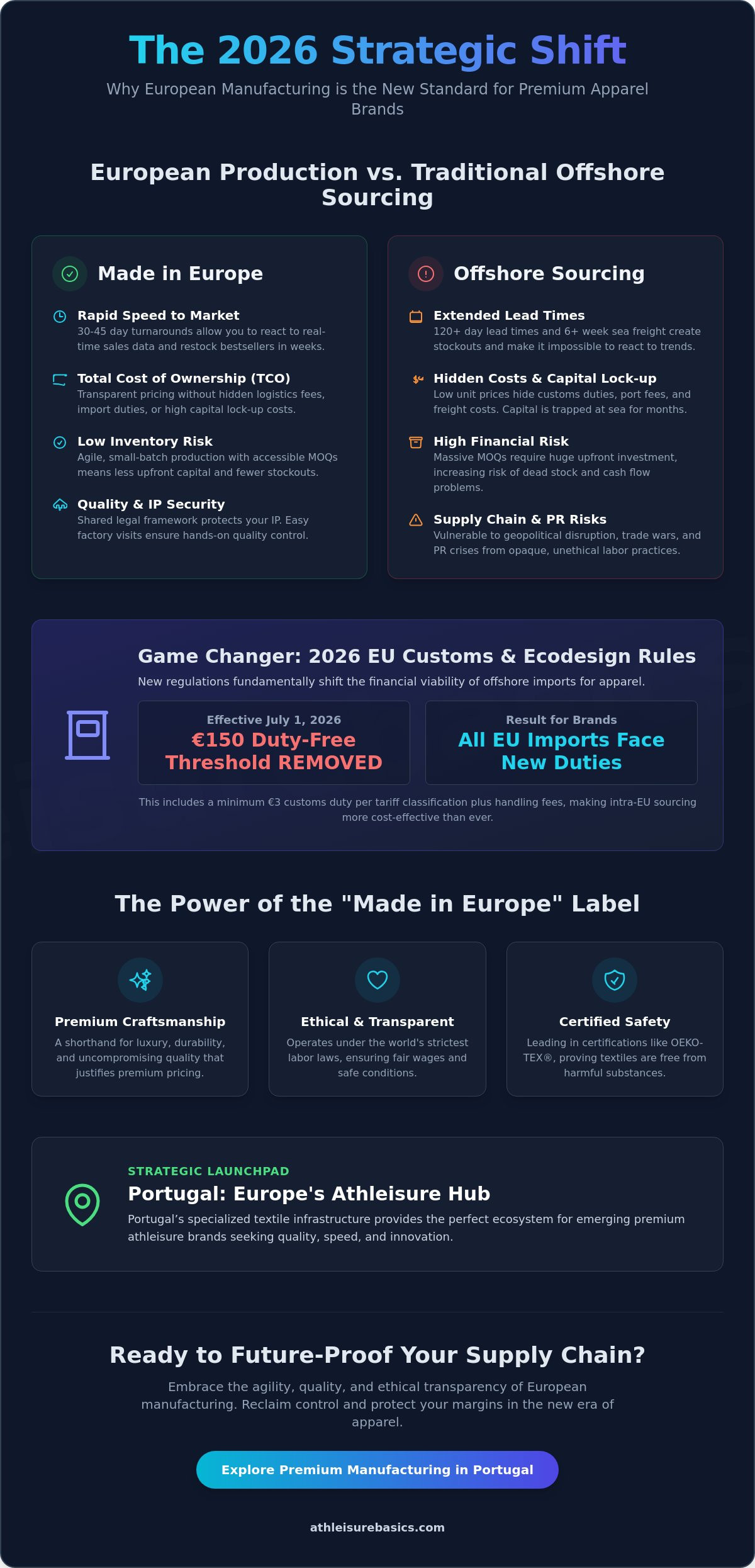
For many emerging brands, the low per-unit price offered by offshore factories is a siren song. It looks excellent on a spreadsheet, but it often hides the true cost of doing business. In 2026, the high-proximity model is the new standard for premium labels. This approach prioritizes geographic closeness over theoretical savings. Understanding why european manufacturing is better requires looking past the initial invoice and analyzing the Total Cost of Ownership (TCO).
TCO accounts for every expense from the initial design phase to the moment a customer receives their package. When you factor in logistics, duties, and the cost of capital, the price gap between Europe and distant hubs narrows significantly. The 2026 regulatory environment has shifted the math even further. As of July 1, 2026, the EU has eliminated the €150 duty-free threshold for imports. This means even small shipments from outside the bloc now face a minimum customs duty of €3 per tariff classification, plus additional handling fees. Shipping within the EU avoids these financial hurdles entirely.
There is also the "Agility Premium" to consider. In a market driven by trends and social proof, speed is your greatest asset. European partners typically offer 30 to 45 day turnarounds. This allows you to restock bestsellers in weeks, not months. You don't have to guess what will be popular half a year in advance. You can react to real-time sales data instead.
The Hidden Costs of Offshore Production
Offshore production often involves a choice between slow sea freight or prohibitively expensive air freight. Sea freight can leave your inventory sitting on a boat for six weeks or longer. This creates a "Capital Lock-up" problem. You've already paid for 1,000 units, but you can't sell them yet. Your liquidity is trapped at sea. European road transport is predictable and efficient. It reduces the time between production and profit. You also avoid the administrative burden of complex customs declarations and the risk of unexpected port delays.
Risk Mitigation in the 2026 Market
The textile industry in the European Union operates under a shared legal framework that provides security for your brand. Geopolitical stability protects your supply chain from sudden disruptions or trade wars. Contract enforcement is straightforward, and your intellectual property is respected. Proximity also simplifies quality control. A factory visit is a short train ride or flight away. This allows for hands-on collaboration and ensures your high standards are met at every stage of the process. Building a partnership with a nearby manufacturer creates a level of transparency that distant suppliers simply cannot match.
Quality Seals and Ethical Integrity: Why 'Made in Europe' Wins
In 2026, consumers don't just buy a product; they buy the values behind it. The "Made in Europe" label has evolved into a shorthand for luxury, durability, and ethical responsibility. This is a core reason why european manufacturing is better for brands that target high-end market segments. While global competitors often struggle with opaque supply chains, European factories operate under some of the world's most stringent labor laws. These regulations guarantee fair wages, safe working conditions, and the absolute prohibition of forced labor. For Gen Z and Alpha consumers, this level of transparency is a non-negotiable requirement. By producing locally, you eliminate the PR risks associated with unethical labor and build a foundation of genuine brand loyalty.
The Power of OEKO-TEX® and Environmental Standards
Certifications like OEKO-TEX® Standard 100 are essential for brands that prioritize consumer safety. This label proves that every component of the garment, from the thread to the buttons, has been tested for harmful substances. European manufacturers lead the way in these standards, often exceeding the EU's official sustainability and circularity goals. Many factories in the region have invested heavily in closed-loop water recycling and low-impact textile dyeing technologies. These aren't just ethical choices; they're powerful marketing assets. Achieving premium garment manufacturing requires these rigorous certifications to ensure your products meet the highest environmental benchmarks in 2026.
Craftsmanship and Technical Expertise
Europe’s textile heritage provides a competitive advantage that is difficult to replicate. Regional clusters, particularly in Portugal, have spent decades refining their technical knowledge. This expertise is vital for high-performance apparel. These factories utilize specialized machinery designed for complex construction, such as flatlock stitching and seamless technology. These techniques are essential for comfort and durability in modern athleisure. Expert material sourcing support also helps you select fabrics that won't pill, stretch out, or lose their shape after a few washes. This focus on longevity is exactly why european manufacturing is better for brands that want to build a lasting reputation for quality. When you partner with a factory that understands the nuances of fabric behavior, you reduce the risk of returns and improve customer satisfaction. If you're ready to elevate your standards, collaborating with a European partner is the most effective way to ensure your brand's integrity remains uncompromised.
Speed to Market: The Competitive Edge of Low MOQs
The era of overproduction is ending. In 2026, the most successful premium brands are moving away from the "Mass Production" mindset. Instead, they're adopting an "Agile Batch" approach. This strategy prioritizes flexibility over volume. It's a fundamental reason why european manufacturing is better for startups and scaling labels. By producing smaller quantities, you avoid the trap of dead stock and heavy discounts that erode brand value.
An "Inventory Lean" model allows you to keep less stock on hand while turning it over much faster. This aligns perfectly with the 2026 trend of "Micro-Collections" and frequent seasonal drops. Rather than launching two massive collections per year, brands now release smaller, curated capsules every few weeks. This strategy keeps your storefront fresh and your audience engaged without requiring a massive upfront investment in warehouse space.
Why 70 vs. 1,000 Pieces Matters for Your Cash Flow
Consider the financial impact of your production volume. If you order 1,000 units from an offshore factory, you're locking up a significant amount of capital in a single style. If that design doesn't resonate with your audience, your business faces a critical financial risk. Contrast this with a 70-piece run through private label Portugal services. You can test the market, gather real-time customer feedback, and pivot your next batch based on what actually sells. This lower entry barrier is essential for protecting your cash flow during the early stages of growth.
Reducing Lead Times from Months to Weeks
Logistics play a decisive role in your ability to compete. Ocean freight from Asia can take 90 to 120 days, leaving you vulnerable to sudden market shifts. In contrast, European road transport delivers finished goods in a fraction of that time. This speed allows you to react to viral trends or unexpected demand spikes almost instantly. You don't have to predict what will be popular four months from now; you can produce what is popular today.
The current landscape of European manufacturing skills and challenges shows that "Nearshoring" has become the dominant supply chain strategy for 2026. By keeping production closer to your primary market, you reduce the complexity of your operations. This proximity is exactly why european manufacturing is better for brands that value responsiveness. You aren't just buying clothes; you're buying the ability to stay relevant in a fast-moving digital economy. This agility ensures that your capital is always working for you, rather than sitting idle in a shipping container.
Evaluating Your Partner: What to Look for in an EU Factory
Choosing a production partner is the most critical decision a brand owner will make. It's not just about finding a facility with sewing machines; it's about establishing a strategic alliance. This vetting process is where the practical reality of why european manufacturing is better becomes clear. A successful partnership rests on three core pillars: transparent communication, verifiable ethical standards, and the ability to scale as your brand grows. You need a collaborator who treats your technical designs with the same respect you do.
Technical proficiency is a non-negotiable requirement. A factory's ability to interpret and execute a detailed Tech Pack is often the difference between a successful launch and a costly mistake. Your Tech Pack is the blueprint for your brand's quality. If a potential partner cannot demonstrate a high level of proficiency in translating these documents into physical garments, they're not the right fit. You should also prioritize factories that insist on a rigorous sampling phase. Never skip the prototype stage. Sampling allows you to test fit, fabric performance, and construction quality before committing to a full production run.
Communication and Cultural Alignment
Working with a partner in a similar time zone offers an immediate logistical advantage. Real-time problem solving prevents minor issues from escalating into weeks of delay. Shared business values also lead to fewer errors throughout the garment production process. You can assess a factory's responsiveness right from the start. Pay attention to how quickly they answer your initial inquiry and how transparently they explain their lead times and minimums. A reliable partner will be upfront about their capabilities and limitations.
Full CMT vs. White Label Services
Your choice between production models depends on your design resources and timeline. Cut, Make, Trim (CMT) is the ideal choice for brands with unique, highly technical designs that require custom patterns. If you need to launch a collection in under 30 days, white label services allow you to apply your branding to pre-developed, premium-quality silhouettes. Regardless of the model you choose, clothing manufacturers in Portugal are widely considered the gold standard. They offer the technical skill required for complex athleisure while maintaining the ethical transparency modern consumers demand. This combination of skill and integrity is why european manufacturing is better for brands that refuse to compromise. If you're ready to secure a production partner that values your success, contact our consulting team to discuss your next collection.
Scaling with Athleisurebasics: Premium Portuguese Manufacturing
Athleisurebasics positions itself as a dedicated ally for emerging brands transitioning from initial concept to market presence. We simplify complex industrial processes so you can focus on building your community and refining your brand identity. While some industry analysts suggest that larger nations like France or Spain are the only viable locations, Portugal remains the undisputed global hub for high-end jersey and technical performance apparel. This specialized regional focus is a primary reason why european manufacturing is better for labels that demand technical precision and tactile quality. We don't just execute orders; we provide end-to-end production consulting to ensure your creative vision translates into a commercial reality that lasts.
By choosing a partner in the Portuguese textile cluster, you gain access to an ecosystem where traditional craftsmanship meets modern innovation. This synergy allows for the production of complex athleisure garments that require specialized machinery and expert handling. We treat our relationship with you as a long-term collaboration rather than a simple transaction. Our goal is to mitigate your risks while maximizing the premium appeal of your collections. We understand the challenges of the 2026 market and have built our services to provide the security and capability you need to scale with confidence.
The 'Made in Portugal' Quality Seal
A made in Portugal clothing label is one of the most effective marketing assets for a premium brand in 2026. It signals a commitment to craftsmanship that resonates with increasingly conscious global audiences. Our Lisbon-based team ensures that every garment adheres to strict ethical labor standards and utilizes OEKO-TEX® certified fabrics. This dedication to material integrity protects your brand from the quality inconsistencies and environmental concerns often found in mass-market hubs. We prioritize transparency and security, providing you with a supply chain you can proudly share with your customers as part of your brand story.
Custom Solutions for Every Growth Stage
We've designed our service model to support you at every stage of your brand's lifecycle. If you're looking to launch or test a new market segment quickly, our luxury blanks and white label options require a minimum of only 70 pieces. This low entry barrier allows you to maintain liquidity while offering high-end products to your early adopters. For brands ready to introduce unique silhouettes, our full CMT production starts at a manageable 250 units. We provide comprehensive support in tech pack development and materials sourcing to remove technical barriers to entry. This tailored flexibility is why european manufacturing is better for ambitious founders who need to scale operations without overextending their capital.
Take the next step in your brand's development. Get a custom apparel manufacturing quote today and see how a Portuguese partnership can transform your production cycle from a logistical hurdle into a powerful competitive advantage.
Future-Proof Your Brand with European Production
Transitioning to a regional supply chain is a strategic pivot that addresses the logistical and ethical demands of the modern market. You've seen how reducing lead times and prioritizing Total Cost of Ownership can safeguard your margins against rising import duties and shipping delays. By embracing the agile batch model, you can test designs with minimal risk and respond to consumer trends in weeks rather than months. Understanding why european manufacturing is better provides the foundation for building a premium brand that values transparency and uncompromising quality.
Athleisurebasics is ready to serve as your dedicated production partner. We operate from the heart of Portugal's textile industry, offering the technical expertise required for high-performance apparel. Our commitment to excellence includes the use of OEKO-TEX® certified fabrics and accessible minimum order requirements. We offer MOQs as low as 70 pieces for white label collections to ensure your capital remains fluid. Whether you're launching your first capsule or scaling operations, we provide the consulting and support necessary for your long-term success. Partner with Athleisurebasics for your next collection and take control of your brand's future today.
Frequently Asked Questions
Is European manufacturing really more expensive than Asian manufacturing?
European manufacturing is often more cost-effective when you analyze the Total Cost of Ownership rather than just the per-unit price. While initial production costs may be higher, you save significantly on logistics, duties, and administrative fees. As of July 1, 2026, the EU has eliminated the €150 duty-free threshold for imports, adding at least €3 per tariff classification to non-EU shipments. These additional costs demonstrate why european manufacturing is better for maintaining healthy margins.
What are the minimum order quantities (MOQs) for European clothing factories?
Minimum order quantities in Europe are designed to support brand agility and reduce inventory risk. For white label clothing and luxury blanks, MOQs can be as low as 70 pieces per style. Custom designs requiring full CMT production typically start around 250 pieces. These accessible thresholds allow emerging brands to launch collections without tying up excessive capital in unsold stock. This flexibility is a key reason why european manufacturing is better for startups seeking to scale sustainably.
How long does it take to produce a clothing collection in Europe?
Production timelines in Europe are significantly shorter than those associated with offshore manufacturing hubs. Most European factories offer turnaround times between 30 and 45 days for finished garments. This speed is possible because of regional proximity and efficient road transport logistics. Faster production cycles allow your brand to react to real-time market demand and viral trends, ensuring your collections remain relevant while minimizing the risk of stockouts or overproduction.
What does 'Made in Portugal' mean for my brand's reputation?
A 'Made in Portugal' label serves as a powerful quality seal that justifies premium pricing and builds consumer trust. It signals to your audience that your garments are produced in a world-renowned textile cluster known for technical expertise and ethical integrity. Portugal is particularly famous for its high-end jersey and performance fabrics. This regional origin helps your brand stand out by demonstrating a commitment to superior craftsmanship and fair labor standards.
Can I visit the factory in Europe before starting production?
Yes, visiting your production partner is highly encouraged and much easier due to geographic proximity. Most European manufacturers maintain an open-door policy for their brand partners to facilitate quality control and build long-term relationships. These visits allow you to inspect the working conditions, verify technical capabilities, and meet the team handling your collection. This transparency is a fundamental advantage of the European model, providing you with peace of mind and greater supply chain control.
What certifications should I look for in an ethical European manufacturer?
You should prioritize manufacturers with recognized environmental and safety certifications, such as OEKO-TEX® Standard 100. This ensures that every component of your garment is free from harmful substances. Additionally, check for compliance with the EU's Ecodesign for Sustainable Products Regulation (ESPR), which takes effect for textiles on July 19, 2026. These certifications provide verifiable proof of your brand's ethical claims, helping you avoid greenwashing penalties and meet the transparency demands of modern consumers.
How do I handle shipping and duties when manufacturing in the EU?
Shipping within the European Union is straightforward and avoids the complex customs declarations required for non-EU imports. When your goods move between EU member states, you don't face the new €3 customs duties or the €2 handling fees implemented in 2026 for low-value parcels. Most factories coordinate with reliable road freight partners to deliver your stock directly to your warehouse. This logistical simplicity reduces administrative burdens and eliminates the risk of unexpected port delays.
Do European manufacturers help with fabric sourcing and tech packs?
Professional European manufacturers often provide comprehensive consulting services that go beyond simple sewing. This includes materials sourcing support to find high-quality, certified fabrics and technical assistance with tech pack development. Partnering with a factory that offers these end-to-end solutions ensures that your designs are optimized for production from the start. This collaborative approach reduces errors during the sampling phase and helps you move from initial concept to finished product with greater efficiency.


Leave a comment
This site is protected by hCaptcha and the hCaptcha Privacy Policy and Terms of Service apply.