
Scaling Clothing Production from Small Batch: The 2026 Growth Guide
What if your biggest hurdle to growth isn't a lack of customers, but the inability to fulfill their orders without draining your bank account? You've likely spent the last year validating your designs, but scaling clothing production from small batch is the only way to move from a passion project to a sustainable business. It's frustrating when high unit costs consume up to 45% of your profit margins. We know the stress of dealing with inconsistent quality from local seamstresses or facing stockouts that drive customers to competitors. You want to grow, but the fear of over-ordering and ending up with dead stock is a real barrier to your progress.
This guide provides the roadmap for transitioning into a high-volume, profitable operation. You'll learn how to move toward factory-grade production without sacrificing the premium craftsmanship that defines your brand. We'll cover strategies to lower your per-unit costs, establish reliable lead times for your 2026 seasonal launches, and leverage the ethical standards of European manufacturing. We'll show you how to build a reliable supply chain that supports your vision from logo to legacy.
Key Takeaways
- Discover how to move beyond the validation phase and solve the "small batch paradox" to unlock higher profit margins in 2026.
- Learn the essential technical shifts required for factory-grade production, including the transition from basic sketches to professional tech packs and wholesale material sourcing.
- Master the financial math of scaling clothing production from small batch by understanding how to balance MOQs with unit costs for maximum efficiency.
- Follow a proven five-stage roadmap to audit your best-sellers and create wear-tested, production-ready samples that ensure quality at any volume.
- Explore the strategic advantages of ethical manufacturing in Portugal and how a "partner-first" approach helps you build a lasting brand legacy.
The Small Batch Paradox: Why Scaling Your Clothing Production is Necessary for 2026
Small batch production serves as the essential validation phase for any emerging fashion label. It allows founders to test designs and gauge market interest without a massive capital outlay. However, many brands fall into a trap where they stay micro-sized for too long. This creates a paradox: while starting small reduces upfront risk, staying small eventually kills profitability. High unit costs and manual labor requirements prevent a brand from generating the margins needed for reinvestment.
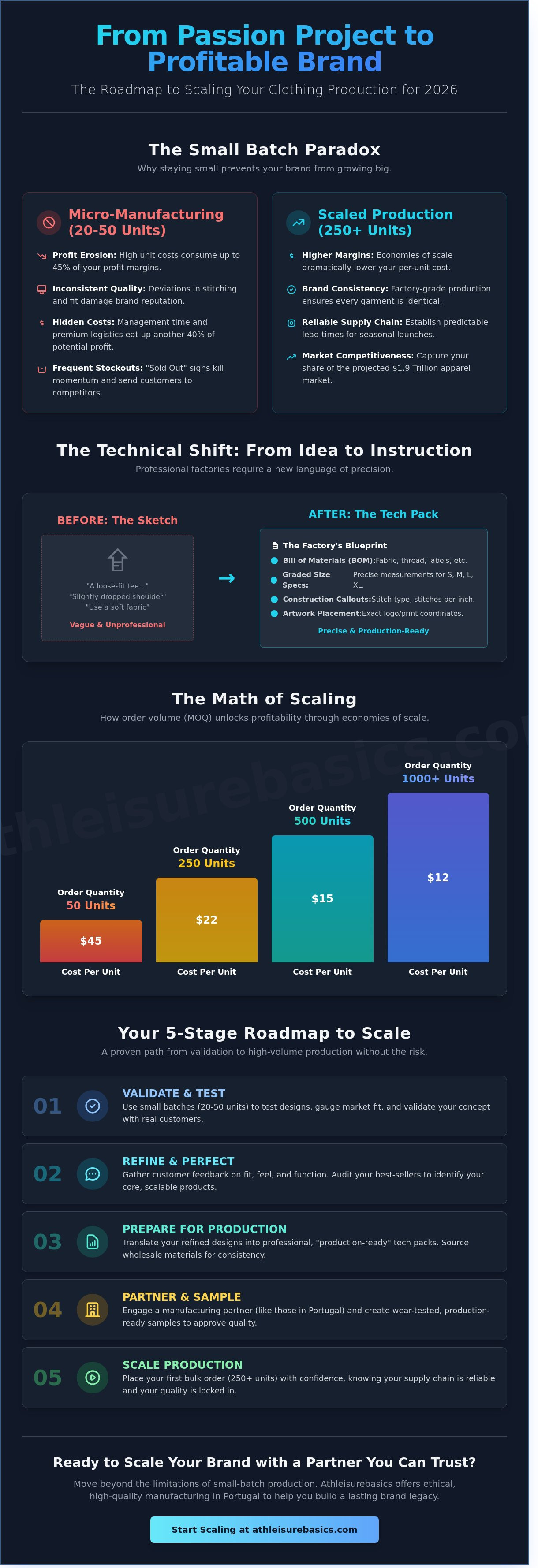
To build a sustainable business, you must eventually leverage Economies of Scale. This economic principle ensures that as your production volume increases, your cost per garment decreases. By 2026, the global apparel market is projected to reach $1.9 trillion according to Statista. Brands stuck in micro-manufacturing will struggle to compete with those that have optimized their supply chains. You know you're ready for scaling clothing production from small batch when your sell-through rate exceeds 85% within the first 30 days of a drop. If you're constantly marking items as "Sold Out" but your bank account isn't growing, your unit costs are likely too high.
The Limitations of Micro-Manufacturing
Relying on local seamstresses or small boutiques often leads to quality variance. A 5% deviation in stitching might be acceptable for a one-off sample, but it's a disaster for a brand trying to build a legacy. Hidden costs also accumulate quickly. Management time, shipping individual rolls of fabric, and premium packaging for tiny runs can eat up 40% of your potential profit. Stockouts are equally dangerous. When a TikTok video goes viral and you only have 12 units in stock, you lose the momentum that the algorithm rewards. Consistency is the foundation of trust, and micro-manufacturing rarely delivers it at a professional level.
Small Batch as a Bridge, Not a Destination
Smart founders use their initial runs of 20 to 50 pieces to refine the fit and gather real-world customer feedback. Once you've perfected the silhouette, the transition to custom manufacturing typically happens at the 250-unit threshold. For 2026, successful brands are moving away from low-quality, fast-fashion hubs. They prioritize made in portugal clothing because it combines ethical production with high-end craftsmanship. Scaling clothing production from small batch into a professional Portuguese facility ensures your brand meets the "Quality over Quantity" demand of modern consumers. It moves you from being a hobbyist to a serious market contender with a reliable, scalable supply chain.
Technical Foundations: Preparing Your Brand for Factory-Grade Production
Transitioning from a home studio or a local seamstress to a professional factory requires a total shift in mindset. You're no longer just making clothes; you're managing a complex supply chain. When you're scaling clothing production from small batch, the creative "vibe" of a sketch must be replaced by the clinical precision of technical data. This foundation ensures that your brand can handle higher volumes without a dip in quality or an explosion in waste.
The Power of a Professional Tech Pack
A sketch is an artistic idea, but a tech pack is a legal and technical contract. It's the primary language of the factory floor. To move beyond small-scale sampling, your tech pack must include a detailed Bill of Materials (BOM), graded size specifications, and specific construction callouts like stitches per inch and seam allowances. This level of detail is what prevents costly errors during the garment production process. A precise tech pack is the blueprint that ensures your 250th unit is identical to your 1st.
Factories in 2026 prioritize brands that provide "production-ready" files. If your documentation is vague, the factory will make its own assumptions, which often leads to inconsistent fit across different colorways. The Manufacturing Extension Partnership highlights that technical standardized documentation is a key driver in helping small manufacturers reduce defects and improve speed to market. By investing in professional tech packs now, you eliminate the "guesswork" that eats into your profit margins.
Sourcing Premium Textiles for Scale
Scaling requires moving from "off-the-shelf" fabrics at retail prices to wholesale rolls or custom-developed knits. Retail fabrics often lack the consistency needed for 500-unit runs; one bolt might feel different from the next. As you scale, you'll need to focus on:
- Color Fastness: Ensuring your signature navy blue doesn't bleed or fade after three washes.
- Shrinkage Testing: Standardizing how a fabric reacts to heat so your size Medium doesn't become a Small after the first laundry cycle.
- Certifications: OEKO-TEX® and GOTS certifications are no longer optional for brands looking to compete in the EU or US markets. These labels prove your textiles are free from harmful chemicals and meet ethical standards.
Leveraging Portuguese textile expertise is a strategic move for brands that value a luxury hand-feel and high-performance durability. Portuguese mills are world-renowned for their technical innovation in athleisure, offering fabrics that maintain their shape and compression over hundreds of wears. If you're serious about scaling clothing production from small batch, sourcing through a trusted manufacturing partner ensures you get access to these premium materials at wholesale minimums that actually fit your growth stage. Finally, always vet your designs for "manufacturability." A design that requires 20 minutes of manual labor for a single pocket might look great, but it will kill your margins at scale. Simplifying construction can often reduce labor costs by 12% to 18% without compromising the aesthetic of the garment.
The Math of Scaling: MOQs, Unit Costs, and Profitability
Scaling your brand requires a shift from simply making clothes to managing a sophisticated supply chain. The most immediate change you'll encounter is the inverse relationship between the Minimum Order Quantity (MOQ) and the Price Per Piece (PPP). In small batch production, your unit cost is high because manufacturers must amortize set-up fees across a handful of items. When you begin scaling clothing production from small batch, these fixed costs distribute across hundreds of units, which significantly lowers your base COGS.
A 250-piece MOQ is frequently cited as the "sweet spot" for growing brands. This volume is large enough to trigger bulk fabric discounts but small enough to mitigate the risk of dead stock. Inventory that doesn't move is a silent profit killer. By sticking to this mid-range volume, you maintain a healthy cash flow while benefiting from professional-grade manufacturing standards.
White Label vs. Custom Manufacturing
Choosing the right production model depends on your current capital and design requirements. Athleisure Basics provides two distinct paths for growth:
- White Label (MOQ 70+): This is the fastest route to market. You use pre-developed, high-quality patterns and focus your budget on branding and distribution. It's a low-risk way to test new colors or styles without heavy development fees.
- Custom Manufacturing (MOQ 250+): This model allows you to build a unique brand identity. You gain full control over the textile choice, specialized fits, and bespoke hardware.
- The Hybrid Strategy: Many successful brands use "Luxury Blanks" for their core essentials like hoodies and joggers. They then reserve their custom manufacturing budget for "hero pieces" that require specific technical features or unique silhouettes.
Calculating Your New Cost of Goods Sold (COGS)
As you scale, your financial model must evolve. You'll see certain costs drop, but others will inevitably rise as your operations become more complex. Understanding these shifts is vital for maintaining your "Margin Safety Net."
Costs that typically decrease:
- Fabric Procurement: Bulk purchasing often leads to a 15% to 20% reduction in raw material costs.
- Pattern and Set-up Fees: The cost of creating tech packs and grading patterns becomes negligible when spread over 250 pieces versus 20 pieces.
- Labelling and Packaging: Unit costs for woven labels and eco-friendly mailers drop significantly at higher volumes.
Costs that may increase:
- Quality Control (QC): Larger batches require more rigorous, independent auditing to ensure every piece meets EU quality standards.
- International Logistics: Shipping 500kg of apparel from Portugal requires professional freight forwarding rather than simple courier services.
- Warehousing: You'll need to account for storage fees and fulfillment software as your "garage stock" phase ends.
Successful scaling clothing production from small batch ensures that your final wholesale price still leaves room for a 2.5x to 3x markup for retail. If your scaled COGS doesn't allow for this margin, you may need to re-evaluate your fabric choices or manufacturing partner to ensure long-term viability.
5 Stages to Scale Your Apparel Production Without Risking Your Brand
Moving from 50 units to 500 units is a pivotal moment for any founder. It requires a shift from a "testing" mindset to a "systems" mindset. Success in scaling clothing production from small batch depends on your ability to remove variables and create a repeatable blueprint for quality.
Stage 1-2: Auditing and Sampling
Start with your sales data. Don't scale based on gut feelings. Analyze your sell-through rates from your initial small batches. If a specific oversized hoodie reached a 75% sell-through rate within 14 days, it's a clear candidate for a 250+ unit run. Use these metrics to predict demand and avoid tying up your cash in slow-moving inventory.
The "Golden Sample" is your most vital legal and production asset. This final, factory-approved version serves as the physical contract between your brand and the manufacturer. It must be wear-tested and refined until every seam is perfect. During the grading process, ensure your fit remains consistent across a wider range of body types. A size Large shouldn't just be a "bigger Small"; it needs adjusted proportions to maintain your brand's premium silhouette.
Stage 3-5: Partnering and Logistics
Vetting a partner is about more than finding the lowest price per unit. You're looking for long-term alignment and reliability. Many brands find that clothing manufacturers portugal offer the best balance for 2026. They provide the flexibility of lower MOQs with the superior craftsmanship and ethical standards expected in the EU market. This proximity to high-quality fabric mills also reduces your carbon footprint and shipping times.
Logistics planning requires a 4 to 6 month lead time for seasonal launches. If you want a September collection, your production needs to be locked in by March. To stay profitable, you must establish a Quality Control (QC) protocol that scales. This should include a mid-production check and a final inspection of at least 10% of the total order. Finally, set up clear re-order triggers. For example, when your stock levels hit 30%, it's time to initiate the next run. This prevents "out of stock" messages that can frustrate your growing customer base.
Ready to move beyond small batches? Partner with Athleisure Basics to scale your production with premium EU quality and expert guidance.
Scaling with Athleisurebasics: Your Partner in Portugal
Athleisurebasics operates on a "Partner, Not Just Producer" philosophy. Most traditional factories focus solely on fulfilling orders. We focus on your brand's long term viability. Scaling clothing production from small batch requires a shift in mindset from survival to strategy. Our team provides the structural support needed to manage this transition, ensuring that quality remains consistent as your order volumes increase. We act as an extension of your team, helping you avoid the common pitfalls of rapid growth.
The Portugal Advantage for Scaling Brands
Portugal remains a premier destination for textile manufacturing, with the industry generating over €6 billion in annual exports according to recent trade data. This success is rooted in a commitment to ethical manufacturing and superior craftsmanship. By choosing a Portuguese partner, you align your brand with OEKO-TEX® certifications and fair labor standards. These values are no longer optional for modern consumers. They are expected requirements for any brand looking to build a lasting legacy.
Logistics play a critical role in your growth. Shipping from our Portuguese facilities to European markets typically takes 3 to 5 business days. Even for US based brands, transit times are significantly shorter than those from Asian manufacturing hubs. You also gain direct access to premium Portuguese cotton and advanced performance synthetics. This allows you to maintain a luxury feel while you scale your operations to meet rising demand.
Ready to Scale? How to Get Started
The jump to larger volumes can be intimidating. Our production consulting service is designed to demystify this process. We help you evaluate your designs and supply chain to ensure they are ready for mass production. Scaling clothing production from small batch becomes much more manageable when you have a clear roadmap. We offer flexible pathways to suit your current growth stage:
- 70-Piece White Label: A streamlined way to scale specific styles with low risk and fast turnaround.
- 250-Piece Custom Manufacturing: Full bespoke production for brands ready to define their unique market position with custom fits and fabrics.
Our onboarding process is rigorous and transparent. It begins with a comprehensive tech pack review to catch potential issues before they become costly mistakes. We then move into sample creation. This stage is vital. It ensures your vision is perfectly translated into a physical garment. Once you approve the final sample, we move to production with a focus on efficiency and precision. Submit your project to Athleisurebasics and get a custom quote today.
Secure Your Brand’s Competitive Edge for 2026
Transitioning to professional manufacturing is the most significant leap your brand will take. You’ve seen how technical foundations and precise math on unit costs dictate your long-term profitability. By 2026, the global apparel industry will demand a shift away from inefficient, high-cost small runs toward streamlined, ethical systems. Successfully scaling clothing production from small batch requires a partner that understands the balance between creative integrity and factory-grade efficiency.
Athleisurebasics simplifies this transition by offering OEKO-TEX® certified premium fabrics and ethical manufacturing in Portugal. We help you maintain lean inventory levels with a low 250-piece MOQ for custom designs, ensuring you don't overextend your capital while pursuing growth. Our team acts as your expert guide through every stage of development, from technical packs to final delivery. You have the vision and the strategy; now you need the infrastructure to make it a reality. Start your journey from logo to legacy with Athleisurebasics today.
Your brand’s next chapter starts with a single, calculated step toward professional production. We're ready to help you lead the market with confidence and quality.
Frequently Asked Questions
How do I know if my brand is ready to scale from small batch to custom manufacturing?
You are ready to scale when your sell-through rate consistently exceeds 80% within the first 6 weeks of a product launch. If more than 20% of your customers are returning for repeat purchases, it's a clear signal that your product-market fit is established. Scaling clothing production from small batch becomes necessary when you are losing potential revenue due to stockouts that last longer than 14 days.
What is a realistic budget for moving from 50 to 250 pieces per style?
Moving to 250 pieces per style typically requires a larger upfront capital investment while reducing your cost-per-unit by an average of 15% to 30%. You should budget for increased raw material procurement, specialized grading for more sizes, and higher shipping weights. Most brands find that their total production investment triples, even though the profit margin per garment improves significantly due to economies of scale.
Can I use my existing small-batch patterns for factory-scale production in Portugal?
You can use existing patterns, but they must be converted into digital formats like DXF or ASTM to work with industrial cutting machines in Portugal. Local factories require these digital files to ensure 100% precision during the automated cutting process. Our technicians often review these patterns to verify that seam allowances and grading increments meet EU premium garment standards before the first 250-unit run begins.
How long does the lead time increase when moving to larger production runs?
Lead times typically extend from a 4-week small-batch window to a period of 8 to 12 weeks for larger custom runs. This increase accounts for the 3 weeks usually needed for bulk fabric dyeing and the 10 days required for intensive quality control protocols. Planning your 2026 collection at least 6 months in advance ensures that you maintain a consistent delivery schedule without gaps in your inventory.
What are the main risks of scaling clothing production too quickly?
The primary risk is accumulating deadstock, which happens to 30% of fashion brands that scale without accurate demand forecasting. Rapid expansion can also lead to quality drift if you don't have a dedicated partner to oversee the manufacturing process. Scaling clothing production from small batch too fast often ties up 70% of a brand's liquid cash in inventory, leaving little room for marketing or unexpected logistics costs.
Why should I choose a manufacturer in Portugal over a cheaper factory in Asia for scaling?
Choosing Portugal ensures your brand meets EU ethical standards and OEKO-TEX certifications, which are vital for 65% of modern consumers who prioritize sustainability. While Asian factories might offer lower initial quotes, Portugal provides faster shipping times of 5 to 7 days compared to 35 days from Asia. This agility allows you to react to market trends quickly while maintaining the premium craftsmanship that luxury athleisure requires.
Do I need a professional tech pack to start custom manufacturing?
A professional tech pack is essential because it serves as the definitive blueprint for your garment, reducing sample errors by up to 50%. It must include detailed measurement charts, a Bill of Materials, and specific stitching instructions to ensure the factory replicates your vision exactly. Without this document, you risk costly production delays and inconsistencies that can ruin a 250-piece production run.
What happens if I scale up and the inventory doesn’t sell as fast as expected?
If inventory moves slowly, you should implement a drop marketing strategy to create urgency or bundle slower items with best-sellers to increase the average order value. Industry data from 2024 shows that brands using tiered discounts can clear 25% of excess stock within two weeks. We help our partners avoid this by offering flexible MOQs that allow for steady growth rather than overwhelming your warehouse.


2 comments
Hello, my name is Alex. I am from Israel. I have a new brand that I want to produce at your factory. I would be happy if you would get back to me as soon as possible. Email kosem8520@gmail.com or WhatsApp 972 54-484-0520. I am interested in coming to meet you. Thank you.
Alex
Hello, my name is Alex Manahimov, I’m from Israel, I’m from Israel, I’m going to develop a new brand that I want to develop with you right away, I’ll be happy to answer it as soon as possible, interested in coming to visit Lamstra
Alex
Leave a comment
This site is protected by hCaptcha and the hCaptcha Privacy Policy and Terms of Service apply.