
The Cut and Sew Manufacturing Process: A Comprehensive 2026 Guide
The difference between a generic apparel label and a premium fashion house isn't just the logo; it's the level of control you have over every individual stitch. You've likely felt the frustration of trying to fit your unique vision into the rigid templates of off-the-shelf blanks, only to be met with high minimums or quality that doesn't meet your standards. Mastering the cut and sew manufacturing process is the only way to break free from the "cookie-cutter" market and build a truly differentiated, high-end brand.
This guide will demystify every stage of the production cycle, giving you the clarity to move from a tech pack to a finished, market-ready collection with confidence. As 2026 brings new regulations like the EU's Digital Product Passport and stricter transparency requirements, managing your supply chain through reliable, high-quality hubs is more critical than ever. We'll explore the roadmap from sourcing to shipping, clarify the differences between custom and white-label manufacturing, and provide the tools you need to select a partner that aligns with your ethical and quality standards. By the end, you'll have a clear strategy to scale your operations while maintaining full control over your brand's integrity.
Key Takeaways
- Master the full 8-step cut and sew manufacturing process to transition your creative concepts into high-end, market-ready apparel collections.
- Evaluate the strategic benefits of custom manufacturing versus white-label solutions to find the fastest and most cost-effective path to launch.
- Learn how to develop professional tech packs that act as a definitive blueprint for factory production and quality control.
- Discover how to navigate minimum order quantities (MOQs) and source premium, OEKO-TEX® certified materials for your brand.
- Identify the operational advantages of partnering with Portuguese manufacturers to ensure ethical production and superior craftsmanship.
Understanding Cut and Sew Manufacturing for Apparel Brands
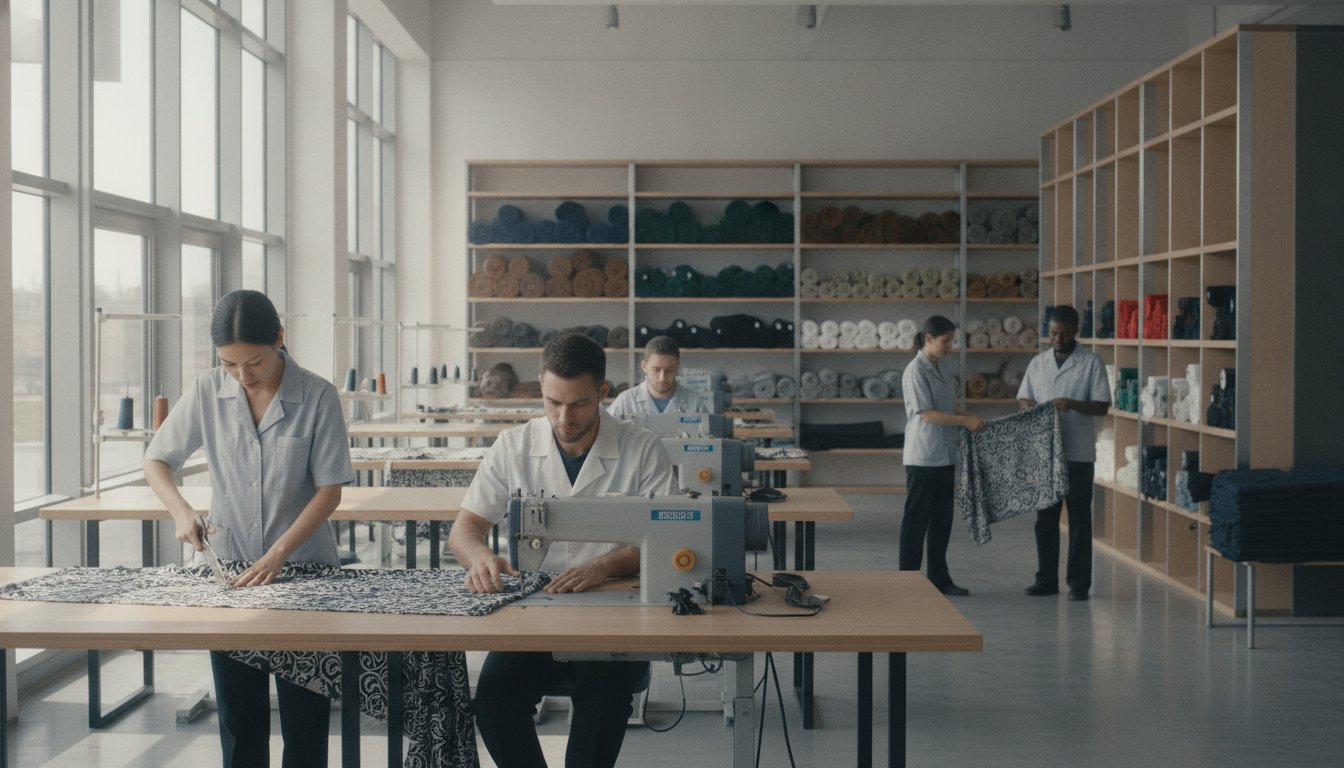
True brand identity begins with a raw roll of fabric. Unlike printing on pre-made blanks, Cut and sew manufacturing involves creating garments from the ground up. You aren't limited by the existing silhouette of a mass-produced t-shirt. Instead, you define the length, the width of the collar, and the specific weight of the jersey. This level of control is what separates a premium label from a temporary side project. It's a strategic choice to prioritize craftsmanship over convenience.
The cut and sew manufacturing process transforms the factory into a collaborative partner rather than just a service provider. Your manufacturer acts as a technical advisor, helping you choose the right fabric weight and construction methods to ensure your designs are both beautiful and functional. This partnership is essential for developing specialized fits and performance features. For example, if you're building an athleisure brand, you can integrate ergonomic seams or moisture-wicking panels that are impossible to achieve with a pre-made blank. Similarly, for corporate entities, ZLK Garments provides custom-tailored uniform solutions that prioritize both durability and professional aesthetics. You control the DNA of the garment.
The Anatomy of a Custom Garment
Most premium production follows the CMT (Cut, Make, Trim) model. This structured approach ensures every detail is a deliberate choice. The process includes several key elements:
- Precision Cutting: Fabric is cut according to your unique patterns, ensuring a consistent fit across all sizes.
- Assembly (Make): Skilled artisans sew the pieces together using specific stitch types that you select for durability or aesthetic appeal.
- Finishings (Trim): This includes the application of custom labels, branded hardware, and high-quality zippers.
Every choice you make in the CMT cycle directly impacts the perceived value of your collection. Custom hardware and reinforced stitching signal to your customers that they're investing in a high-end product, justifying a higher price point at retail.
Why Premium Brands Choose Custom Over Blanks
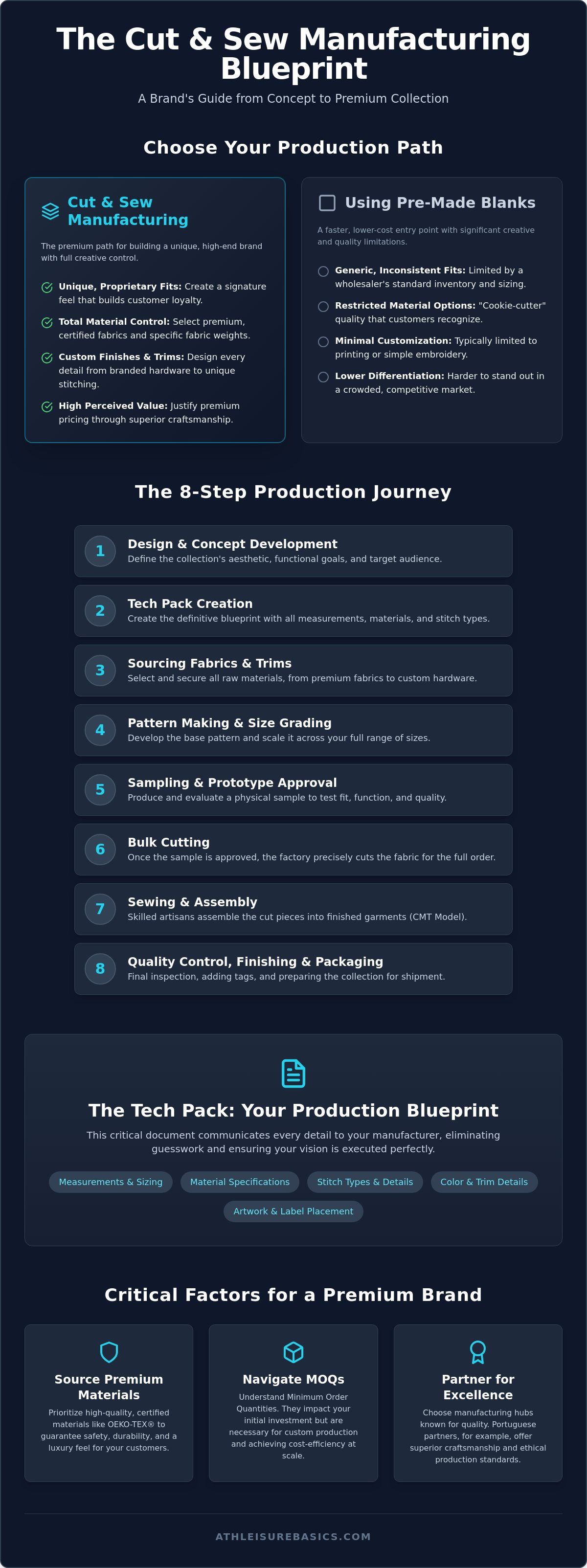
Mass-produced blanks often suffer from inconsistent fits and generic styles that customers recognize instantly. When you utilize the cut and sew manufacturing process, you create proprietary fits that belong only to your brand. This creates a "signature feel" that builds customer loyalty. If a customer loves how your hoodies fit, they can't simply find that same fit elsewhere. This differentiation is vital for long-term scalability. It allows you to build a cohesive aesthetic that evolves with your brand rather than being tied to a wholesaler's inventory. You aren't just selling clothes; you're selling a unique engineering of fabric and form.
The 8-Step Cut and Sew Manufacturing Process
Transitioning from a creative vision to a physical product requires a disciplined approach. The cut and sew manufacturing process is a linear journey where each phase builds upon the technical accuracy of the last. While the timeline can vary based on complexity, following a step-by-step garment production process ensures that material integrity and brand standards remain high from the first sketch to the final shipment.
The journey begins with Phase 1: Design and concept development, where you define the aesthetic and functional goals of your collection. This leads directly into Phase 2: Tech pack creation, followed by Phase 3: Sourcing fabrics and trims. Once materials are secured, Phase 4 involves pattern making and size grading. Phase 5 is the critical sampling and prototype approval stage. After approval, the factory moves into Phase 6: Bulk cutting, Phase 7: Sewing and assembly, and finally, Phase 8: Quality control, finishing, and packaging.
Pre-Production: From Tech Pack to Prototype
Before a single piece of fabric is cut, you must establish a technical foundation. You need to understand how to create a tech pack for clothing to provide the factory with a definitive blueprint. This document includes every measurement, material specification, and stitch type. Without a detailed tech pack, pattern grading becomes guesswork. Grading is the process of scaling your base pattern into a full range of sizes while maintaining a consistent fit across the entire collection.
Once the patterns are ready, the factory produces a prototype. You must evaluate this sample for more than just aesthetics. Test the garment for movement, durability, and fit on a live model. If the drape is off or a seam feels restrictive, this is the stage to make corrections. Successful brands often go through two or three rounds of sampling to perfect the cut and sew manufacturing process before committing to bulk orders.
The Production Floor: Bulk Execution and Finishing
Bulk production demands extreme precision. In Phase 6, factories use high-speed machinery to cut hundreds of fabric layers simultaneously. This requires expert markers to minimize fabric waste, which directly impacts your production costs. During Phase 7, the assembly line uses specialized equipment. For athleisure, this often includes flatlock machines that create smooth, chafe-free seams essential for performance wear.
The final phase is where many brands fail to provide enough detail. Quality control must be rigorous. Every garment should undergo a final checkpoint to verify measurements against the tech pack, check for loose threads, and test seam strength under tension. At Athleisurebasics, we prioritize these final details to ensure every piece meets luxury standards. Once cleared, garments are steamed, folded, and packaged for retail, completing the transformation from raw material to market-ready collection.
If you're ready to move from concept to creation, we can help you scale your production with expert guidance throughout the entire cycle.
Cut and Sew vs. White Label: Which Path Fits Your Brand?
Deciding between these two models depends on your brand's current maturity and your specific market entry strategy. While the cut and sew manufacturing process offers the ultimate level of differentiation, it's not always the most efficient starting point for every entrepreneur. You must weigh the desire for total creative control against the need for speed and capital efficiency. Both paths lead to premium products, but they serve different operational goals.
For brands that require a "signature" fit that doesn't exist elsewhere, full custom manufacturing is the only option. This is where you control the exact specifications of the cut and sew manufacturing process from the initial pattern to the final button. Conversely, white-label manufacturing allows you to utilize existing, high-quality patterns and silhouettes that have already been tested for market fit. This reduces the time spent in the development phase, allowing you to focus on marketing and sales.
Total Creative Control vs. Speed to Market
Many emerging brands choose private label Portugal services to achieve a faster launch. This path utilizes luxury blanks—pre-developed garments made with premium, OEKO-TEX® certified fabrics—that you can customize with your own branding and labels. It's a pragmatic way to test market demand without the long lead times of full technical development.
Transitioning from white label to full custom is a common growth strategy. You can start with curated styles to build your initial customer base and then reinvest those profits into developing proprietary fits. This evolution ensures you aren't over-extending your resources before you've proven your brand's concept in a competitive landscape. It's about scaling intelligently rather than rushing into complex production cycles.
Evaluating the Financial Commitment
The financial trade-off involves balancing upfront development costs against long-term unit margins. Full custom production requires a significant investment in tech packs, pattern grading, and multiple rounds of sampling. While this increases your initial costs, custom designs often command higher retail prices because they are unique to your brand. They offer a level of exclusivity that mass-produced styles simply cannot match.
To help you manage this transition, we provide accessible entry points. Our low MOQs start at just 70 pieces for white label and 250 pieces for full custom manufacturing. This flexible approach reduces your startup risk and prevents the common trap of over-ordering inventory. By choosing a partner that supports low-volume production, you can maintain high standards of craftsmanship while keeping your capital liquid for other growth initiatives.
Navigating MOQs and Sourcing High-Quality Materials
Material selection is the physical foundation of your brand. In the cut and sew manufacturing process, the fabric you choose often determines your minimum order quantity (MOQ). Manufacturers set these thresholds based on the requirements of fabric mills; these mills often require specific yardage to start a production run or a custom dye bath. By understanding this relationship, you can make smarter design choices that align with your budget and inventory goals. You don't have to compromise on quality to maintain a manageable stock level.
The foundation of a premium athleisure brand is built on performance and skin-safety. If you select materials that pilled easily or lost their elasticity after two washes, your brand's reputation would suffer before you could even scale. This is why sourcing is a collaborative effort between the designer and the factory. Your partner should offer technical insights into how different fibers behave during assembly and after repeated consumer use.
Strategic Fabric Sourcing and OEKO-TEX® Standards
Modern consumers demand transparency and safety. OEKO-TEX® certified fabrics are a non-negotiable standard for brands aiming for the premium market. These certifications ensure that the cut and sew manufacturing process uses materials free from harmful chemicals. Choosing the right textile involves more than just picking a color; you must evaluate stretch recovery, breathability, and hand-feel. Leveraging your manufacturer's existing network gives you access to these high-performance materials without having to source them from scratch. This ensures consistency and material integrity across every collection you release.
Managing Minimum Order Quantities as a Startup
High MOQs are often the biggest barrier for emerging businesses. While many global factories demand 500 units per style, Portuguese manufacturing offers much more flexibility. At Athleisurebasics, we provide accessible entry points with MOQs starting at 70 pieces for white label and 250 pieces for full custom manufacturing. It's essential to distinguish between per-style and per-color minimums. A "per-style" MOQ often allows you to hit your targets by splitting the volume across different colors, provided the base fabric remains the same. This flexibility is a core part of our mission to support small-scale ventures.
Managing inventory without overextending requires a phased approach. Start with a core collection of essential styles and use low-volume production runs to gauge customer preferences. This data-driven strategy prevents you from sitting on deadstock while allowing you to reinvest in your best-selling items. Negotiating production runs that grow with your brand creates a sustainable partnership that scales alongside your revenue. If you're ready to secure high-quality materials for your next launch, you can explore our sourcing support and production services today.
Launching Your Collection with a Portuguese Manufacturing Partner
Portugal has established itself as the premier destination for high-end apparel production. When you choose to work with clothing manufacturers Portugal, you're aligning your brand with a legacy of luxury craftsmanship and ethical integrity. This choice is particularly strategic in 2026 as the regulatory environment becomes more complex. EU-based production offers inherent advantages in proximity and trade ease, reducing the logistical friction that often plagues global supply chains. By manufacturing within the European Union, you ensure your brand is positioned for stability and growth.
The 'Made in Portugal' Quality Advantage
Portugal is recognized globally as the European hub for premium jersey and performance wear. The "Made in Portugal" label serves as a shorthand for quality, signaling to your customers that your garments are produced under strict labor and environmental standards. As of early 2026, the EU's Ecodesign for Sustainable Products Regulation (ESPR) is in full effect, requiring a Digital Product Passport for every garment entering the market. Portuguese factories are already integrated into this framework, providing the verifiable data on material origin and chemical use that you need for compliance.
By producing closer to your target market, you avoid the rising tariffs and long shipping delays associated with other global manufacturing hubs. The ethical transparency of Portuguese production isn't just a moral choice; it's a competitive advantage. Consumers in 2026 are more informed and willing to pay a premium for products that meet high social and environmental benchmarks. This regional pride translates directly into higher marketability for your collection.
How Athleisurebasics Supports Your Brand's Growth
We understand that the cut and sew manufacturing process can feel daunting for new entrepreneurs. Our role is to simplify this journey by providing end-to-end support, from initial production consulting to final delivery. We've designed our service model to remove the traditional barriers to entry that many startups face, allowing you to focus on building your brand's presence.
Our 250-piece custom MOQ allows you to launch unique, fully customized collections without the burden of excessive inventory. This operational agility is critical in a market where the EU has banned the destruction of unsold apparel as of July 19, 2026. Smaller, more frequent production runs help you maintain a healthy cash flow while adhering to sustainable inventory practices. You're able to test new designs and respond to market trends without the risk of overproduction.
Transparent communication is the cornerstone of our brand-manufacturer relationship. We provide clear updates at every stage of the cut and sew manufacturing process, ensuring you remain in control of your vision. If you're ready to transform your designs into a market-ready collection, the next step is simple. Contact us today to request a quote and begin your first production run with a partner dedicated to your long-term success.
Building Your Legacy in Premium Apparel
Transitioning from a creative concept to a market-ready collection requires a disciplined approach. You now have a comprehensive roadmap for the production cycle and an understanding of how to leverage the "Made in Portugal" quality seal. By prioritizing material integrity and technical precision, you can navigate the 2026 regulatory landscape while maintaining full creative control. The cut and sew manufacturing process remains the definitive path for brands that refuse to settle for generic, mass-produced blanks.
We specialize in low-MOQ premium athleisure and provide expert consulting to help emerging brands scale with confidence. Our commitment to OEKO-TEX® certified materials and ethical Portuguese production ensures your brand meets the highest industry standards from day one. It's time to bridge the gap between inspiration and retail reality.
Start your premium production journey with Athleisurebasics today
Your vision deserves a partner that values craftsmanship as much as you do. We're ready to help you turn your sketches into a lasting commercial presence.
Frequently Asked Questions
What exactly does cut and sew mean in the clothing industry?
Cut and sew refers to the process of producing a garment from scratch using raw rolls of fabric. Unlike screen printing on pre-made blanks, this method allows you to customize every element, including the fit, stitching, and hardware. It gives brands total creative control over the final product's engineering and silhouette, ensuring your collection is truly unique.
Is cut and sew manufacturing more expensive than using blanks?
Custom production usually carries higher upfront development costs compared to buying off-the-shelf blanks. You'll invest in tech packs, pattern grading, and sampling rounds to perfect your design. However, the ability to create a unique, premium product often justifies a higher retail price point. This leads to better long-term brand equity and market differentiation that generic blanks cannot provide.
What is the typical minimum order quantity (MOQ) for cut and sew?
Minimum order quantities vary significantly depending on the factory and region. While many global manufacturers require 500 to 1,000 pieces per style, we offer more accessible entry points for emerging brands. Our minimums start at 70 pieces for white-label options and 250 pieces for the full custom cut and sew manufacturing process.
How long does the entire cut and sew manufacturing process take?
The timeline for a full cut and sew manufacturing process typically ranges from 12 to 24 weeks. This includes several weeks for tech pack development and fabric sourcing, followed by sampling rounds and bulk production. Factors like fabric availability and the complexity of your designs will influence the final delivery date for your collection.
Do I need to be a professional designer to start a cut and sew project?
You don't need a formal design degree to launch a successful apparel collection. However, you must have a clear vision and the ability to communicate your specifications through a technical document. We provide clothing production consulting services to help new entrepreneurs translate their creative ideas into professional manufacturing blueprints that factories can execute with precision.
What is a tech pack and why is it essential for the process?
A tech pack is a comprehensive blueprint that contains every technical detail of your garment. It includes exact measurements, material lists, stitch types, and placement for labels or hardware. This document is essential because it acts as a contract between you and the factory. It ensures the finished product matches your original vision and minimizes costly production errors.
Can I source my own fabrics for a cut and sew production run?
Many brands choose to source their own textiles, but leveraging your manufacturer's existing network is often more efficient. Factories have established relationships with mills that provide OEKO-TEX® certified materials. This collaborative approach helps you secure premium fabrics that meet high performance standards while potentially reducing lead times and shipping costs for raw materials.
Why should I choose a manufacturer in Portugal for my apparel brand?
Portugal is a global leader in high-end jersey and athleisure production. Choosing a Portuguese partner ensures your brand benefits from ethical labor standards, superior craftsmanship, and shorter lead times to major markets. The "Made in Portugal" seal serves as a prestigious quality mark that increases your collection's marketability and appeals to conscious consumers who value transparency.


Leave a comment
This site is protected by hCaptcha and the hCaptcha Privacy Policy and Terms of Service apply.