
Low MOQ Manufacturing Benefits: The 2026 Strategic Guide for Emerging Apparel Brands
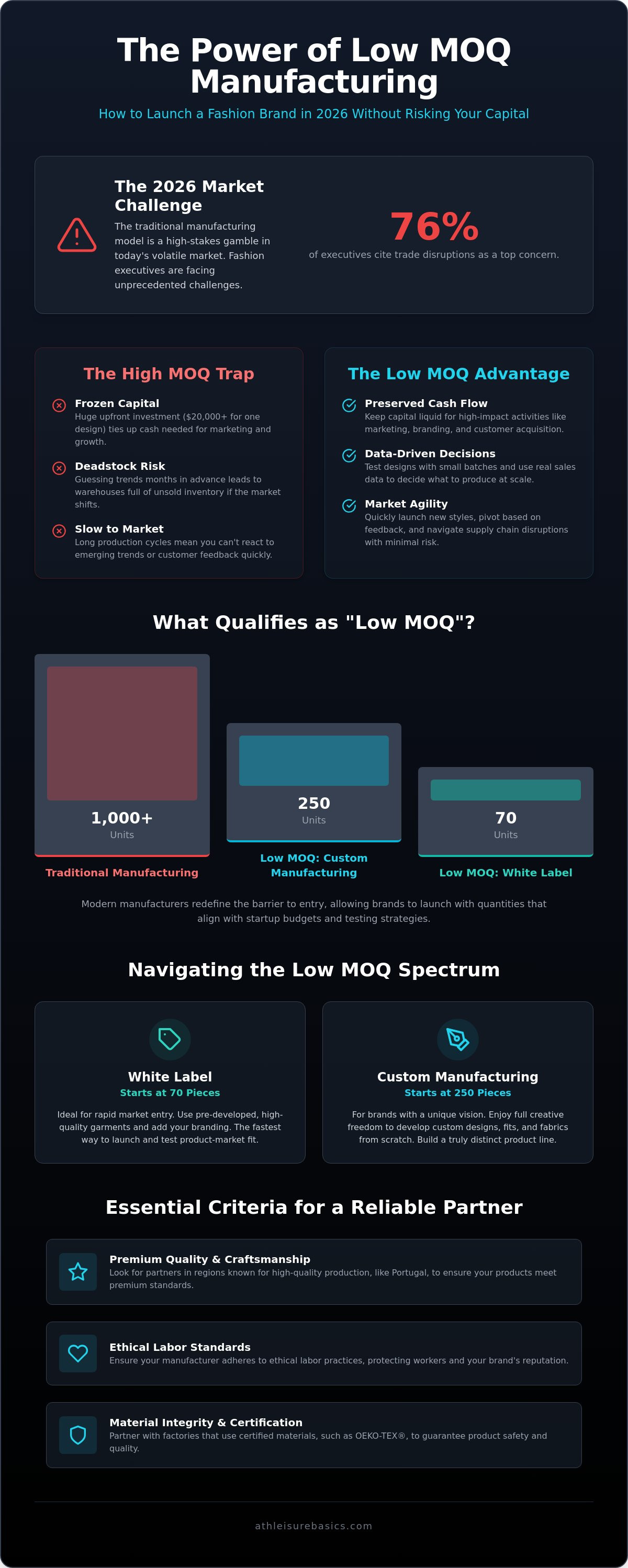
In 2026, the traditional model of ordering thousands of units before selling a single garment isn't just outdated; it's a significant financial risk. With 76% of fashion executives citing trade disruptions as a top concern this year, the primary low moq manufacturing benefits revolve around your ability to remain agile. You've likely felt the pressure of high upfront costs and the looming fear of ending up with a warehouse full of deadstock. It's difficult to scale when your capital is tied up in inventory that hasn't been market-tested yet.
This guide reveals how to safeguard your capital and accelerate your growth by leveraging flexible production. We'll show you how to launch a professional line with as few as 70 pieces for white-label or 250 for custom designs without sacrificing the premium standards your customers expect. You'll discover a strategy to navigate the latest 2026 OEKO-TEX regulations and find a reliable Portuguese partner dedicated to high-quality, ethical craftsmanship. It's time to transition from a risky gamble to a data-driven, scalable brand.
Key Takeaways
- Understand why high minimum order requirements are a financial liability in 2026 and how to preserve your capital for marketing and growth.
- Discover the primary low moq manufacturing benefits that allow you to test multiple designs using real sales data rather than inventory guesswork.
- Compare the rapid market entry of White Label branding with the creative freedom of Custom Manufacturing to determine your brand's ideal starting point.
- Learn why premium Portuguese production provides a strategic advantage through ethical labor standards and OEKO-TEX® certified material integrity.
- Identify the essential criteria for selecting a reliable manufacturing partner capable of scaling your production from 70 to 250 pieces and beyond.
What is Low MOQ Manufacturing and Why Does It Matter in 2026?
Minimum Order Quantity (MOQ) represents the lowest number of units a manufacturer will produce for a single style or color. Historically, factories demanded thousands of pieces to justify the setup costs of heavy machinery. In 2026, this rigid approach is a liability. The apparel industry is shifting toward a lean, demand-driven model where agility is the most valuable asset. Modern technology, including AI-driven pattern making and 3D garment visualization, allows factories to switch between designs with minimal downtime. These advancements mean you no longer need to commit to massive volumes to achieve professional results. Realizing the full low moq manufacturing benefits allows you to align your supply with actual consumer interest while protecting your bottom line.
Market volatility is the defining characteristic of the 2026 fashion landscape. Data from the State of Fashion 2026 Report indicates that 76% of fashion executives identify trade disruptions and tariffs as major hurdles this year. High MOQs amplify these risks by forcing brands to commit to large shipments months before they reach the customer. If a new tariff is introduced while your 5,000-unit order is in transit, your profit margins can vanish instantly. Low MOQ production acts as a strategic buffer, allowing you to navigate these fluctuations without overextending your resources.
The Thresholds: What Qualifies as "Low"?
Industry standards vary, but many traditional manufacturers still require 500 to 1,000 units per style. For an emerging brand, these numbers are often insurmountable. Specialized startup manufacturers have redefined these boundaries to ensure low moq manufacturing benefits are available to new entrepreneurs. It's essential to distinguish between factory MOQs and fabric MOQs. Even if a factory agrees to sew 50 pieces, the textile mill might require 500 meters of custom-dyed fabric. Athleisurebasics bridges this gap by setting transparent thresholds that account for the entire supply chain. We offer White Label production starting at just 70 pieces and custom manufacturing at 250 pieces. This clarity helps you plan your collection without facing hidden volume requirements later in the process.
The High MOQ Trap: The Risks of Traditional Manufacturing
Entering a high-volume contract too early can cripple a brand's growth. If you invest $20,000 into a single design that fails to resonate with your audience, your capital is effectively frozen. This challenge relates to the concept of Economic Order Quantity (EOQ), which traditionally balances ordering costs against holding costs. For startups, the "holding cost" of unsold inventory is often fatal. Beyond the initial investment, you face ongoing warehousing fees and the risk of deadstock. High MOQs force you to guess what customers want months in advance. If a trend shifts or a fit needs adjustment, you're stuck with thousands of units that cannot be sold. Choosing a flexible partner avoids these pitfalls and keeps your brand responsive to the market's evolving demands.
Strategic Benefits of Low MOQ Production for Growing Brands
Financial survival for a new label often depends on how long you can keep your capital liquid. One of the most impactful low moq manufacturing benefits is the preservation of cash flow. When you aren't forced to pay for 1,000 units upfront, you can reallocate that budget toward high-impact marketing and brand development. This liquidity allows you to build an audience while your inventory remains manageable. You don't want your entire startup fund sitting in a warehouse as unsold stock.
Market testing becomes a reality rather than a theory with smaller production runs. Instead of relying on trend forecasts that might be months out of date by the time your shipment arrives, you can use real-time sales data. Releasing a small batch of 70 to 250 pieces provides immediate feedback on fit, color, and style. You'll know exactly what your customers love before you commit to a larger restock. This agility is a cornerstone of the Strategic Benefits of Low MOQ Production, enabling you to pivot your designs to match 2026 fashion trends as they emerge.
Financial Freedom and Risk Mitigation
Lowering the barrier to entry empowers creative entrepreneurs who may not have massive venture backing. It changes the math of starting a business. Rather than focusing on sheer volume, you can prioritize the quality of your textile selections. Investing in premium fabrics for a small run creates a better brand impression than a high-volume run of mediocre quality. The "true cost" of a failed high-volume run isn't just the production invoice; it's the missed opportunity to spend that money on a design that actually sells. If you're ready to start small and scale smart, exploring premium materials is your first step toward a luxury positioning.
Sustainability as a Competitive Advantage
Modern consumers are increasingly skeptical of mass production. Gen Z and Alpha shoppers actively seek out brands that demonstrate environmental responsibility. Low MOQ manufacturing naturally aligns with the "Slow Fashion" movement by eliminating the overproduction that leads to textile waste. When you produce only what the market demands, you reduce your brand's carbon footprint and avoid the ethical dilemma of destroying unsold deadstock. Manufacturing in Portugal adds another layer of value. It ensures your products are made under strict European labor and environmental standards, which serves as a powerful marketing tool. Positioning your brand as waste-conscious isn't just good for the planet; it's a strategic differentiator that builds deep trust with your audience. To see how these ethical standards can work for your brand, consider a partnership with a manufacturer that shares your values.
Custom vs. White Label: Navigating the Low MOQ Spectrum
Not all production models are created equal. To fully capture low moq manufacturing benefits, you must choose the path that aligns with your current capital and design complexity. The choice usually falls between white label production and full custom manufacturing. White label allows you to brand premium, pre-existing silhouettes, while custom manufacturing gives you total control over every seam and stitch. Understanding the nuances between these production models is essential for maximizing your Custom vs. White Label: Navigating the Low MOQ Spectrum.
Choosing the right model depends on your brand's maturity. Many successful founders use a hybrid approach. They launch with white label pieces to generate immediate cash flow. While those items sell, they invest time in developing the detailed tech packs required for unique, custom designs. This strategy minimizes risk while building a roadmap toward a completely original collection. It ensures you aren't overextending your resources before you've proven your concept in the marketplace.
White Label: The 70-Piece Fast Track
Startups often prioritize speed to market. White label production is the fastest entry point because the patterns and fabrics are already vetted and ready for assembly. With a minimum of just 70 pieces, you can launch a professional line without the long lead times of the sampling phase. You aren't just buying "blanks"; you're creating a cohesive brand experience through specialized customization. Options include:
- Custom woven neck labels and heat-press branding.
- High-quality screen printing or embroidery for localized graphics.
- Specialized hang tags and sustainable packaging that reflects your brand's values.
Custom Production: The 250-Piece Professional Standard
When your brand requires a unique fit or a proprietary design feature, it's time to transition to custom clothing manufacturing. This model typically requires a 250-piece minimum, which remains a relatively low threshold for the global industry. At this stage, your technical documentation is critical. A professional tech pack ensures the factory understands your vision perfectly, reducing the need for multiple expensive sample rounds.
Balancing unique design with manufacturing feasibility is the key to success here. Your partner should help you refine your silhouettes to ensure they can be produced efficiently at lower volumes. This level of strategic planning allows you to maintain exclusivity while scaling your operations in a controlled, profitable manner. By leveraging low moq manufacturing benefits in custom production, you create a distinct product that stands out in a crowded market without the burden of excessive inventory.
Evaluating Low MOQ Partners: Quality, Ethics, and Location
Choosing a production partner is the most consequential decision you'll make for your brand's future. While many global factories claim to offer small-batch runs, the low moq manufacturing benefits quickly disappear if the final product doesn't meet premium standards. A "cheap" low MOQ often turns into an expensive mistake when you receive garments with inconsistent stitching, poor sizing, or fabric that pills after a single wash. Realizing the full low moq manufacturing benefits requires a partner who prioritizes craftsmanship over cutting corners, ensuring your first 70 pieces are as perfect as your thousandth.
Luxury labels like Jiwa Couture demonstrate this need for excellence, as their bridal and ethnic collections depend on the intricate craftsmanship and high-quality finishes that define a premium brand.
Quality control is inseparable from location and ethical standards. Working with European partners provides a level of security that's difficult to replicate in high-volume hubs. In 2026, compliance with OEKO-TEX® Standard 100 is more rigorous than ever, requiring stricter certification of upstream suppliers and new rules for wet processes. Ensuring your partner follows these standards and REACH regulations protects your brand from legal risks. It also guarantees your customers receive safe, high-quality apparel that aligns with modern expectations for transparency.
Portugal vs. Asia: The Real Cost Comparison
When comparing clothing manufacturers in Portugal to those in Asian manufacturing centers, you must look beyond the unit price. You need to factor in shipping times, import duties, and the hidden costs of quality control. High-volume hubs often struggle with the agility required for low MOQ runs, leading to delays that can miss seasonal windows. Portugal has established itself as the gold standard for athleisure due to its expertise in technical performance fabrics and circular knitting. The "Made in Europe" label isn't just a tag; it's a quality seal that justifies a premium retail price point and builds immediate trust with your audience.
Red Flags in Low MOQ Suppliers
You should be wary of suppliers offering unusually low prices for small runs. Manufacturing at low volumes is inherently more labor-intensive per unit. If a price seems too good to be true, it likely suggests unethical labor practices or substandard fabric sourcing. Transparency is a non-negotiable requirement for a healthy partnership. A reliable partner will openly discuss their material origins and provide clear, honest timelines during the sampling phase. Poor communication early on is a major red flag that often leads to significant production errors later.
Clear, professional communication ensures your vision is translated accurately from a tech pack to a finished garment. European partners typically offer better alignment with Western business standards, which reduces the friction of the production cycle. If you're looking for a partner that values transparency and premium craftsmanship, you can start your production journey with Athleisurebasics to discuss your 2026 collection strategy.
How Athleisurebasics Scales Your Brand with Low MOQ
Athleisurebasics positions itself as more than a manufacturer. We act as a dedicated partner for entrepreneurs entering the premium apparel space. Our infrastructure is specifically designed to maximize the low moq manufacturing benefits discussed throughout this guide. While high-volume factories often overlook emerging labels, we prioritize your growth by offering accessible entry points. By providing access to OEKO-TEX® certified materials for batches as small as 70 pieces, we ensure your brand meets the rigorous environmental standards of 2026 without the massive capital typically demanded by textile mills.
Our private label Portugal services are engineered to remove the logistical friction from your launch. We handle the complexities of sourcing and production so you can focus on building your community. This streamlined model allows you to transition from a conceptual design to a market-ready product with confidence. You'll have the security of knowing your collection is produced in an ethical, high-standard European facility that shares your commitment to quality. It's about removing barriers and empowering you to lead with a quality-first mindset.
End-to-End Production Support
We support your journey from the initial consultation to the final delivery. This includes expert assistance with tech pack development and material sourcing to ensure your vision is technically sound. Our full CMT (Cut, Make, Trim) process includes rigorous quality assurance at every stage of assembly. We understand that your needs will change as your brand gains traction. Our flexible model allows you to scale seamlessly, moving from an initial run of 70 pieces to 1,000 units and beyond as your sales data proves your success. This scalability is one of the most significant low moq manufacturing benefits for brands aiming for a long-term commercial presence.
Get Started with Your First Run
Preparing for a successful 2026 launch requires a clear strategy and a reliable production timeline. Whether you're interested in branding our luxury white-label blanks or developing a completely custom silhouette, the process begins with a detailed consultation. We'll review your designs, discuss material options, and provide a transparent quote that reflects our commitment to your success. Don't let high volume requirements stop your creative momentum. Take the first step toward building a lasting premium brand today. You can partner with Athleisurebasics for your low MOQ production and secure your place in the competitive fashion landscape.
Future-Proof Your Brand with Agile Manufacturing
The shift toward demand-driven production is the most effective way to navigate the market volatility of 2026. By prioritizing agility over sheer volume, you protect your capital and ensure that every garment in your collection serves a specific purpose. The low moq manufacturing benefits we've explored provide a clear roadmap for scaling without the burden of deadstock or compromised ethics. Whether you start with white label essentials or unique custom silhouettes, your brand's success depends on the integrity of your supply chain.
Choosing a partner that values craftsmanship and sustainability is a strategic investment in your brand's longevity. Accessing OEKO-TEX® certified fabrics and premium Portuguese craftsmanship ensures your products stand out in a crowded marketplace. You don't need to wait for a massive budget to create a high-end experience for your customers. Taking small, calculated steps today allows you to build a foundation that supports long-term growth.
Launch your premium brand with Athleisurebasics today. With white label options starting at just 70 pieces, you can begin your journey with the security of a world-class manufacturing partner. We're ready to help you turn your vision into a lasting commercial presence.
Frequently Asked Questions
Is low MOQ manufacturing more expensive per unit?
Yes, the cost per unit is typically higher for smaller production runs than for mass-produced orders. This happens because setup costs, such as pattern grading and machine calibration, are spread across fewer garments. However, the low moq manufacturing benefits often outweigh this cost through reduced inventory risk and lower warehousing fees. You're paying for the flexibility to stay liquid rather than tying up your capital in thousands of unsold units.
How do I find a reliable low MOQ clothing manufacturer in Europe?
Focus your search on regions with established textile heritage, particularly Portugal. You should prioritize manufacturers that offer transparent communication and specialized services for emerging brands, such as tech pack development. Look for partners that use OEKO-TEX® certified fabrics and clearly state their minimum thresholds. A reliable partner acts as a collaborator, helping you navigate technical choices rather than just acting as a fulfillment center.
Can I get custom designs with a low MOQ of 50 or 100 pieces?
While some factories offer micro-runs, professional custom manufacturing usually requires a slightly higher threshold to ensure quality and feasibility. At Athleisurebasics, full custom designs start at 250 pieces. This allows for the specialized attention required for unique silhouettes and proprietary fits. If you need to launch with fewer units, our white-label services start at 70 pieces and allow for significant branding customization on premium, pre-vetted blanks.
What is the typical lead time for low MOQ production runs?
Lead times generally range from 4 to 12 weeks depending on the complexity of your designs and material availability. White-label production is the fastest route because the base patterns and fabrics are already in stock. Custom cut-and-sew projects take longer due to the sampling and fit-testing phases. Choosing a European partner often reduces total lead times by significantly shortening the shipping duration compared to Asian manufacturing hubs.
Do low MOQ manufacturers provide samples before bulk production?
Professional manufacturers always provide a pre-production sample (PPS) before the main run begins. This is a critical step to verify the fit, fabric hand-feel, and branding details. You shouldn't proceed with bulk production until you've physically inspected and approved a sample that matches your tech pack. This process ensures that the final delivery meets your brand's quality standards and reduces the risk of costly production errors.
Why do most factories have high MOQs in the first place?
Traditional factories are built for high-volume efficiency to minimize the cost of labor and machinery downtime. Every time a factory switches to a new style, they must stop the machines, change threads, and recalibrate equipment. High MOQs ensure these setup costs are covered. Modern, agile manufacturers have invested in technology that allows them to handle smaller batches efficiently, making low moq manufacturing benefits accessible to the next generation of premium brands.
Can I mix sizes and colors within a low MOQ order?
You can typically mix sizes within a single style, but mixing colors is more restrictive. Most manufacturers require a specific minimum per color because each change requires a different fabric roll and specific thread matching. For example, a 250-piece custom order might allow for multiple sizes but may be limited to one or two colorways. It's best to discuss your specific color requirements during the initial consultation to ensure production feasibility.
What certifications should I look for in a low MOQ factory?
Prioritize factories that hold OEKO-TEX® Standard 100 certifications to ensure all materials are safe and free from harmful substances. In 2026, you should also look for GOTS certification if you're using organic textiles and ensure the facility is REACH compliant. These certifications serve as a quality seal, proving that your production meets strict European environmental and ethical labor standards, which is a major differentiator for premium brand positioning.



Leave a comment
This site is protected by hCaptcha and the hCaptcha Privacy Policy and Terms of Service apply.