

Sustainable Fabrics for Athleisure: A 2026 Sourcing Guide for Brands
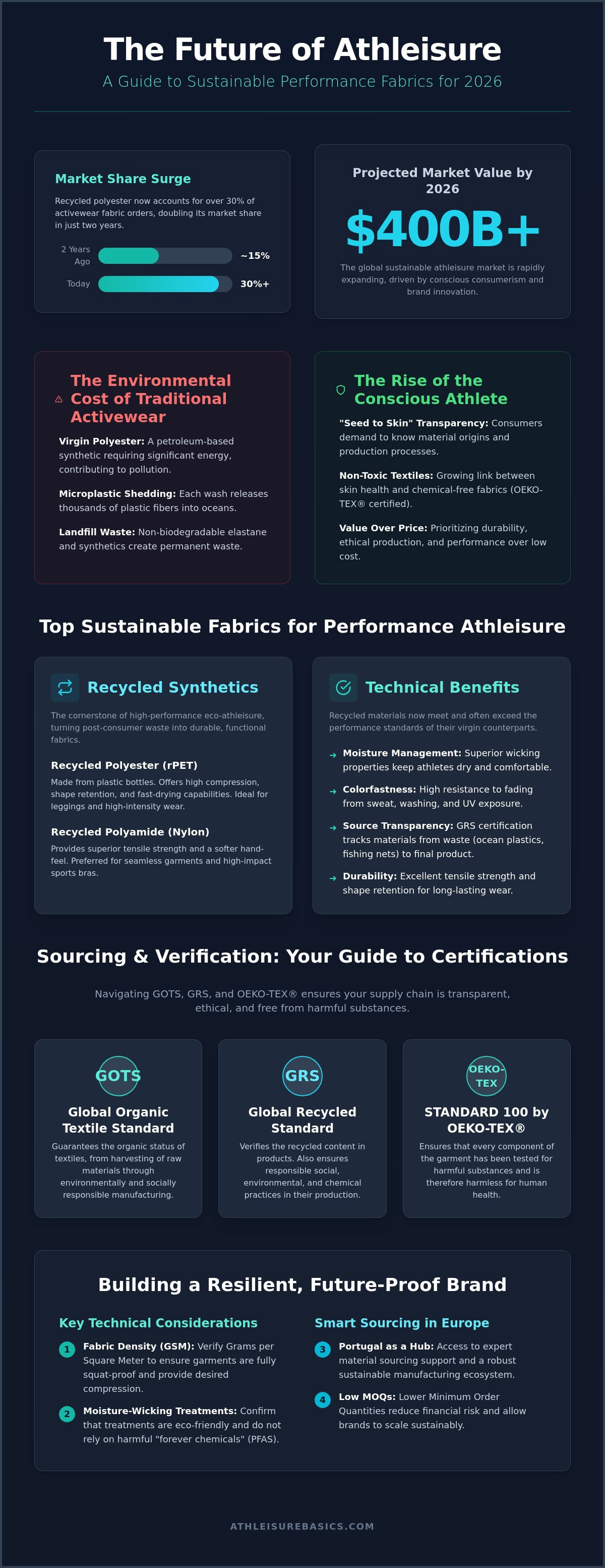
Recycled polyester now accounts for over 30% of activewear fabric orders, doubling its market share in just two years. You likely recognize that choosing sustainable fabrics for athleisure is no longer an optional feature but a baseline requirement for any growth-oriented brand. Still, the shift toward eco-friendly materials often brings a valid fear of greenwashing, complex EU regulations like the Ecodesign for Sustainable Products Regulation, and the worry that these textiles won't be squat-proof or moisture-wicking.
This guide provides the clarity you need to source high-performance textiles that meet the highest technical and ethical standards. You'll discover how to balance environmental responsibility with the durability and compression your customers expect. We'll break down the most viable eco-fabrics for 2026, explain the nuances of OEKO-TEX and GOTS certifications, and provide a roadmap for finding a reliable manufacturing partner in Europe to scale your operations with confidence.
Key Takeaways
- Identify high-performance recycled polyester and polyamide as the primary sustainable fabrics for athleisure that maintain technical utility and compression.
- Understand how to verify density requirements (GSM) and eco-friendly moisture-wicking treatments to ensure your garments remain squat-proof and functional.
- Learn to navigate the complexities of GOTS, GRS, and OEKO-TEX® certifications to ensure your supply chain is fully transparent and ethically compliant.
- Discover how materials sourcing support and low minimum order quantities (MOQs) in Portugal allow your brand to scale sustainably with reduced financial risk.
Why Sustainable Fabrics are the Industry Standard for 2026
By 2026, the global sustainable athleisure market is projected to exceed $400 billion. This growth isn't driven by a passing trend but by a fundamental shift in how brands build value. Using sustainable fabrics for athleisure is now the primary way to signal quality and technical superiority to a sophisticated audience. These materials are defined as textiles that minimize environmental footprint through recycled or bio-based origins while maintaining the high utility required for physical activity. This transition represents a "premiumization" of the market, where ethical material choices serve as a core indicator of a brand's commitment to excellence.
The industry is moving away from the "take-make-waste" model of fast fashion. Instead, brands are adopting circular performance apparel. This means designing for longevity and recyclability from the initial sourcing phase. As the global sustainable fashion overview demonstrates, the focus has shifted toward reducing the ecological impact of production while ensuring social responsibility across the supply chain. For emerging businesses, choosing the right textiles is the first step in building a resilient, future-proof brand.
The Environmental Impact of Traditional Activewear
Traditional activewear relies heavily on virgin polyester. This petroleum-based synthetic requires significant energy to produce and contributes to the global microplastic crisis. Every time a standard synthetic garment is washed, it sheds thousands of tiny fibers that eventually enter our oceans. Additionally, the standard elastane used for stretch isn't biodegradable, making old garments a permanent fixture in landfills. For new brands, the "performance at any cost" model has become a liability. High-performance gear that damages the planet is no longer seen as a premium product; it's viewed as an outdated risk.
The Rise of the Conscious Athlete
Today's consumers prioritize brand values over low price points. They demand "seed to skin" transparency, which includes knowing exactly where their leggings were made and what chemicals were used in the dyeing process. There's a growing link between skin health and non-toxic textiles. Fabrics certified by OEKO-TEX® ensure that no harmful substances remain in the finished garment. This level of safety is a core requirement for athletes who wear these materials during intense training sessions. Sustainable athleisure represents a precise balance of long-term durability, ethical production standards, and uncompromised technical performance. Choosing sustainable fabrics for athleisure allows emerging businesses to enter the market at a premium level, building trust through material integrity rather than just marketing claims.
Top Sustainable Fabric Options for Performance Athleisure
Selecting the right sustainable fabrics for athleisure is a balance of technical utility and environmental stewardship. By 2026, the market has moved beyond simple alternatives to high-performance textiles that often outperform their virgin counterparts. Brands now have access to a sophisticated toolkit of recycled synthetics and regenerative natural fibers that meet the rigorous demands of modern training. Addressing waste is a primary driver for these innovations. Official EPA data on textile waste highlights the urgency of moving away from virgin synthetics to close the loop on production.
Recycled Synthetics: rPET and Recycled Nylon
Recycled polyester (rPET) remains a cornerstone of the industry. It currently accounts for over 30% of activewear fabric orders. This material transforms post-consumer waste, such as plastic bottles, into high-compression leggings that offer excellent shape retention and fast-drying capabilities. For brands focusing on seamless wear, high-impact sports bras, or technical swimwear, recycled polyamide (nylon) is the preferred choice. It provides superior tensile strength and a softer hand-feel than polyester—a combination utilized by Ocean Motion Wear to create durable, ocean-inspired performance gear. Technical benefits of these recycled synthetics include:
- Moisture Management: Superior wicking properties that keep athletes dry during high-intensity sessions.
- Colorfastness: High resistance to fading, even after repeated exposure to sweat and UV light.
- Source Transparency: The ability to track materials back to ocean-bound plastics or discarded fishing nets through GRS certification.
Natural and Regenerative Fibers
Natural fibers offer a different set of benefits, particularly for low-impact activities and recovery wear. While synthetics dominate high-intensity training, Portuguese cotton fabric is the gold standard for lifestyle athleisure. Organic cotton uses significantly less water than conventional varieties and eliminates the use of toxic pesticides, making it safer for both the planet and the wearer's skin.
Tencel™ Lyocell has also emerged as a leader in the "eco-luxury" space. It's produced through a closed-loop process that recovers 99% of the solvents used, resulting in a silk-like texture ideal for yoga wear. Bamboo is another popular option, though brands must distinguish between bamboo viscose and bamboo lyocell. The lyocell process is much cleaner, avoiding the harsh chemicals often associated with traditional bamboo processing. When you source sustainable fabrics for athleisure, you're not just buying material; you're investing in a brand story that resonates with the conscious athlete. Navigating these options requires technical expertise. Accessing professional materials sourcing support can help you identify which blend best aligns with your brand's performance goals.
Balancing Performance and Planet: Technical Considerations
Athletes won't compromise on performance, regardless of a garment's eco-credentials. If a pair of leggings is see-through or loses its shape after three washes, its environmental benefit is lost to the landfill. Scientific research on the environmental impact of fashion confirms that product longevity is a primary factor in reducing textile waste. When sourcing sustainable fabrics for athleisure, you must prioritize technical specifications like stretch recovery and density to ensure the product meets professional standards. A long-lasting premium garment that retains its utility for years is fundamentally more sustainable than a poorly made "green" alternative that fails within months.
GSM and Fabric Weight for Activewear
Grams per Square Metre (GSM) is the most critical metric for ensuring your gear is squat-proof. Leggings require density. We recommend a range of 280 to 320 GSM for bottom-weight fabrics to ensure complete opacity and compression. While lightweight jerseys work for lifestyle tees, high-performance gear demands interlock knits. These double-knit structures are inherently more stable and durable than single jersey. Choosing the right weight for your specific niche prevents returns and builds long-term customer trust.
- High-Compression Leggings: 290-320 GSM interlock knits.
- Performance T-shirts: 140-160 GSM recycled polyester blends.
- Lifestyle Hoodies: 300-400 GSM organic cotton fleece.
Non-Toxic Chemistry and OEKO-TEX®
Technical utility shouldn't come at the cost of skin health. Conventional moisture-wicking treatments often rely on PFC-based finishes, which are persistent environmental pollutants. Modern sustainable fabrics for athleisure now utilize plant-based or mechanical wicking properties that are completely non-toxic. We treat "clean from seed to skin" as a baseline requirement, not a luxury feature. This is why we prioritize OEKO-TEX® Standard 100 certification for all our materials. This standard ensures that every thread, button, and dye used is tested for over 1,000 harmful substances. At Athleisurebasics, we simplify this complex verification process by sourcing only from mills that adhere to these rigorous EU safety standards. This ensures your brand delivers a product that is safe for the athlete and the ecosystem alike.
Sourcing and Verifying Sustainable Textiles for Your Brand
Securing the right sustainable fabrics for athleisure requires a transition from simple procurement to rigorous verification. In a market where eco-friendly claims are ubiquitous, your brand's integrity depends on your ability to substantiate every material choice. This process begins with understanding global standards and leveraging professional materials sourcing support to navigate complex, multi-tiered supply chains. Before committing to full-scale production, always request and test fabric headers. These physical swatches allow you to verify the hand-feel, weight, and stretch recovery in person; this ensures the material aligns perfectly with your technical requirements.
Navigating Certifications and Greenwashing
Distinguishing between "recycled content" and "certified recycled" is a critical step in avoiding greenwashing. While many mills claim to use eco-friendly fibers, only those with recognized certifications like the Global Recycled Standard (GRS) or the Global Organic Textile Standard (GOTS) provide a verifiable paper trail. You should always ask your manufacturer for Transaction Certificates (TCs). These documents prove that the specific batch of fabric you are purchasing actually contains the certified fibers claimed. A certification is only as good as the factory's willingness to prove it. For chemical safety, the OEKO-TEX® Standard 100 remains the industry benchmark, confirming that the finished textile is free from harmful residues from seed to skin.
Low MOQ Sourcing Strategies
Historically, accessing premium eco-textiles required massive volume commitments that excluded emerging brands. Modern manufacturing models in Portugal have lowered these entry barriers significantly. Utilizing white label clothing services allows you to access high-end, pre-certified sustainable fabrics for athleisure with minimum order quantities as low as 70 to 250 pieces. This approach utilizes "stock" fabrics that are already produced and certified, removing the need for expensive custom-dyed runs and long lead times.
- Stock Fabrics: Gain immediate access to premium materials without the 500 meter minimums typical of custom orders.
- Fabric Remnants: Consult with your production partner to identify high-quality leftover rolls from larger productions, which are ideal for limited-edition capsule collections.
- Operational Agility: Low MOQs allow you to test new sustainable lines with minimal financial risk, facilitating faster market entry and easier scaling.
Building a transparent supply chain is a collaborative effort that requires the right industry connections. If you are ready to secure high-performance, ethically sourced materials for your next collection, contact the experts at Athleisurebasics to begin your materials sourcing consultation today.
Partnering with a Sustainable Manufacturer in Portugal
Choosing the right sustainable fabrics for athleisure is only half the battle; the second half is ensuring those materials are handled within a transparent and ethical production environment. Portugal has established itself as the premier European hub for technical textile innovation, offering a strategic advantage that global competitors in other regions often cannot match. By manufacturing within the European Union, brands benefit from strict environmental laws and labor standards that align with the values of the conscious consumer. This proximity also reduces the carbon footprint of your supply chain through localized shipping and shorter transit times compared to sourcing from Asia.
At Athleisurebasics, we integrate materials sourcing directly into the custom manufacturing process. This means you don't have to manage separate relationships with mills and factories. We provide a streamlined path from tech pack development to the finished product, leveraging local expertise to ensure your eco-innovations are technically sound. A partnership model is essential for long-term growth. Moving away from transactional factory relationships allows you to collaborate with experts who are invested in your brand's scaling journey and material integrity.
The Portuguese Textile Heritage
Portugal's status as a leader in technical and sustainable knits is built on generations of craftsmanship. Regions like Porto and Guimarães are home to some of the world's most advanced circular knitting facilities. These factories specialize in the high-performance sustainable fabrics for athleisure discussed throughout this guide, such as recycled polyamides and organic cotton blends. The value of this heritage lies in the quality of the "luxury-level" blanks and custom pieces produced. Every garment meets high-end standards for stitching, fit, and durability, ensuring your brand stands out in a crowded market.
Start Your Sustainable Journey with Athleisurebasics
Our operational model is designed specifically to empower emerging eco-brands. We remove the traditional barriers to entry by offering accessible production volumes and end-to-end support. Our consulting services help you refine your material strategy, ensuring you choose the most effective fibers for your specific performance goals.
- Accessible Minimums: Start your collection with low MOQs of 70 pieces for white label or 250 pieces for fully custom designs.
- Expert Consulting: Receive guidance on technical specifications, certifications, and the latest sustainable textile innovations.
- End-to-End Service: We manage everything from tech pack refinement and materials sourcing to final CMT production in our Portuguese facilities.
Taking the next step in your brand's development requires a reliable manufacturing ally. Contact us today to request a quote for your custom sustainable collection and see how our expertise can transform your concept into a market-ready reality.
Future-Proofing Your Brand with Material Integrity
The shift toward circularity and transparency in 2026 has transformed how emerging businesses approach production. Success now requires a synergy between high-performance utility and verifiable ethical standards. By prioritizing density metrics like GSM and moisture-wicking treatments that are free from harmful chemicals, you ensure your garments exceed athlete expectations. Sourcing the right sustainable fabrics for athleisure is no longer just a design choice; it's a strategic foundation for long-term growth and consumer trust.
As you scale, partnering with a manufacturer that understands the nuances of EU environmental laws and OEKO-TEX® certifications will mitigate your operational risks. Athleisurebasics specializes in these premium textiles, offering accessible entry points with low MOQs starting at just 70 pieces. Our Portugal-based production ensures your collection is crafted with the highest standards of European quality and labor ethics. Ready to build your sustainable brand? Contact Athleisurebasics for a custom manufacturing quote today. We're here to help you navigate the complexities of the industry and turn your vision into a lasting commercial presence.
Frequently Asked Questions
What is the best sustainable fabric for high-impact sports?
Recycled Polyamide, commonly known as recycled nylon, is the superior choice for high-impact sports gear. It offers higher tensile strength and better abrasion resistance than polyester, making it ideal for garments that endure intense friction and movement. When blended with recycled elastane, it provides the necessary compression and shape recovery required for professional-grade sports bras and technical leggings.
Is recycled polyester really better for the environment than cotton?
Recycled polyester is better for performance-driven applications because it doesn't absorb moisture like cotton does. While organic cotton is excellent for lifestyle wear, it becomes heavy and loses shape when wet with sweat. From an environmental perspective, recycled polyester diverts plastic waste from landfills and oceans; meanwhile, organic cotton focuses on reducing water consumption and eliminating toxic pesticides during cultivation.
How can I tell if a fabric is truly OEKO-TEX® certified?
You can verify a fabric's certification by requesting the specific certificate number from your manufacturer or fabric mill. Once you have the number, enter it into the OEKO-TEX® Label Check tool on their official website. This transparency ensures the material has been tested for over 1,000 harmful substances. Reliable manufacturers in Portugal will always provide this documentation to prove the safety of their textiles.
Can I get sustainable fabrics with low minimum order quantities (MOQs)?
Yes, you can access premium materials through white label programs or by sourcing from stock fabric collections. Athleisurebasics offers MOQs starting at just 70 pieces for white label designs, which allows startups to launch collections using sustainable fabrics for athleisure without significant financial risk. This model provides the same high-performance textiles used by major brands but at a scale that suits emerging businesses.
Do sustainable fabrics perform as well as traditional activewear materials?
Modern eco-textiles provide identical, and sometimes superior, performance compared to virgin synthetics. Recycled polyester and nylon fibers are engineered to offer the same moisture-wicking, breathability, and durability as traditional materials. Choosing sustainable fabrics for athleisure ensures your garments meet professional athletic standards while providing the added marketing benefit of a reduced environmental footprint and improved skin safety.
What are the most common certifications for eco-friendly textiles?
The three industry benchmarks are GOTS, GRS, and OEKO-TEX® Standard 100. GOTS covers organic natural fibers like cotton, while GRS verifies the recycled content and social practices in synthetic production. OEKO-TEX® focuses on chemical safety, ensuring the finished garment is non-toxic. Always look for these specific labels when sourcing to ensure your brand's claims are backed by rigorous, third-party verification.
Why is Portugal considered a leader in sustainable clothing manufacturing?
Portugal combines a deep heritage in textile craftsmanship with strict adherence to EU environmental and labor regulations. The country's factories are global leaders in technical circular knits and sustainable dyeing processes. Furthermore, manufacturing in Portugal allows brands to shorten their supply chains and reduce transport emissions, providing a significant logistical advantage for businesses targeting the European and North American markets.
How do I start a sustainable athleisure brand with no prior experience?
Partnering with a full-service manufacturer that provides production consulting and materials sourcing support is the most effective strategy. This collaborative approach removes the technical barriers associated with fabric chemistry and complex supply chain management. By working with an expert partner, you can leverage their industry connections and technical knowledge to build a professional collection that meets the highest standards of quality and sustainability.



Leave a comment
This site is protected by hCaptcha and the hCaptcha Privacy Policy and Terms of Service apply.