

What Does Cut Make Trim (CMT) Mean? A 2026 Guide for Clothing Brands
Choosing the wrong production model is the fastest way to lose both your profit margins and your brand's creative soul. You likely started your search for a clothing manufacturer for small business because you want more than just a supplier; you want a partner who respects your vision. It's natural to feel overwhelmed by industry jargon, especially when you're worried that a single technical misunderstanding could lead to hidden costs or a loss of quality control. In an era where the EU Digital Product Passport and strict sustainability mandates like the Green Claims Directive demand absolute transparency, the manufacturing model you choose is more critical than ever.
This 2026 guide will demystify the Cut, Make, Trim process so you can reclaim control over your production and ensure every garment meets your high standards. We'll break down the CMT acronym, compare it against Full Package production, and provide the framework you need to approach ethical factories in Portugal with total confidence. By the end of this article, you'll understand how to leverage CMT to scale your business while maintaining the premium quality your customers expect. We're here to help you transform complex industrial processes into a clear path for your brand's growth.
Key Takeaways
- Learn the precise definition of Cut, Make, and Trim to understand how this labor-focused model gives you ultimate control over your garment's DNA.
- Compare the benefits of CMT against Full Package Production to determine which model fits your goals when selecting a clothing manufacturer for small business.
- Identify the critical inputs, such as professional tech packs and raw materials, required to ensure a seamless transition from concept to finished product.
- Establish a clear framework for managing production costs and quality standards to avoid hidden expenses and maintain high-end craftsmanship.
- Discover why Portugal remains the premier choice for ethical, high-quality manufacturing and how to leverage regional expertise to scale your operations.
What is CMT? Defining Cut, Make, and Trim in Apparel
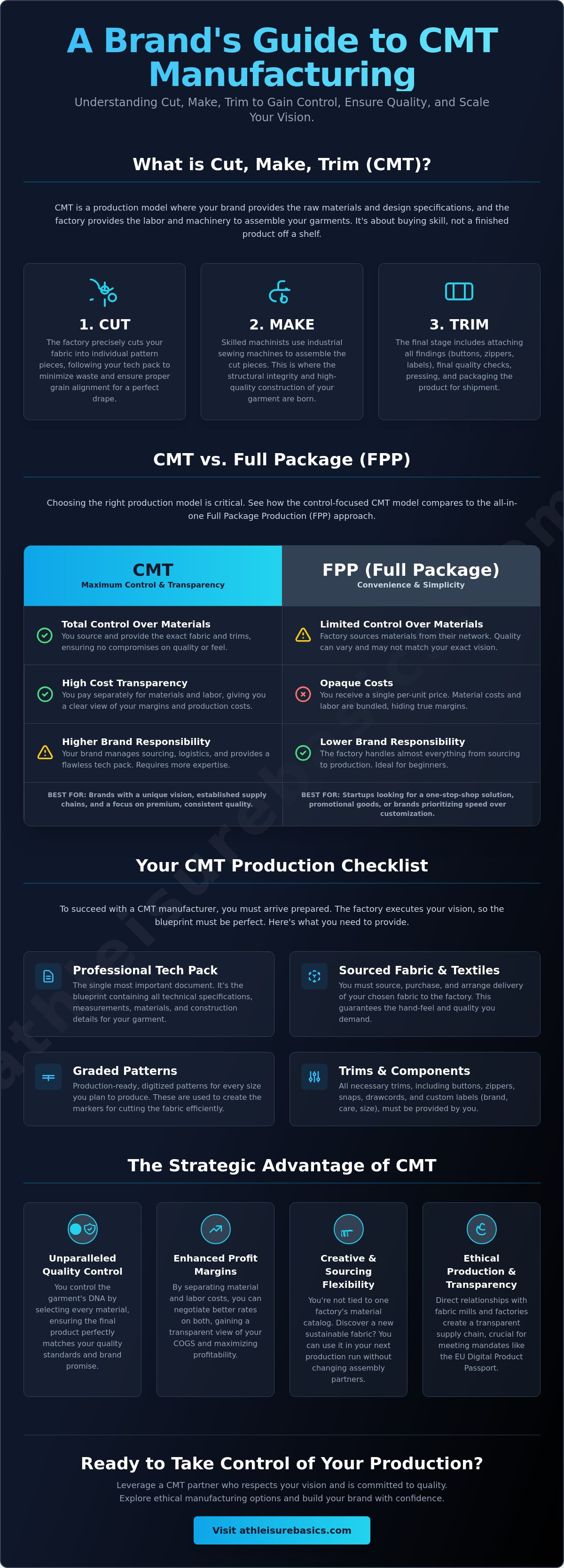
CMT stands for Cut, Make, and Trim. These are the three fundamental stages of garment assembly that transform raw materials into a finished product. For any brand searching for a clothing manufacturer for small business, understanding this model is the first step toward professionalizing your supply chain. In a CMT arrangement, you act as the architect of your product. You are responsible for providing the fabric, tech packs, and patterns. The factory acts as the skilled labor force that executes your specific instructions.
This model is highly popular because it offers unparalleled transparency in the garment production process. You aren't simply buying a finished, off-the-shelf product from a catalog. Instead, you're purchasing the time, technical skill, and industrial equipment of a specialized facility. This distinction is vital for brands that prioritize craftsmanship over mass-produced convenience. It ensures that your brand's unique identity isn't diluted by generic materials or standard factory silhouettes.
The Anatomy of the CMT Acronym
To master this production style, you must understand exactly what happens at each stage of the acronym. Each phase requires precision to ensure the final garment matches your original vision.
- Cut: This is the precision process of turning raw fabric rolls into individual pattern pieces. It involves laying out the fabric to minimize waste and using industrial cutting tools to follow your graded patterns exactly.
- Make: This represents the actual sewing and assembly. Highly skilled machinists use specialized industrial sewing machines to join the cut pieces together. This is where the structural integrity of your garment is established.
- Trim: The final stage involves adding the finishing touches that define a premium product. This includes attaching buttons, zippers, and care labels. It also encompasses the final quality checks and packaging before the goods leave the factory floor.
Why Brands Move to CMT Models
Transitioning to a CMT model is a strategic move for growing labels. It provides a level of oversight that is often missing in other manufacturing styles. By separating material costs from labor costs, you gain a clearer clothing industry overview regarding your true margins. You know exactly what you're paying for every meter of fabric and every hour of labor.
Quality control is perhaps the most significant advantage. Since you select the specific textile for your collection, you ensure the hand-feel and durability meet your standards. This flexibility allows you to iterate on your designs without being tied to a single factory's material inventory. If you find a superior fabric supplier, you can simply ship those materials to your clothing manufacturer for small business without disrupting your established assembly line. This control minimizes the risk of unexpected quality shifts and empowers you to build a brand based on principled, high-standard production.
The 3 Stages of CMT Manufacturing: A Step-by-Step Look
The journey of a professional garment begins long before the first scissors touch the fabric. A factory requires a complete technical blueprint, or tech pack, to ensure the assembly stage is accurate. Without this detailed guide, even the most skilled machinists cannot guarantee your vision is realized. For those looking for a reliable clothing manufacturer for small business, understanding these three stages is essential for maintaining quality control and protecting your investment.
Step 1: The Precision Cut
The process starts with spreading the fabric. This involves unrolling the textile and allowing it to rest so it's tension-free. This step prevents the fabric from shrinking or distorting once it's cut into pattern pieces. Factories then use markers, which are digital or physical layouts of all pattern pieces, to minimize waste and optimize your material yield. Efficiency in this stage is what determines your final profit margins. Fabric grain alignment must be perfect because it ensures the garment drapes correctly and prevents the side seams from twisting after the first wash.
Step 2: The Make (Sewing and Assembly)
This is the core assembly phase where specialized machinery brings the pieces together. Depending on your design, the factory will use overlock, flatlock, or coverstitch machines to create durable and aesthetic seams. While apparel manufacturing industry statistics show the vast scale of global production, the specific value of skilled labor in Europe is a major differentiator. Investing in made in portugal clothing provides access to artisans who understand high-end construction. Managing these assembly lines effectively ensures consistent sizing across your entire production run, which is vital for brand reputation.
Step 3: Trimming and Finishing
Trimming is the silent stage that defines how a premium garment feels in the customer's hands. It involves applying all necessary hardware, such as zippers, snaps, and eyelets, exactly as specified in your tech pack. Internal branding happens here too. Machinists sew in neck labels, care instructions, and size tabs with surgical precision. The final inspection is the last line of defense. It includes meticulous thread trimming, professional steaming to remove wrinkles, and careful folding for shipment. If you want to ensure your designs are production-ready, partnering with an expert consultant can help you avoid common pitfalls during these final stages.
CMT vs. Full Package Production (FPP): Which is Best for Your Startup?
Selecting a production model is a pivotal decision that dictates your daily operational rhythm. Full Package Production (FPP) is a comprehensive, hands-off service where the factory sources every component, from the main textile to the smallest care label. Conversely, CMT is a hands-on model where you serve as the architect of your own supply chain. The right clothing manufacturer for small business will offer the model that best fits your current team's technical knowledge and bandwidth. While startups often prefer FPP for its simplicity, established premium brands typically choose CMT to maintain absolute exclusivity over their material DNA.
When to Choose CMT
CMT is the superior choice when your competitive advantage relies on fabric innovation. If you've secured a unique fabric source that your competitors can't access, using a CMT factory protects that exclusivity. This model also empowers you to maximize profit margins by negotiating directly with textile mills, effectively cutting out factory sourcing markups. For brands focused on technical apparel or high-end athleisure, CMT is the industry standard. It ensures that technical performance isn't compromised by a factory's limited stock options. Analyzing the global apparel value chain reveals that CMT allows brands to specialize in design and material selection while outsourcing the industrial assembly to experts.
When to Choose Full Package (FPP)
FPP remains the most efficient path for founders who need a single point of accountability. Managing a clothing manufacturer for small business alongside separate fabric and trim suppliers requires significant logistical coordination. If you don't have the internal capacity to track multiple shipping dates and customs clearances, FPP removes those barriers to entry. This model is particularly effective when using high-quality, standard fabrics that the factory already keeps in their inventory. By opting for FPP, you ensure that the factory is solely responsible for the final quality of the finished garment, allowing you to dedicate your energy to brand growth and customer engagement. It's a pragmatic solution for teams that prioritize speed to market over granular material control.
How to Prepare for Your First CMT Run: A Checklist for Small Businesses
Transitioning to a CMT model requires a fundamental shift in your operational mindset. It's vital to remember that a CMT factory is a professional service provider, not a design agency. They exist to execute your technical instructions with industrial precision, but they won't make creative or technical decisions on your behalf. This means the quality of your inputs directly determines the quality of their outputs. If your documentation is vague or your materials are late, the factory cannot maintain the production schedule you expect. When you work with a clothing manufacturer for small business, your role is to provide the fuel for their machines. One missing component, like a specific thread color or a size label, can halt an entire production line for weeks, leading to missed retail deadlines and strained manufacturing relationships.
The Essential Tech Pack
Your tech pack is the definitive blueprint for your garment's construction. It must include detailed technical drawings and construction notes for every seam. A professional tech pack also includes a comprehensive Bill of Materials (BOM). This document acts as a master list for every physical component required, from the main textile to the specific brand of zipper. Finally, you must provide graded size specs to ensure fit consistency across your entire range, preventing the sizing discrepancies that often damage a new brand's reputation.
Fabric and Trim Logistics
In the CMT model, you are the manager of your own raw materials. We strongly recommend sourcing OEKO-TEX® certified fabrics to ensure both ethical compliance and consumer safety, which are mandatory standards for the 2026 apparel market. You must also calculate your fabric requirements accurately, including a specific buffer to account for cutting waste. Order your trims, such as zippers and custom labels, well in advance to ensure they arrive at the factory before the cutting stage begins. To ensure your brand is fully prepared for a seamless manufacturing experience, book a consulting session to review your production strategy today.
Organization is the cornerstone of a healthy relationship with your clothing manufacturer for small business. By providing clear, professional documentation and reliable material delivery, you remove the barriers that typically cause production delays. This level of preparation allows the factory to focus on what they do best: delivering high-end craftsmanship that meets your exact specifications. Your success in the CMT model depends on your ability to act as a disciplined supply chain manager, ensuring every needle, thread, and fabric roll is in place before the first cut is made.
Why Premium Brands Choose CMT Manufacturing in Portugal
Portugal has established itself as the global epicenter for high-end, ethical athleisure production. While many manufacturing hubs compete solely on cost, Portuguese facilities prioritize craftsmanship and technical precision. For an emerging clothing manufacturer for small business, the region provides a unique blend of heritage and operational agility. This environment allows premium brands to scale without compromising on their ethical principles or material integrity. The "Made in Portugal" seal is a shorthand for quality, signaling to your customers that every garment meets the highest European standards.
The Portuguese Textile Heritage
The region's reputation is built on centuries of textile expertise integrated with modern, sustainable technology. Unlike many global hubs, Portugal maintains strict adherence to EU environmental and labor regulations. This ensures that your production line is compliant with the latest transparency mandates, such as the 2026 EU Green Claims Directive. This principled approach to manufacturing protects your brand from the risks of unsubstantiated sustainability claims. You can discover why clothing manufacturers portugal are the preferred choice for labels that value material integrity and ethical labor above all else.
Partnering with Athleisurebasics
Athleisurebasics bridges the gap between traditional industrial processes and the specific needs of modern startups. We offer the technical precision of CMT manufacturing while providing the strategic support of a dedicated production consultant. This collaborative approach is designed to mitigate the risks typically associated with a clothing manufacturer for small business. Our accessible minimum order requirements ensure that professional CMT production is no longer reserved for established industry giants. We help you move beyond generic options to create custom, high-performance activewear that reflects your brand's unique DNA.
Our expertise in technical fabrics and high-performance assembly allows you to transition from luxury blanks to a fully custom CMT powerhouse. By producing in Portugal, you benefit from proximity to major EU markets, which significantly reduces lead times and logistical complexity. This operational agility is vital for brands that need to react quickly to market trends without sacrificing quality. Choosing a partner in Portugal means investing in a long-term relationship built on transparency, quality, and a shared commitment to excellence. Reach out to our team today to begin your journey toward professional, custom production.
Take Control of Your Production Journey
Mastering the CMT model is the most effective way to protect your brand's creative integrity and financial health. By separating labor from material sourcing, you eliminate the ambiguity that often leads to hidden costs. Success in this model requires meticulous preparation, from professional tech packs to precise material logistics. When you partner with the right clothing manufacturer for small business, these industrial complexities become manageable steps toward scaling your vision.
Athleisurebasics specializes in high-end Portuguese craftsmanship, offering the transparency you need to grow with confidence. We simplify the transition to custom production by providing access to OEKO-TEX® certified materials and maintaining accessible low MOQs starting at just 70 pieces. Our team acts as a dedicated collaborator, ensuring your technical specifications are met with industrial precision.
Ready to start your production run? Contact Athleisurebasics for a custom CMT quote today.
Your brand deserves a manufacturing partner invested in your long-term commercial presence. We're here to help you turn your concepts into finished, premium products that define the 2026 market.
Frequently Asked Questions
Is CMT cheaper than Full Package Production (FPP)?
CMT is generally cheaper in terms of unit labor cost because you remove the factory's markup on raw materials. However, your total expenditure might be higher once you factor in the logistics of sourcing and shipping your own fabric. This model is most cost-effective for brands with established material supply chains. It allows you to pay for specific skilled labor rather than a bundled service.
Do I need a tech pack for CMT manufacturing?
Yes, a professional tech pack is mandatory for any CMT production run. Because the factory doesn't handle the design or sourcing, they rely entirely on your technical blueprint to execute the Make stage. This document ensures that your chosen clothing manufacturer for small business understands every seam, stitch type, and measurement. Without it, the risk of production errors and wasted fabric increases significantly.
Who is responsible for fabric defects in a CMT contract?
You are responsible for the quality of the fabric provided to the factory. In a CMT contract, the manufacturer is only liable for errors made during the cutting, sewing, and finishing processes. If the fabric arrives with holes, dye lot variations, or structural weaknesses, the factory will likely stop production and wait for your instructions. This highlights the importance of working with reliable textile mills.
What are the typical minimum order quantities (MOQs) for CMT?
MOQs for CMT vary by facility but typically range from 50 to 500 units per style. While larger industrial factories require higher volumes to justify setting up assembly lines, specialized boutiques often accommodate smaller runs for emerging labels. Finding a clothing manufacturer for small business that offers flexible thresholds is essential for testing new designs without overextending your initial capital or inventory space.
Can a CMT factory help me with fabric sourcing?
Most traditional CMT factories don't provide sourcing services as part of their standard labor contract. Their core expertise lies in assembly and finishing. However, some partners offer Materials Sourcing Support as an additional consulting service. If you're unsure where to find high-performance textiles, it is best to seek a manufacturer that provides both labor and consulting to bridge that gap effectively.
What does Trim include in a manufacturing quote?
Trim refers to the labor involved in applying the final hardware and branding to your garment. This includes attaching zippers, buttons, snaps, and eyelets according to your tech pack. It also covers the sewing of neck labels, care instructions, and size tabs. While you provide these physical components, the factory's Trim fee covers the time and precision required to integrate them into the finished piece correctly.
How do I calculate how much fabric to send to the factory?
You calculate fabric requirements by multiplying the consumption per garment by the total order quantity, then adding a buffer for cutting waste. Your pattern maker or tech pack developer usually provides the yield per size. A standard buffer is typically between 3% and 5% to account for fabric flaws and industrial cutting margins. Always confirm these totals with your factory before shipping raw materials.
Why is Portugal considered a top location for CMT production?
Portugal is favored because it combines centuries of textile heritage with strict adherence to EU labor and environmental standards. The region offers exceptional craftsmanship, particularly for technical apparel and high-end jersey. Proximity to European markets also ensures shorter lead times and lower transport emissions. This makes it a strategic choice for brands that prioritize ethical production and premium quality over the lowest possible unit price.



Leave a comment
This site is protected by hCaptcha and the hCaptcha Privacy Policy and Terms of Service apply.