

CMT vs FPP Manufacturing: Choosing the Right Model for Your Apparel Brand in 2026
Did you know that up to 40% of total production costs are frequently lost to preventable rework and quality issues? Choosing between CMT vs FPP manufacturing is one of the most critical decisions you'll make for your clothing line's profitability in 2026. While one model offers granular control over every component, the other provides a streamlined path from concept to finished product. You shouldn't have to guess which path fits your brand's technical bandwidth or sourcing expertise.
We recognize that the leap from a creative concept to a commercial reality is often clouded by technical jargon and supply chain complexity. It's natural to worry about hidden costs or the challenge of meeting new 2026 regulations like the EU Digital Product Passport. You want a production partner that simplifies these industrial processes while maintaining the high standards your customers expect and the ethical transparency the market now demands.
This guide will help you master the differences between these two models so you can select the most profitable strategy for your business. We'll provide a clear decision-making framework and break down the total cost of each approach. You'll learn how to find a reliable partner in a premium region like Portugal to ensure your brand scales efficiently, remains compliant with evolving EU standards, and maintains your competitive edge.
Key Takeaways
- Identify the core differences between CMT vs FPP manufacturing to select the most efficient production strategy for your brand's current technical bandwidth.
- Master the "Total Cost of Ownership" framework to look beyond per-unit pricing and account for hidden logistics, sourcing, and quality control expenses.
- Evaluate the legal and operational implications of pattern ownership to protect your intellectual property throughout the manufacturing lifecycle.
- Explore how established brands use the CMT model to build direct relationships with fabric mills for exclusive and custom textile selections.
- Understand the benefits of manufacturing in Portugal, including proximity to the EU market, ethical labor standards, and world-class craftsmanship.
Understanding CMT and FPP: The Two Pillars of Apparel Manufacturing
The garment industry operates on two fundamental pillars that dictate how a brand interacts with its supply chain. Deciding between CMT vs FPP manufacturing isn't just a logistical choice; it's a strategic decision that defines your brand's internal structure and financial risk. As we move into 2026, the lines between these models are blurring as brands seek greater agility to meet new EU regulations and consumer demands for transparency. Aligning your business goals with the correct garment production process ensures you don't overextend your team or lose control of your quality standards.
What is CMT (Cut, Make, Trim)?
CMT stands for Cut, Make, and Trim. In this model, the brand acts as the primary orchestrator of the supply chain. You are responsible for delivering every physical component the factory needs to assemble your product. This includes the finalized tech packs, the specific fabrics, and all trims such as zippers, buttons, drawstrings, and brand labels. Understanding the core differences in CMT vs FPP manufacturing is the first step toward building a resilient supply chain in 2026.
Success in a CMT arrangement requires a high level of technical fashion knowledge. Because you control the raw material inputs, you must understand the nuances of Textile manufacturing to ensure the fabrics you source are compatible with your designs and meet necessary performance requirements. The factory's role is strictly limited to the labor and machinery required for assembly. If a fabric behaves poorly during the cutting phase, the responsibility rests with your sourcing choices rather than the factory's execution. This model offers maximum control but places the burden of logistics and quality assurance of materials squarely on your shoulders.
What is FPP (Full Package Production)?
FPP, or Full Package Production, provides a turnkey approach where the manufacturer manages the entire lifecycle of the garment. In this scenario, the factory moves beyond being a simple sewing unit and acts as your dedicated product developer. They handle everything from initial pattern making and grading to sourcing materials and managing final shipping logistics. This end-to-end service model is designed to mitigate the perceived risks for new entrepreneurs by consolidating the supply chain into a single partnership.
The CMT Model: Maximizing Control and Customization
Established brands often outgrow "all-in-one" solutions as they seek to differentiate their products through proprietary materials. For these businesses, the choice of CMT vs FPP manufacturing leans heavily toward the Cut, Make, Trim model because it offers total authority over the textile selection process. By building direct relationships with fabric mills, you can secure exclusive weights, custom dyes, and technical finishes that aren't available in a factory's standard catalog. This level of granular control ensures that your raw material inputs meet your exact quality standards before a single stitch is sewn.
In the high-performance athleisure market, this control is particularly vital. Working with complex stretch fabrics requires specific technical expertise and specialized machinery, such as flatlock stitching or ultrasonic bonding. A CMT arrangement allows you to vet the assembly facility's machinery and labor skills independently from the fabric source. Organizations like Fashion Revolution highlight the importance of supply chain transparency; CMT makes it easier to track and verify the ethical origins of your fibers. If you need expert guidance on vetting these technical requirements, our clothing production consulting services can help you navigate these industrial choices.
When to Choose CMT: Sourcing and Tech Packs
Transitioning to a CMT model requires a specific set of operational assets. You should only consider this path if your brand meets the following three criteria:
- Professional Tech Packs: You must have completed, production-ready tech packs that include every measurement, tolerance, and construction detail.
- Established Mill Relationships: You have already secured a reliable fabric supplier, perhaps a high-quality mill in Portugal, that can guarantee consistent material performance.
- Logistical Bandwidth: Your team has the capacity to manage multiple logistics streams, coordinating the delivery of fabric, labels, and trims to arrive at the factory exactly when the production slot opens.
The Hidden Risks of the CMT Model
While CMT offers control, it introduces significant logistical risks. The most common challenge is the "blame game" that occurs when materials arrive damaged or late. If the fabric has a defect that is only discovered after cutting, the factory will claim it's a sourcing issue, while the mill may argue the factory handled the material incorrectly. This leaves the brand to absorb the financial loss.
To mitigate these risks, brands must factor in "wastage" when ordering materials. Standard industry practice requires sending 10% to 15% more fabric than the final garment count to account for cutting errors, seam allowances, and minor defects. If you fail to calculate your fabric yield accurately, a single cutting error in a CMT run can leave you with incomplete sets that effectively bankrupt the profitability of a small production run.
Full Package Production (FPP): The Fast Track for Emerging Athleisure Brands
Startups often face a steep learning curve when entering the technical apparel space. While established players might have the resources to juggle multiple vendors, emerging brands need a more streamlined approach to survive. Full Package Production (FPP) acts as an end-to-end accelerator, consolidating the complexities of CMT vs FPP manufacturing into a single, manageable partnership. This model is particularly effective for athleisure, where the technical requirements for stretch, recovery, and moisture management are exceptionally high.
One of the most significant advantages of FPP is access to a factory's pre-vetted library of performance fabrics. Instead of spending months searching for a mill that will sell small quantities of high-grade recycled polyester or organic cotton, you can leverage the factory's existing inventory. Because these manufacturers buy in bulk for multiple clients, they can provide high-quality materials that meet 2026 standards without the prohibitive costs of custom mill runs. This "in-house" sourcing significantly reduces the time between design approval and final delivery, allowing you to respond to market trends with much greater agility.
The Services Included in FPP
FPP goes far beyond simple assembly. It provides a comprehensive suite of technical services that are essential for creating a professional-grade product:
- Pattern Making and Grading: Experts transform your sketches into digital patterns and ensure a consistent fit across your entire size range, from XS to XXL.
- Fabric and Trim Sourcing: Factories manage the procurement of OEKO-TEX certified materials and durable trims, ensuring every component meets updated 2026 safety and environmental limit values.
- Sampling and Prototyping: The iterative process of perfecting your design happens in-house, allowing for rapid adjustments to seam placement or pocket depth before bulk production begins.
Why FPP is the Gold Standard for Low MOQ Projects
For brands focused on a "test and scale" model, FPP is the most practical choice. Factories like Athleisurebasics utilize this model to offer accessible entry points, such as 70-piece minimums for white label products. This low barrier to entry is a game-changer for entrepreneurs who want to validate their brand identity without committing to thousands of units of unsold stock. By choosing FPP, you lower your financial risk significantly; you manage one invoice, work with one point of contact, and track one delivery date.
A hidden value of the FPP model is the "Design for Manufacturing" (DFM) advice provided by the factory team. Unlike a CMT unit that simply follows instructions, an FPP partner will suggest construction methods that improve durability or reduce costs. For example, they might recommend a specific flatlock stitch placement to enhance comfort in a pair of leggings while ensuring the garment remains easy to produce. This collaborative approach turns the manufacturer into a strategic ally invested in your brand's long-term commercial presence.
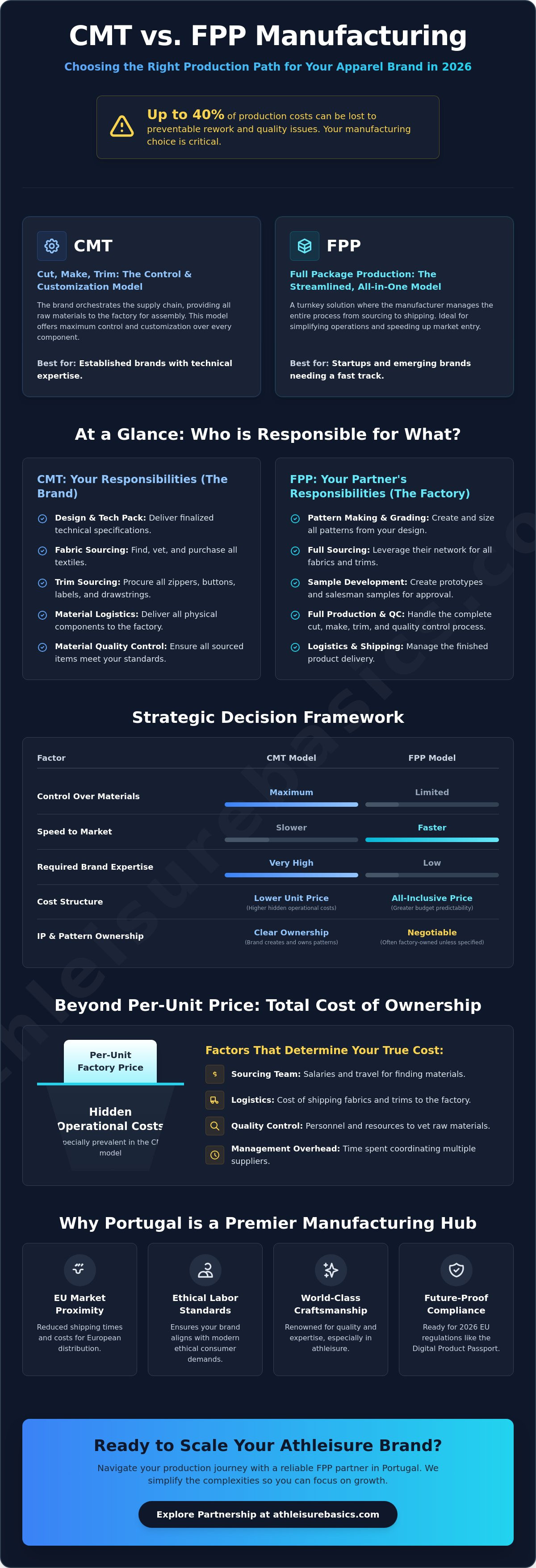
CMT vs FPP: A Strategic Comparison of Costs, Risk, and Scalability
Successful production management requires looking beyond the initial factory quote to understand the Total Cost of Ownership (TCO). While the unit price is a visible metric, it doesn't account for the administrative hours, shipping logistics, or the financial impact of production delays. Choosing between CMT vs FPP manufacturing involves balancing your brand's technical capability against your need for operational speed. Your decision should align with your long-term growth strategy, especially if you plan to leverage the premium craftsmanship offered by clothing manufacturers Portugal.
A critical legal distinction between these models lies in pattern ownership. In a CMT arrangement, you provide the technical files, meaning you own the intellectual property from day one. In many FPP partnerships, the factory's internal team develops the patterns and grading. Unless your contract explicitly states otherwise, the manufacturer may retain ownership of these files, making it difficult to move production to a different facility later. You must clarify these terms early to protect your brand's scalability.
Cost Comparison: Upfront Price vs. Hidden Expenses
CMT often appears more cost-effective on a spreadsheet because you aren't paying the manufacturer's sourcing markup. However, this model introduces several hidden expenses that can quickly erode your margins:
- Logistics and Duties: You are responsible for the cost of shipping raw materials to the factory and any import duties associated with those textiles.
- Administrative Overhead: The time your team spends vetting mills, tracking shipments, and managing trim inventory has a direct financial value.
- Bulk Material Rates: FPP factories often secure lower prices on high-quality materials because they purchase in massive volumes for multiple clients.
Sourcing fatigue represents the hidden cost of a founder's time spent chasing fabric swatches and coordinating trim deliveries, a drain that often outweighs any per-unit savings found in a CMT quote. If you prefer to focus on brand development rather than logistics, our custom clothing manufacturing services provide a streamlined alternative.
Quality Control and Responsibility
The division of responsibility for quality control is the most significant operational difference in CMT vs FPP manufacturing. In a CMT model, you act as the quality manager for all raw materials. If the fabric pilled after the first wash or the elastic lost its recovery, the factory bears no responsibility because they simply assembled the materials you provided. This requires your team to have rigorous in-house testing protocols.
In contrast, an FPP partner is responsible for the performance of the entire garment. If a finished product fails to meet the agreed-upon standards, the factory must resolve the issue because they managed the sourcing and the assembly. For technical athleisure, where compression levels and seam strength are non-negotiable, the unified responsibility of FPP provides a much higher level of security. It ensures that the technical experts who understand the machinery are also the ones selecting the textiles that will run through it, a focus on precision that is equally important when selecting branding tools from providers like KP Innovations.
Navigating Your Production Journey with Athleisurebasics in Portugal
Choosing between CMT vs FPP manufacturing is a pivotal moment for your brand's operational health. At Athleisurebasics, we bridge the gap between these two models by offering flexible solutions that adapt to your brand's technical maturity. We act as a dedicated ally for emerging businesses, removing the industrial barriers that often prevent high-quality designs from reaching the market. By positioning our operations in Northern Portugal, we provide our partners with a strategic advantage that combines world-class craftsmanship with ethical transparency.
Our role extends beyond simple assembly. In 2026, the real value-add for clothing brands lies in consulting and materials sourcing support. We help you navigate the complexities of new EU regulations, ensuring your supply chain is ready for the Digital Product Passport and other sustainability mandates. Whether you require full technical development or simple production capacity, our team provides the industry expertise needed to scale your operations without the risk of hidden costs or quality failures.
Our Custom and White Label Solutions
We offer two distinct paths to production, allowing you to select the model that best fits your current volume requirements and design complexity:
- Custom Manufacturing (250+ pieces): This is our full FPP support model for unique, ground-up designs. We handle everything from initial pattern development to final shipping, providing a turnkey solution for brands creating proprietary collections.
- White Label (70+ pieces): For those seeking lower entry barriers, our private label Portugal solution offers high-quality luxury blanks. You can apply your own branding to our pre-vetted, premium silhouettes, significantly reducing your time to market.
Both paths benefit from our deep roots in the Portuguese textile industry. Our sourcing support ensures your athleisure line utilizes the latest sustainable fabrics, from organic cotton to recycled performance polymers. We maintain the high standards required for the modern market, ensuring every garment reflects your brand's commitment to quality.
The Advantage of a Portuguese Manufacturing Partner
The "Made in Portugal" seal is recognized globally as a mark of premium quality and ethical labor standards. Unlike manufacturing hubs that prioritize cost-cutting at the expense of social responsibility, Portugal maintains rigorous EU labor protections and environmental certifications. This regional pride translates into superior garment durability and material integrity, which are essential for high-performance athleisure brands.
Our strategic location also offers logistical benefits that impact your bottom line. Proximity to major European and North American markets allows for faster shipping times and a significantly lower carbon footprint compared to sourcing from distant global hubs. This agility is crucial for the "test and scale" models that define successful 2026 apparel brands. We simplify the transition from a small idea to a lasting commercial presence by providing a secure, high-standard production environment.
Ready to start? Get a custom apparel manufacturing quote today.
Strategize for Growth in the 2026 Apparel Market
Your choice between CMT vs FPP manufacturing determines how quickly you can respond to market shifts and regulatory changes. While established brands may value the granular control of CMT; emerging entrepreneurs often find that the end-to-end security of FPP is the most profitable path for a new clothing line. By consolidating your supply chain into a single partnership, you reduce the risk of sourcing fatigue and ensure that technical experts manage every construction detail from the first stitch.
Partnering with a specialist in Portugal provides immediate access to premium craftsmanship and ethical standards that resonate with modern consumers. We offer OEKO-TEX® certified fabrics and accessible low MOQs starting at just 70 pieces to help you validate your brand without excessive inventory risk. Whether you require ground-up custom development or high-quality white label blanks, we are here to simplify the transition from a creative concept to a commercial success. Our team is dedicated to removing industrial barriers so you can focus on building your community.
Launch your clothing line with Athleisurebasics Portugal today and build a resilient, quality-conscious brand. We look forward to scaling your vision together.
Frequently Asked Questions
Which is cheaper: CMT or FPP manufacturing?
FPP often provides better total value despite a higher upfront factory quote. While CMT looks cheaper on paper, you must add the costs of shipping raw materials, import duties, and the significant time spent on sourcing. FPP factories leverage their bulk buying power to secure lower material rates, which often offsets the convenience fee. Analyzing the total cost of ownership is essential when comparing CMT vs FPP manufacturing.
Do I need a tech pack for CMT manufacturing?
Yes, a professional tech pack is an absolute requirement for successful CMT production. Since the factory provides only labor and machinery, they rely entirely on your technical files for measurements, tolerances, and construction details. Without a completed tech pack, the factory cannot guarantee the fit or quality of the finished garment. This document serves as your primary quality control tool during the assembly process.
Can I switch from FPP to CMT as my brand grows?
You can certainly switch models as your brand matures and your internal technical bandwidth increases. Many emerging labels start with FPP to launch quickly and move to CMT once they've established direct relationships with specific fabric mills. It's vital to ensure you own your digital patterns before making this transition. This flexibility allows you to scale your operations as your sourcing expertise develops.
What is the minimum order quantity (MOQ) for FPP in Portugal?
In Portugal, minimum order quantities for FPP services are exceptionally accessible for modern brands. Thresholds often start as low as 70 units for white label products and 250 units for fully custom designs. This operational agility allows you to test market demand with smaller initial runs before committing to larger volumes. These lower minimums help mitigate the financial risks associated with holding excessive unsold inventory.
Who is responsible for fabric defects in a CMT agreement?
The brand is legally responsible for any fabric defects in a CMT arrangement. Because you source and deliver the materials to the factory floor, the manufacturer only guarantees the quality of the stitching and assembly. If the fabric arrives with holes or fails performance tests after production, you must resolve the financial loss with your textile mill. This requires your team to maintain rigorous material inspection protocols.
Is FPP better for startups than CMT?
FPP is generally the superior choice for startups due to its turnkey nature and consolidated risk management. It removes the burden of managing multiple vendors and complex logistics streams simultaneously. This model allows new entrepreneurs to focus on marketing and community building while the manufacturer handles the technical industrial processes involved in CMT vs FPP manufacturing. It provides a more predictable path to a finished product.
Does Athleisurebasics offer both CMT and FPP services?
Athleisurebasics provides a comprehensive range of production solutions including full CMT production and end-to-end custom clothing manufacturing. We offer specialized services such as tech pack development and materials sourcing support to bridge the gap for modern brands. Our team acts as a knowledgeable collaborator in Portugal, helping you transition from an initial concept to a high-standard commercial presence with ease and security.



Leave a comment
This site is protected by hCaptcha and the hCaptcha Privacy Policy and Terms of Service apply.